

The morels are gone, and the forest is hot and damp and full of insects, and that’s exactly the condition many summer mushrooms want. It’s not so much fun for the forager, but it’s worth getting out there for many of these edible mushroom species. Summer is the season when chanterelles, black trumpets, lobster mushrooms, and puffballs show up across most of the continent.
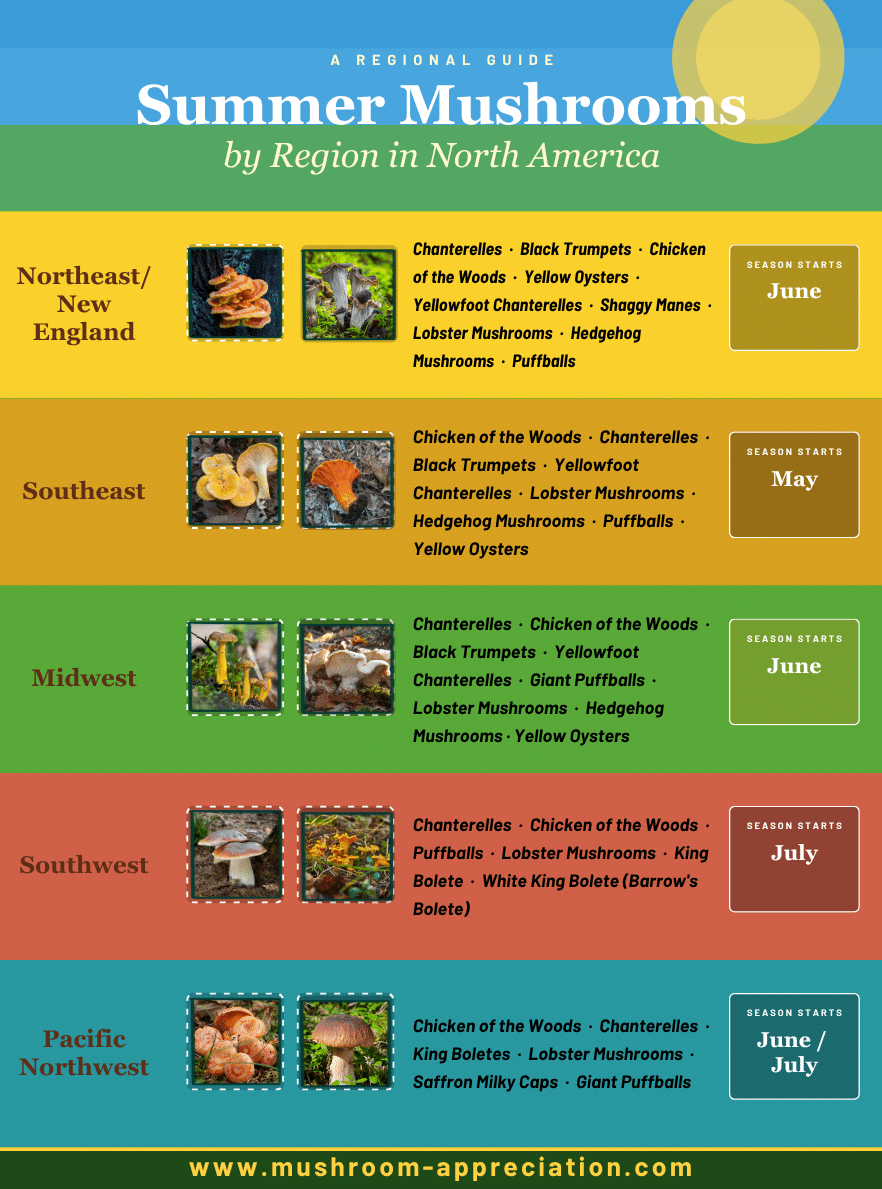
Of course, the summer mushrooms fruiting varies a bit by region. Many mushrooms are super specific about where and when they grow. What’s fruiting in July in the Southeast is not what’s fruiting in July in the Pacific Northwest. A big part of becoming a successful mushroom forager is knowing which species grow when and where in your region, and focusing on those species. This guide covers what mushrooms grow in summer across the United States.
Jump to:
- New England Summer Mushrooms
- Southeast Summer Mushrooms (Tennessee, Arkansas, Missouri, and South)
- Midwest Summer Mushrooms (Ohio, Indiana, Illinois, Michigan, Wisconsin, and surrounding states)
- Pacific Northwest Summer Mushrooms (Washington, Oregon, Northern California)
- Southwest Summer Mushrooms (New Mexico, Arizona, Colorado, Utah, Nevada)
- When to Go Out Summer Mushroom Foraging
New England Summer Mushrooms
Summer foraging in New England depends heavily on the weather. If it’s a rainy summer, expect heavy flushes of chanterelles, lobsters, and hedgehogs. But, in a dry summer, take a deep breath and be prepared not to find much at all. It can be rough mushroom foraging when there hasn’t been enough rain. When there is rain, get out in the woods two to three days afterward for the best foraging. If you wait too long, the insects will beat you to the mushrooms, and the finds might be well beyond foraging.
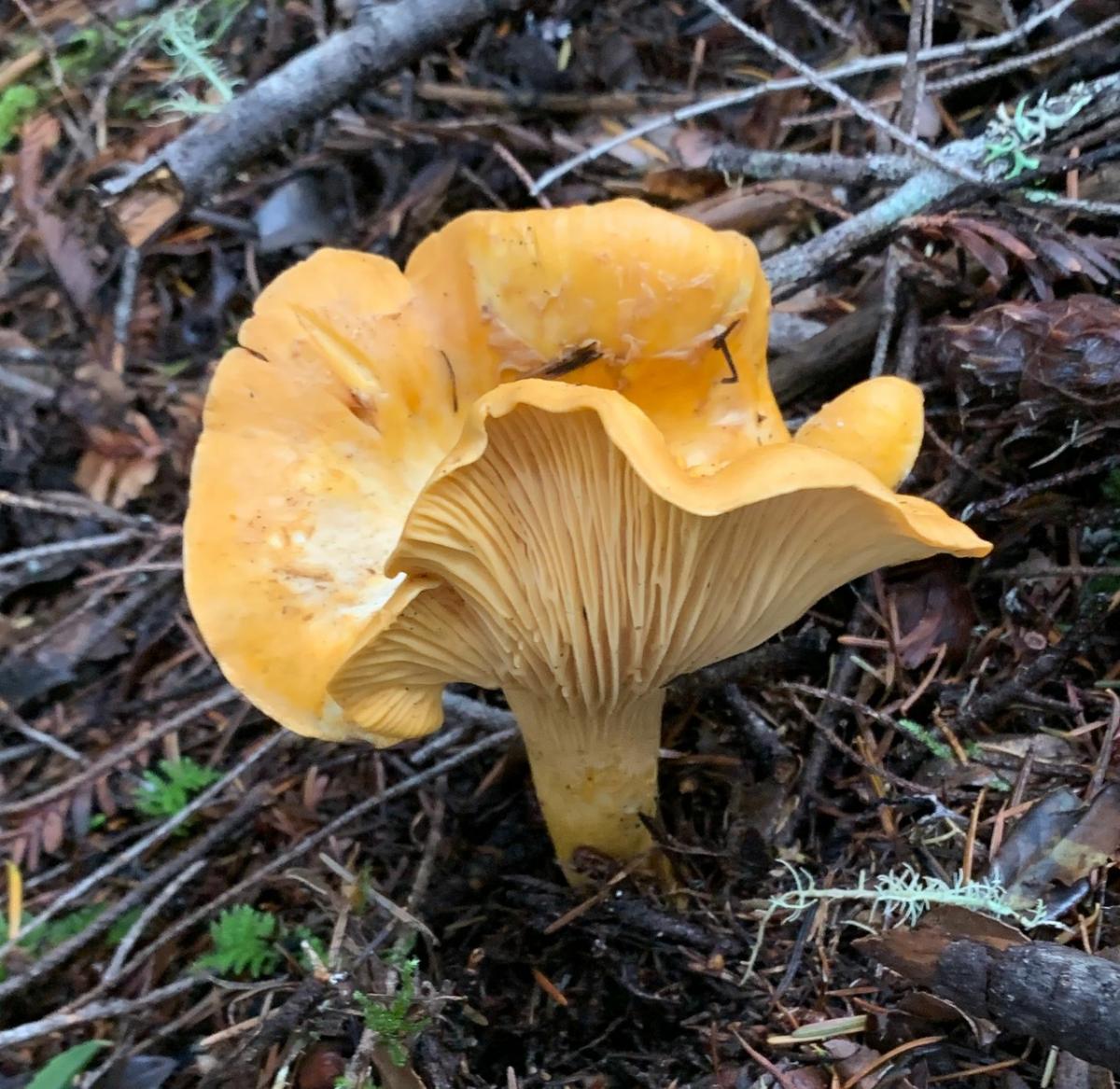
Chanterelles
Chanterelles start showing up as early as late June and fruit through August. They fruit from the same location each year in large, scattered groupings, so if you find a spot, make a note of it. There are several New England species of chanterelles, and they’re not all that classic egg-yolk yellow:
- Cantharellus appalachiensis is brownish-yellow and fruits with oaks.
- Cantharellus enelensis is yellow-brown and grows in conifer forests.
- Cantharellus lateritius is yellow and has a smooth underside. It grows with oak and hickory trees.
- Cantharellus minor is small, orange-yellow, and grows under oaks.
- Cantharellus cinnabarinus is bright orange, red, or flamingo pink and fruits with oaks, beech, aspen, and hickory.
Where to look: Hardwood forests under oak trees. They fruit in scattered groupings that can cover a large area. Mark the good locations and be sure to return in the following years.
→ [Full chanterelle identification guide]
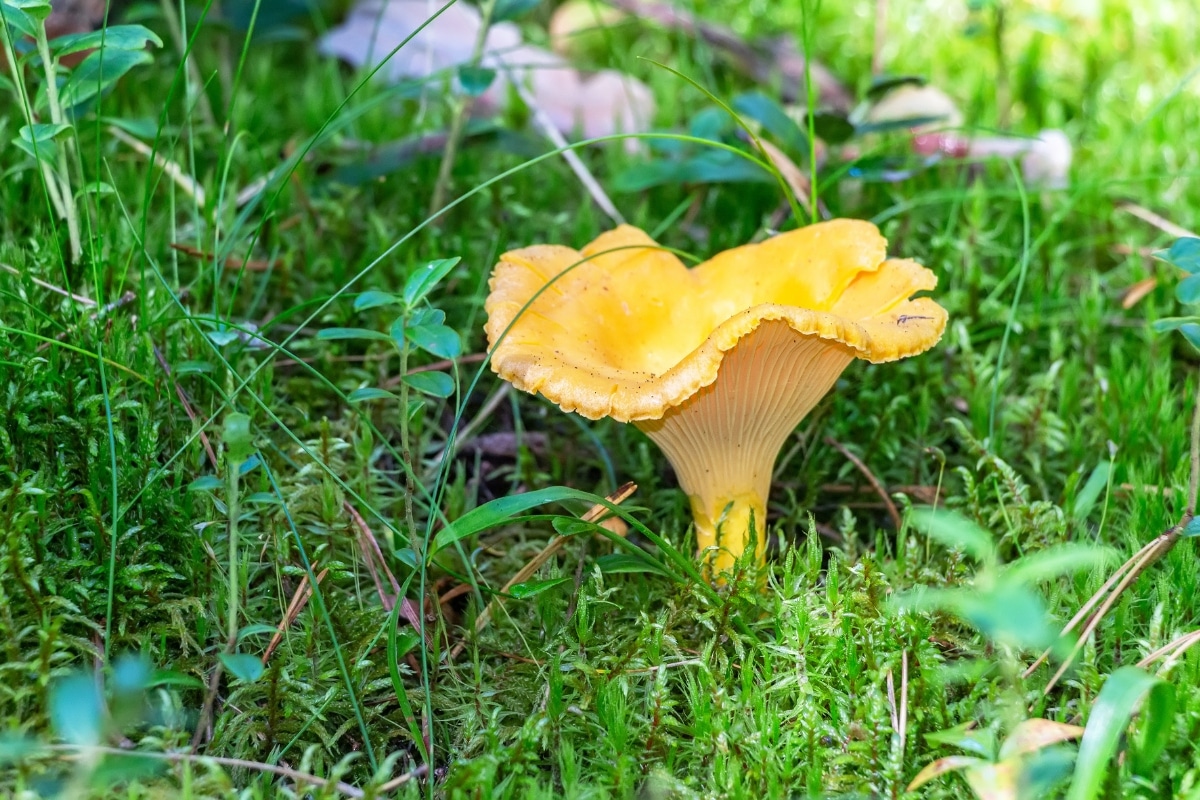
Yellowfoot Chanterelles
Yellowfoot chanterelles are bright orange to brownish and grow in large, scattered groups throughout summer. They grow on the forest floor, especially in boggy, wet areas filled with lots of moss. They are bland in taste compared to chanterelles, but they grow super prolifically and are worth foraging. They can be differentiated from true chanterelles by their hollow. Yellowfoot chanterelles often fruit in the same habitat as black trumpets.
There are several types of yellowfoot chanterelles in New England. They are mycorrhizal (form relationships with specific trees), with two species preferring conifers and one growing in association with hardwoods.
- Craterellus tubaeformis is yellow-brown with grayish-brown false gills lighter than the cap and grows with conifers.
- Craterellus lutescens is orange-brown with pastel orange or creamy yellow false gills and a bright orange stem. It is brighter overall than C. tubaeformis and grows with conifers.
- Craterellus ignicolor is bright orange to orange-yellow, with pale yellow to gray false gills. It grows with hardwoods: oak, beech, and birch.
Where to look: Forest floor. Check the same areas for black trumpets a few days after finding yellowfeet.
→ [Full yellowfoot chanterelle guide]
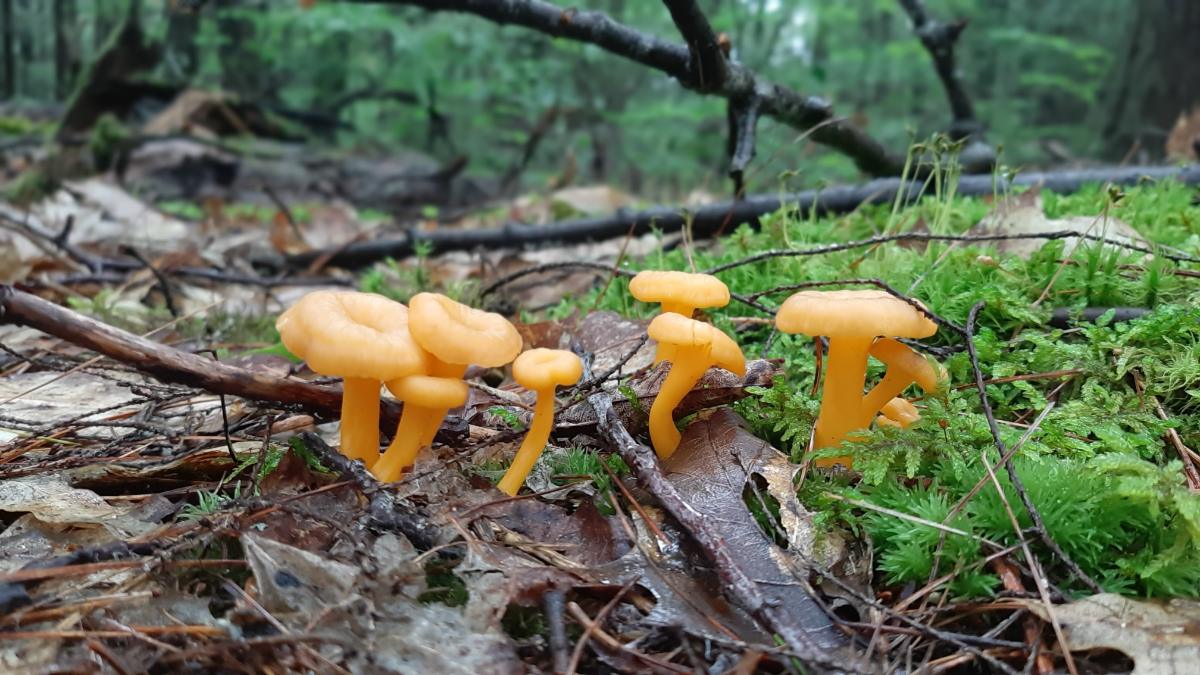
Black Trumpets
Black trumpets are a mid- to late-summer find in New England, though in recent years they have been appearing earlier in the season. Their grayish-to-black funnels blend into the leaf litter and require a lot of patience to find. The flavor of black trumpets is smoky, rich, and earthy, and truly one of a kind. They return to the same patch every year when the weather is good, so mark your spots.
Where to look: On the forest floor around oak and beech. Search near yellowfoot chanterelles, which often fruit in the same area. Moving slowly and low to the ground helps locate these masters of disguise.
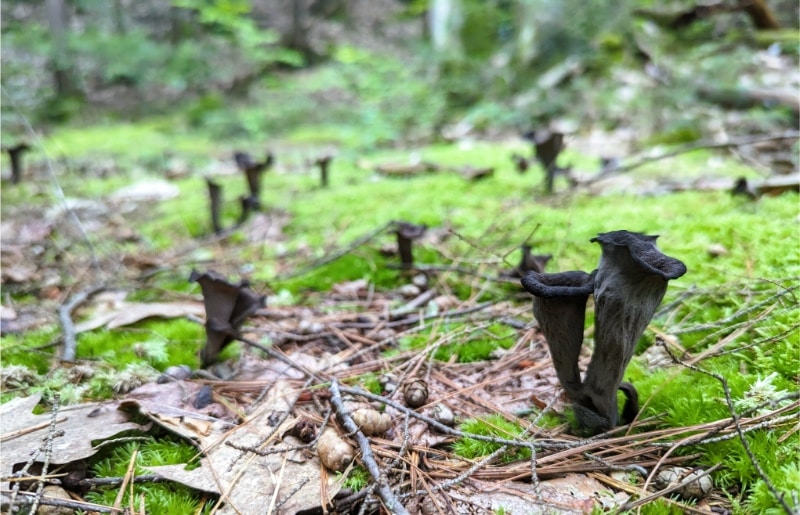
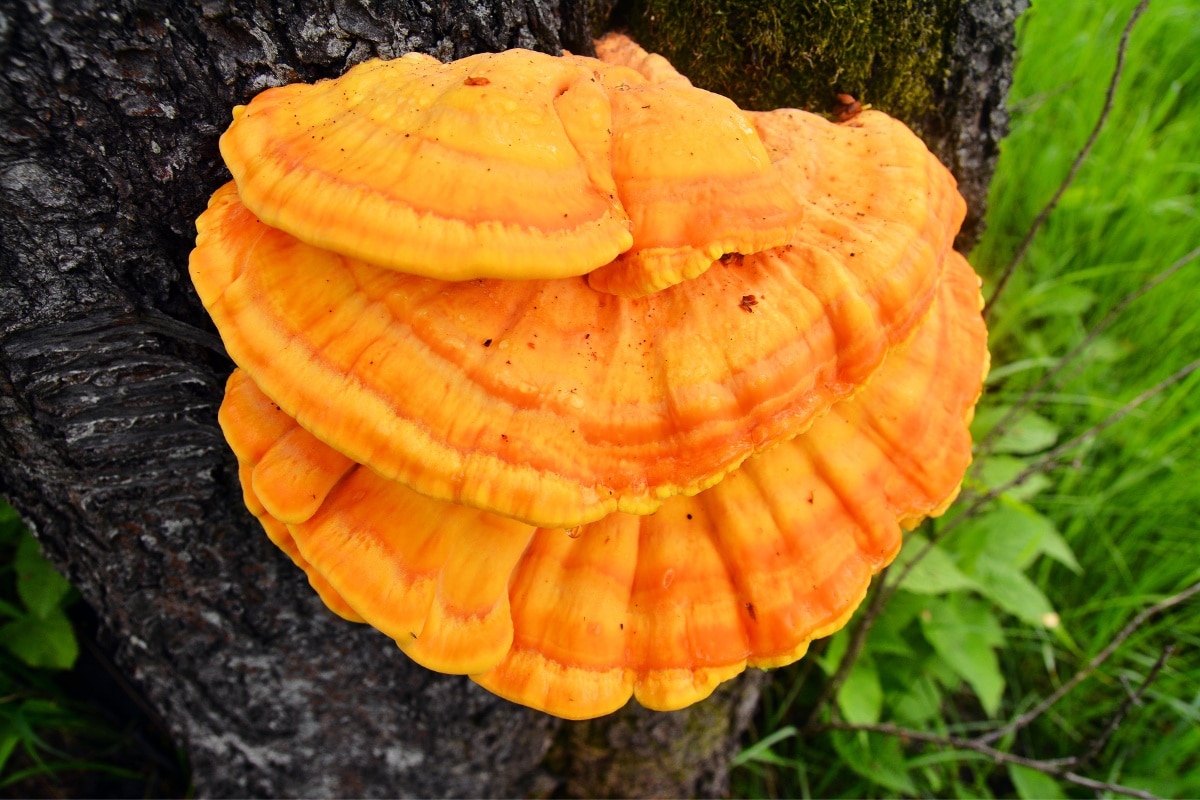
Chicken of the Woods
Chicken of the woods fruits primarily in late summer and fall, but it will show up in spring and at unpredictable times throughout the year. Chicken of the woods does what it wants to do whenever it’s ready; it can be a hard one to predict. Luckily, they often reappear in the same spot year to year, so if you find one, pin that location for the following years.
Three species of Chicken of the Woods grow in New England. They are not all the same bright orange/yellow; there is a peachy colored one, too.
- Laetiporus sulphureus is bright orange and yellow and grows on hardwood trees.
- Laetiporus cincinnatus is peachy orange and grows as a rosette from buried wood near oaks (it often looks like it is growing from the ground).
- Laetiporus huroniensis is bright orange or yellow and grows on conifers.
Where to look: Hardwood trees, stumps, and buried roots. Returns to the same tree each year (usually).
→ [Full chicken of the woods guide]
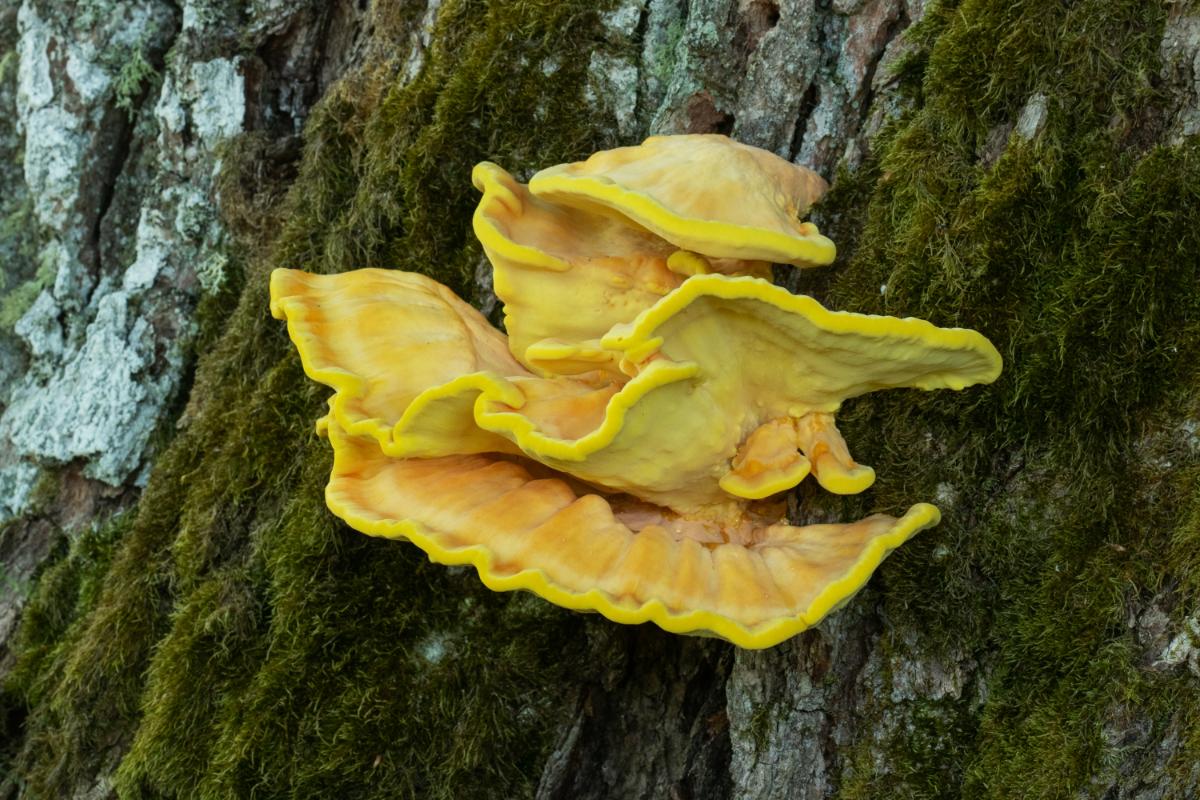
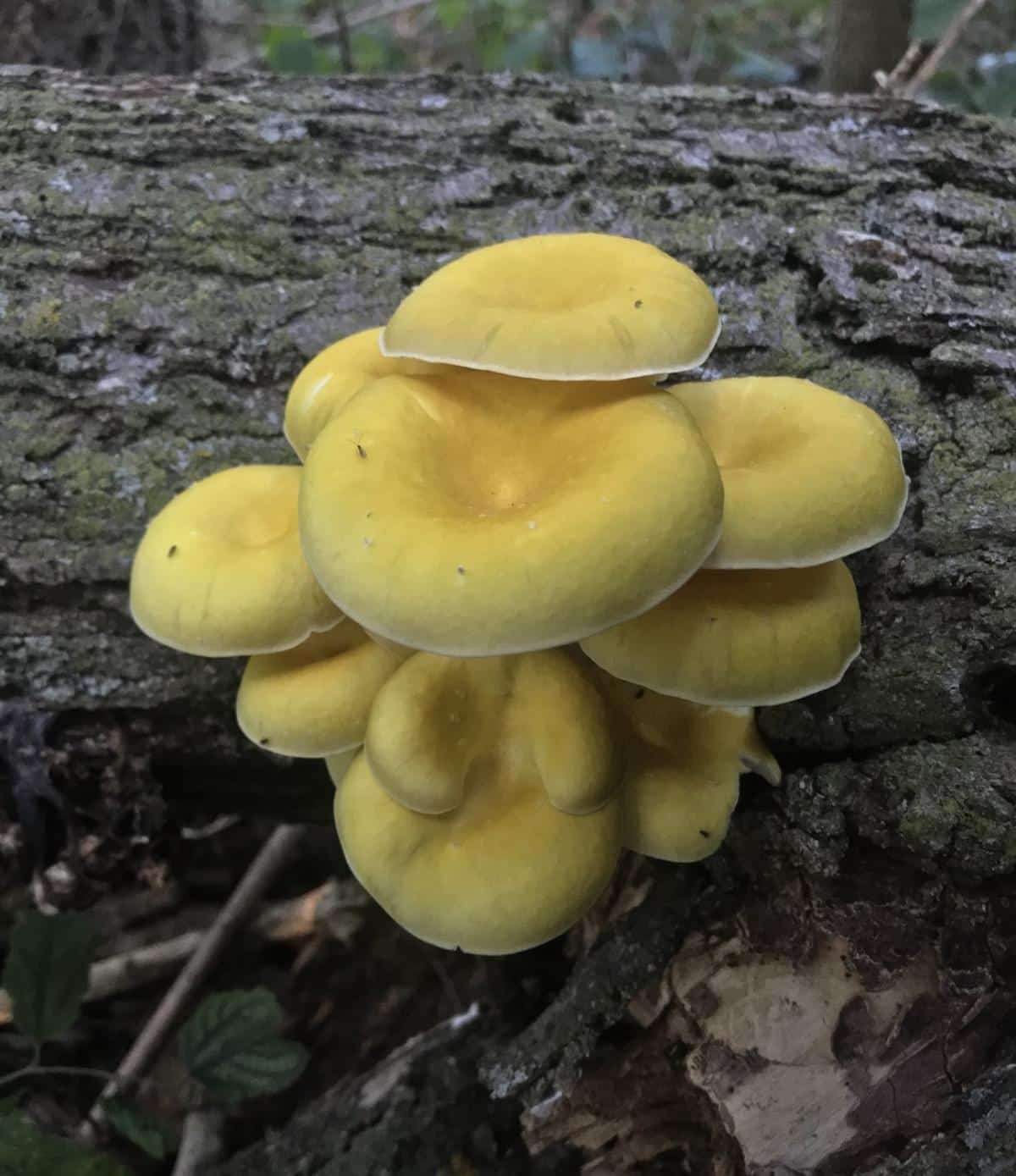
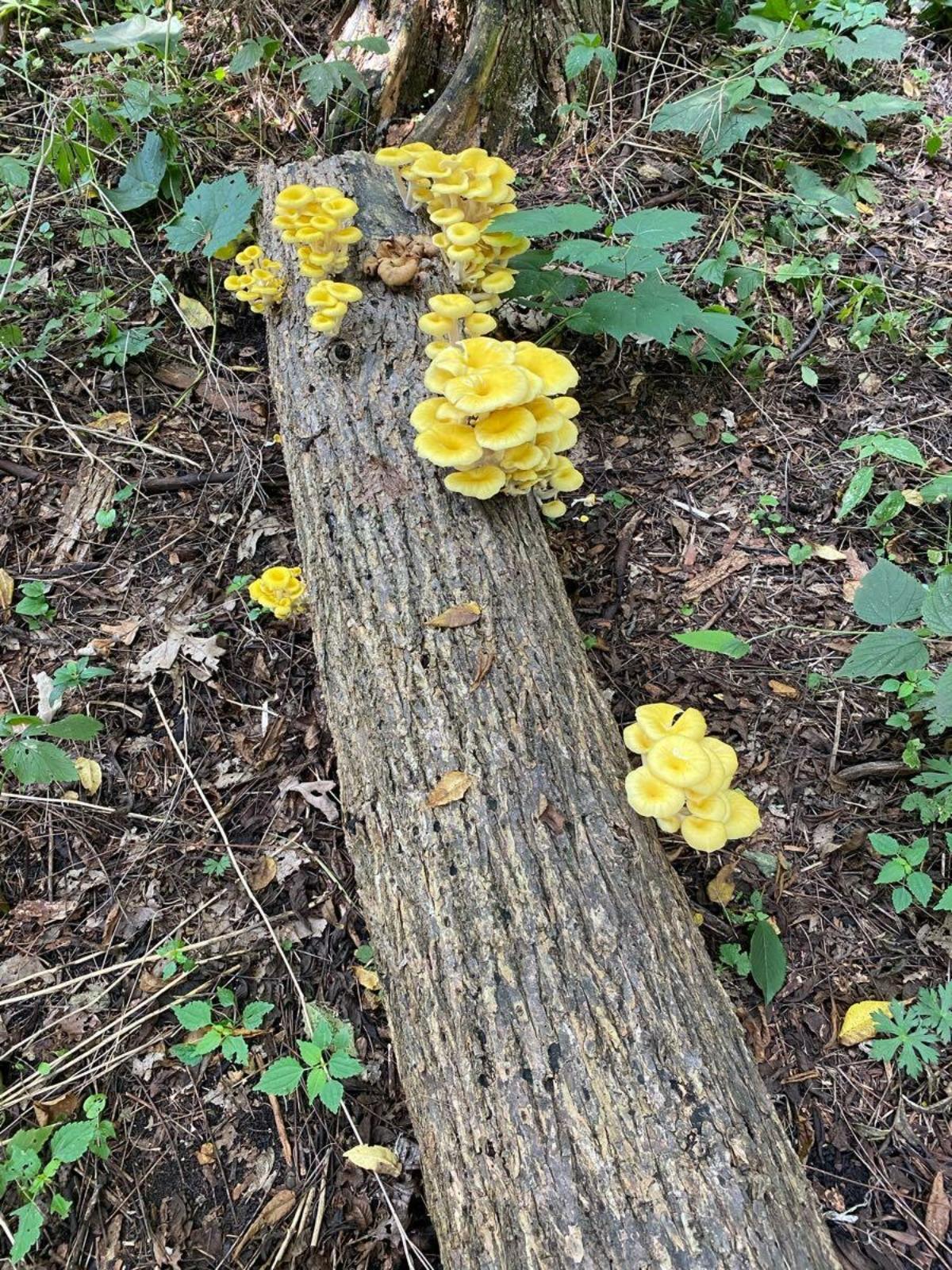
Yellow Oysters
Yellow oysters are a non-native species spreading through New England and have recently been declared definitely invasive. If you see them, take them all; do not worry about harvesting sustainably with this one! They are most commonly sighted following the I-87 corridor up the Hudson River, and their range is expanding. Any finds should be recorded on iNaturalist or Mushroom Observer to help track the spread.
Where to look: Dead hardwood trees. Not yet common but increasingly reported throughout the region.
→ [Full yellow oyster mushroom guide]
Shaggy Manes
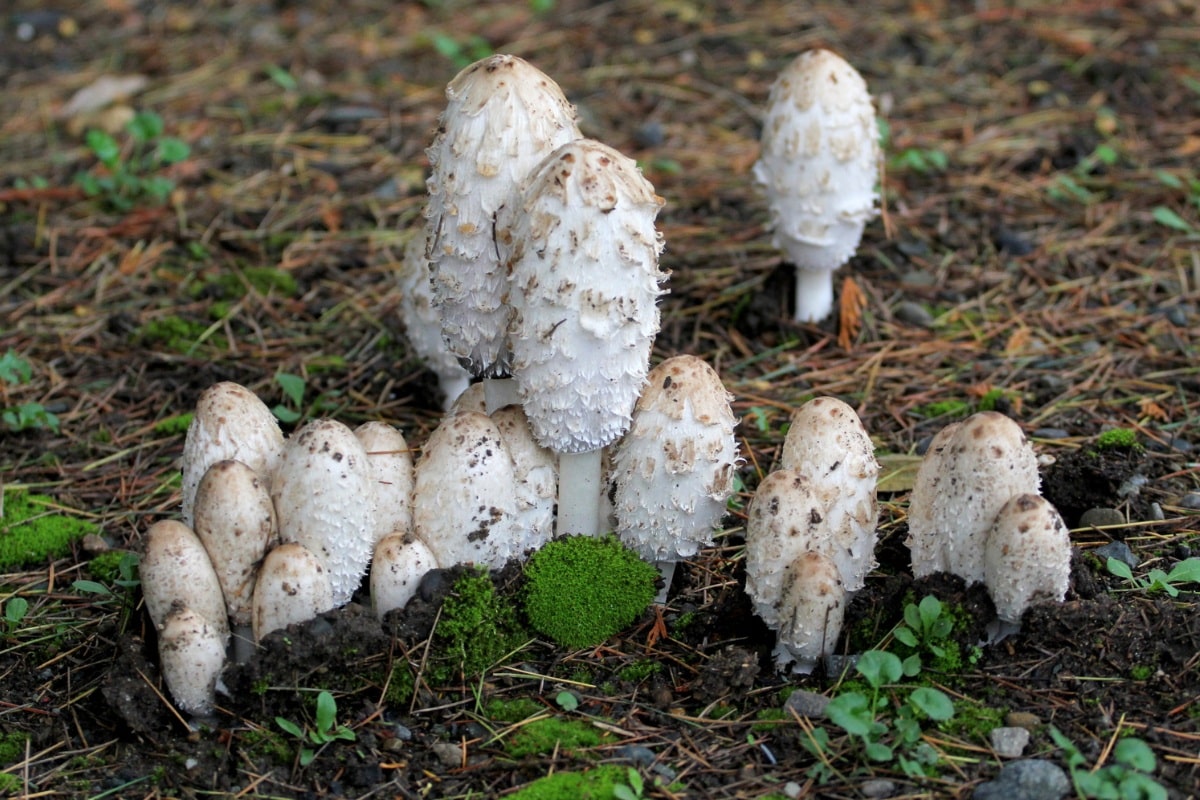
Shaggy manes tend to appear later in the summer and fruit in large groups in meadows, grasslands, along paths, and in disturbed areas. Their shelf life is extremely short after picking because they deliquesce quickly into black ink. Only collect specimens that are still fully white and firm, and that you intend to cook in 24 hours.
Where to look: Meadows, grasslands, roadsides, and disturbed areas. These are not found in the deep forest. Cook on the day of harvest.
Lobster Mushrooms
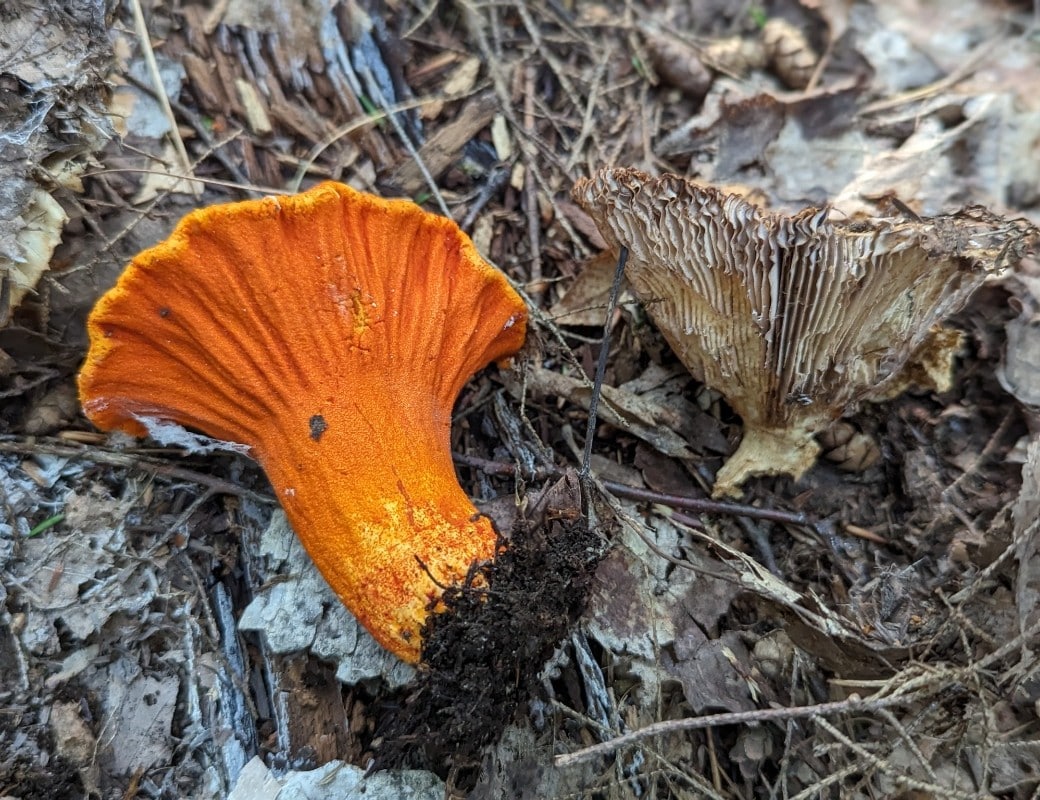
Lobster mushrooms are a prime summer mushroom, and their red-orange color is striking! Even though they’re brightly colored, they are easy to miss because they hide under the forest duff. Check for humps in the leaf debris, and keep a keen eye for that cooked lobster shell coloring. They parasitize Russula species, so areas where Russulas are fruiting are the places to watch.
Where to look: On the forest floor. Look for humps under leaf debris and needle duff. They will usually reappear in the same spot year to year.
→ [Full lobster mushroom guide]
Hedgehog Mushrooms
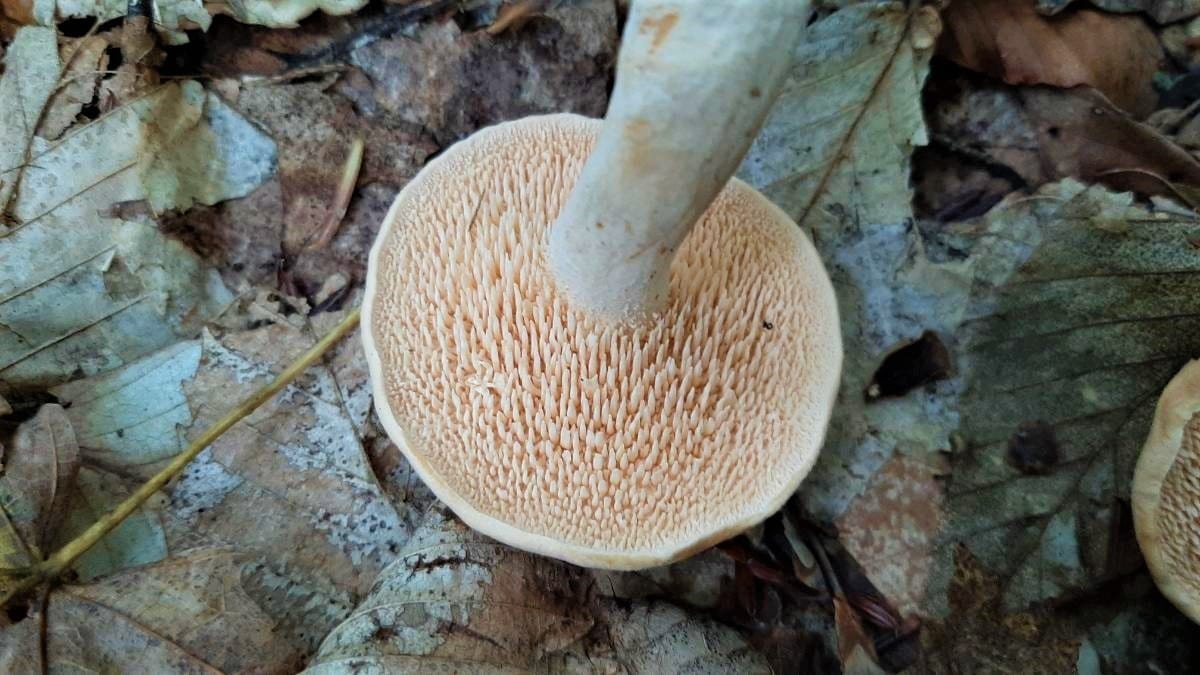
Hedgehog mushrooms are mid-summer to late summer to fall species. They have teeth under their caps instead of gills, and have dense flesh and a sweet, nutty flavor. Hedgehogs are notoriously easy to miss because their caps are plain tan to buff-white and blend in with the leaf litter.
Where to look: Forest floor under hardwoods and mixed woods. Check the underside of every plain-looking cap.
→ [Full hedgehog mushroom guide]
Puffballs
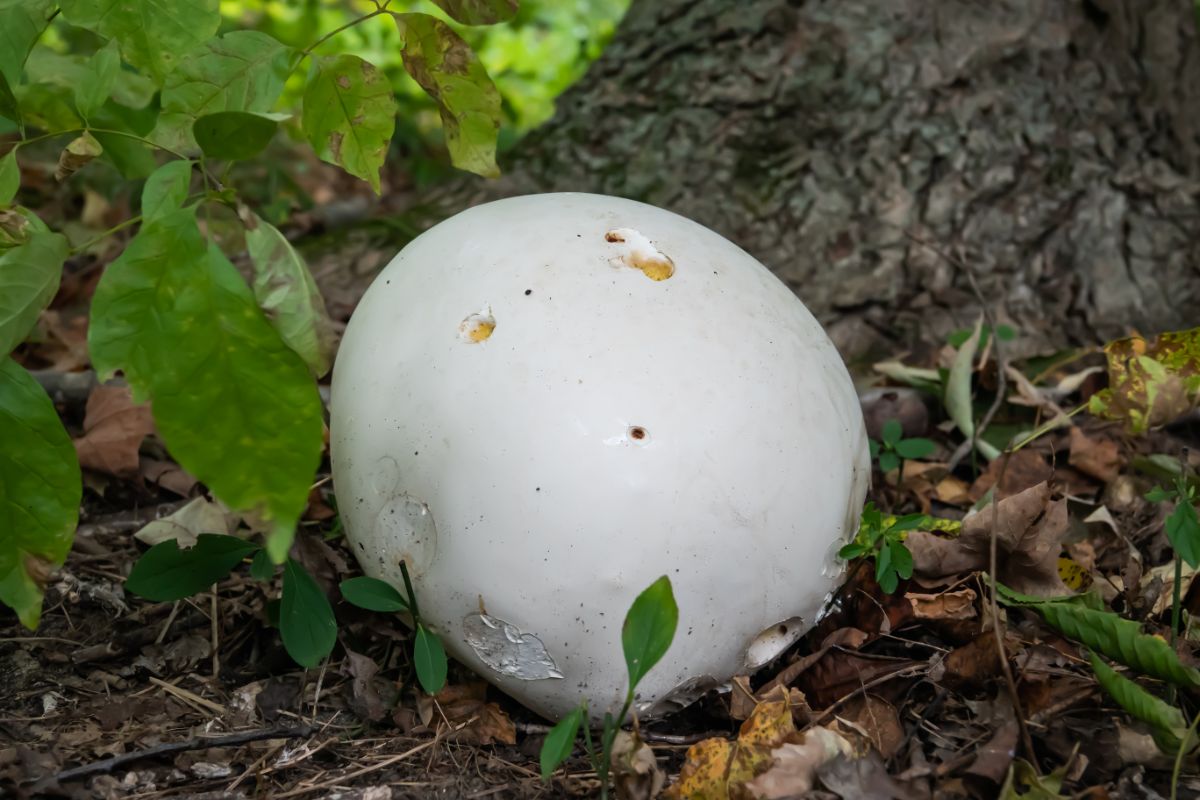
Puffballs start appearing mid- to late summer. Giant puffballs and smaller species are both edible when they’re entirely white inside. The giant puffball is hard to miss when it’s in a large grassy area — it looks like an abandoned volleyball. The smaller puffballs usually show up prolifically when they fruit .
Where to look: Giant puffballs in open meadows and grassy clearings. Smaller puffballs in mixed habitats.
Southeast Summer Mushrooms (Tennessee, Arkansas, Missouri, and South)
Summer in the Southeast is hot, humid, and filled with all kinds of bugs, but the potential for finding excellent edible summer mushrooms is very good. Chanterelles, puffballs, and black trumpets are the prime summer species at this time. The best time to go foraging is two to five days after a good rainstorm, before the insects get to them.
Chicken of the Woods
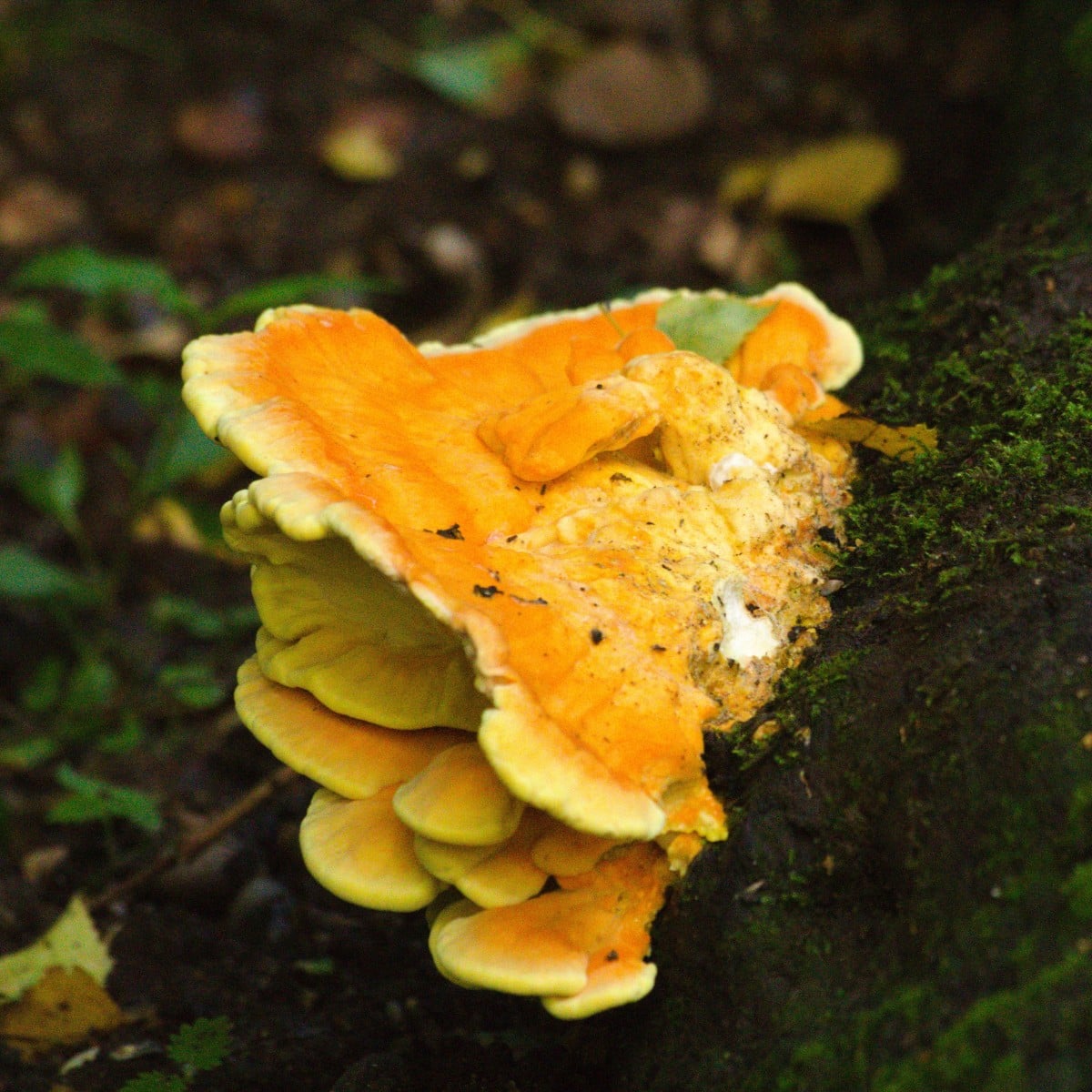
Chicken of the woods starts appearing in late spring and continues through summer and fall. This mushroom doesn’t follow a set fruiting schedule; it is highly variable. Each individual fruiting is on its own timeline, and so it’s always worth it to be looking for these. There are a few species of chicken of the woods in the Southeast, and not all of them are the classic bright orange.
- Laetiporus sulphureus is the classic bright orange to yellow variety and grows on hardwoods.
- Laetiporus cincinnatus is a peachy-colored species that is almost exclusive to oaks.
Where to look: Dead and dying hardwood trees and stumps. Mark the location when found; it usually returns to the same spot each year.
→ [Full chicken of the woods guide]
Chanterelles
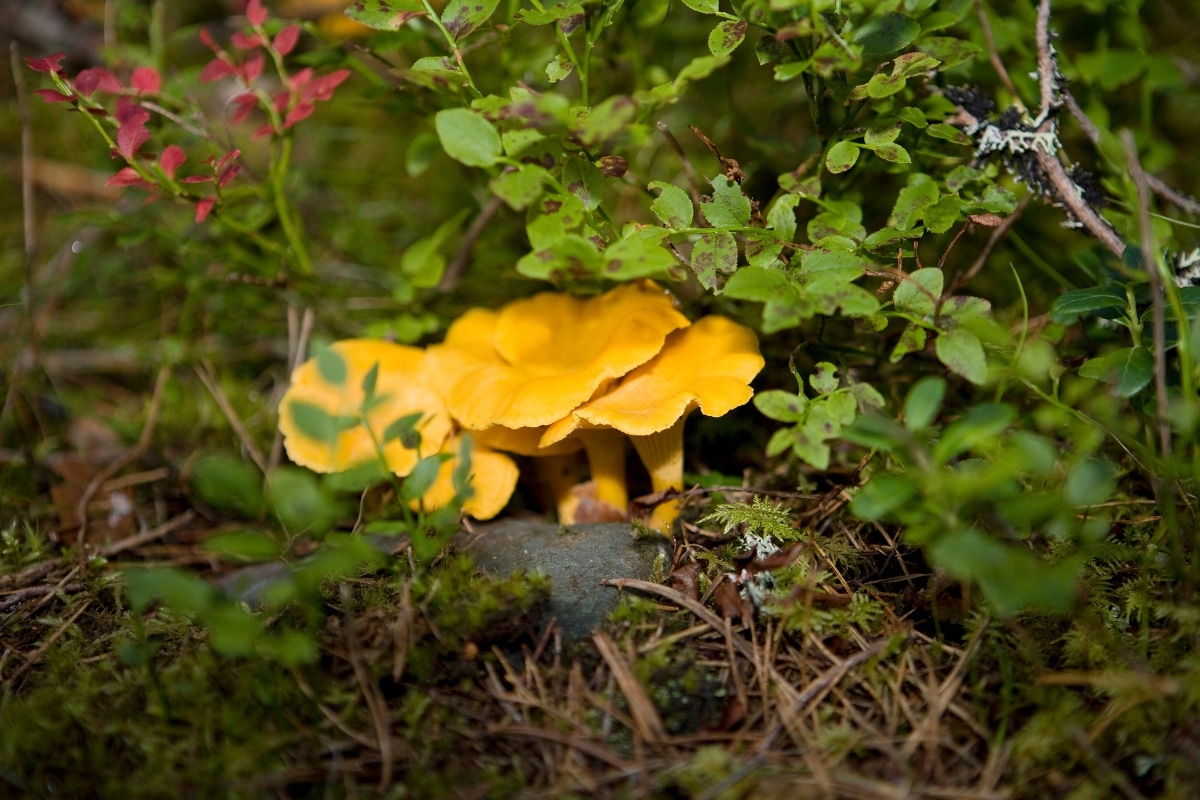
Chanterelles have a fruity scent and a dense texture, and appear in large scattered patches in early to mid-summer. There are several species of chanterelles in the southeast, and they come in many colors, from golden yellow to brownish yellow to red.
- Cantharellus appalachiensis has brownish-yellow caps and fruits with oak trees.
- Cantharellus confluens has golden-yellow caps and grows in dense, overlapping clusters.
- Cantharellus lateritius has a smooth underside, which is very different from the false gills of other species, and grows with oak and hickory trees.
- Cantharellus minor is a small chanterelle, usually under 1.5 inches tall, and is orange-yellow,
- Cantharellus cinnabarinus is small and red to flamingo pink.
- Cantharellus persicinus is a peachy orange color and is most common in the Appalachian Mountains.
- Cantharellus coccolobae is pinkish-red and only known in Florida and coastal areas with sea grape bushes.
Where to look: Hardwood forests on the ground. Most species grow under or near oak trees and fruit in scattered groups. Chanterelles fruit in the same place year after year, so be sure to mark your spots.
→ [Full chanterelle identification guide]
Yellowfoot Chanterelles
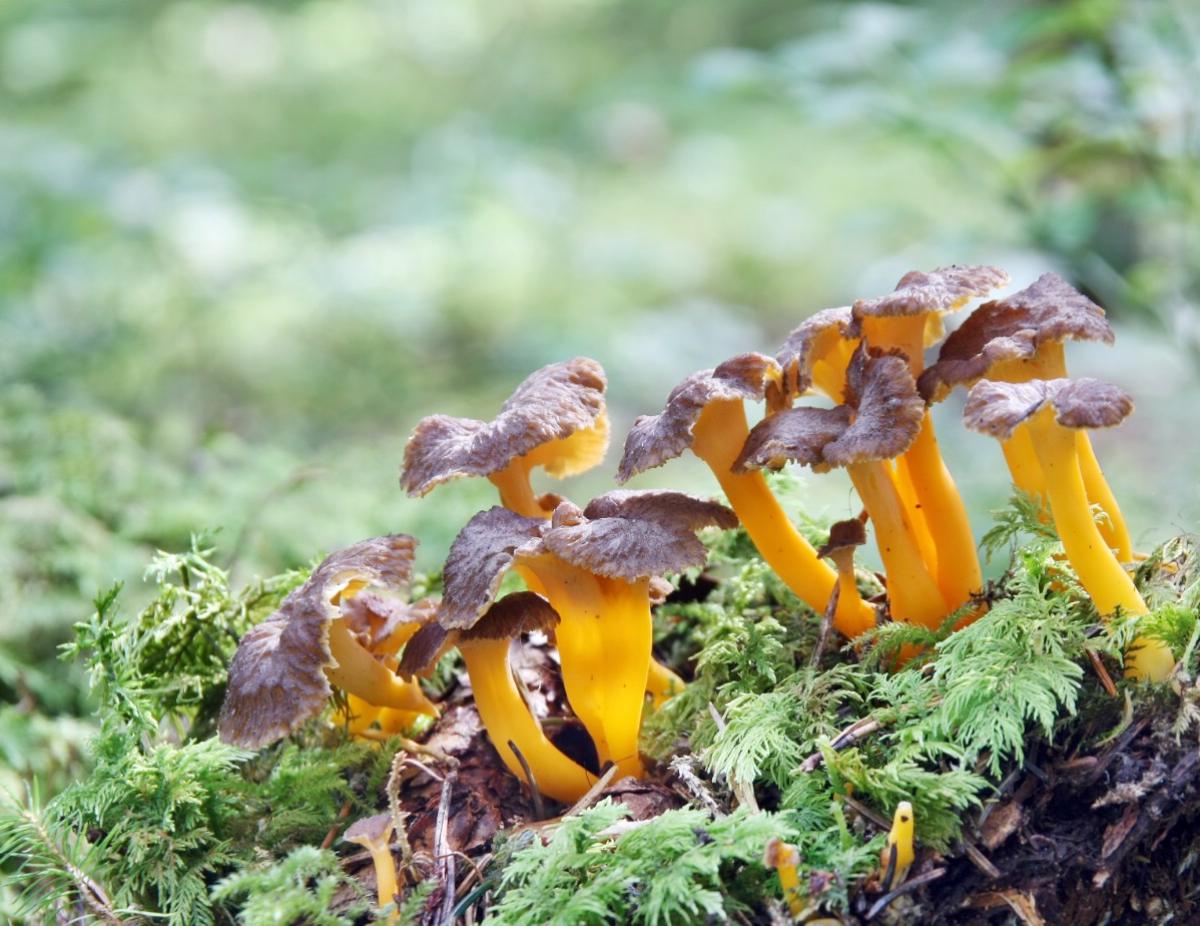
Yellowfoot chanterelles are close relatives of chanterelles and look similar, but are smaller and not as brightly colored. The caps vary from yellow-orange to brownish, and the stem is hollow, which is the key difference from a true chanterelle. The flavor is bland compared to chanterelles, but they fruit in large scattered groups and are widely foraged.
- Craterellus ignicolor has a cap that is bright orange to orangish-yellow and pale yellow to grayish false gills. It grows with oaks, beech, and birches.
- Craterellus odoratus is medium to pale yellowish-orange with a smooth undersurface and no defined stem. It grows in clusters around oaks, primarily in the southern Appalachian Mountains, but its range extends from Florida to Texas.
- Craterellus lutescens is brown to orangish-brown with a nearly smooth pastel orangish-yellow undersurface and a bright orange stem. It grows with conifers in wet bogs and is most common in the Appalachians.
- Cantharellus tabernensis is yellowish-brown with bright orange gills and stem. It grows in mixed pine and hardwood forests.
- Craterellus tubaeformis is widely distributed in the Appalachian Mountains, where it grows with conifers in mossy and boggy areas. It is scarce in the deep South.
Where to look: Forest floor. Check the same areas for black trumpets a few days after finding yellowfeet.
→ [Full yellowfoot chanterelle guide]
Black Trumpets
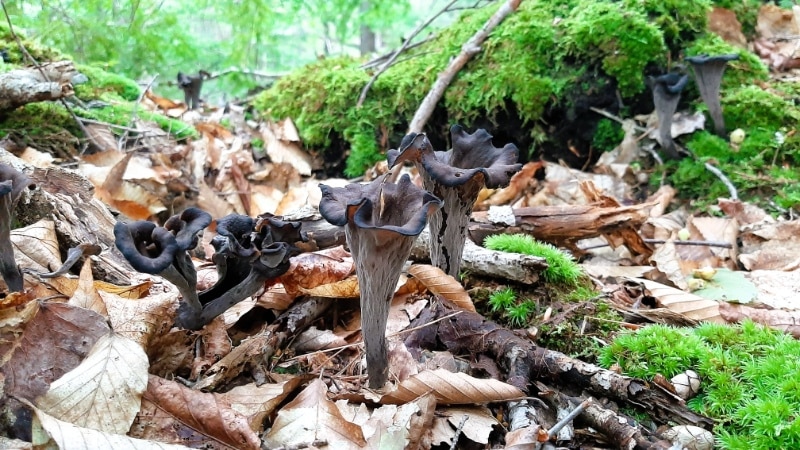
Black trumpets are a mid- to late-summer mushroom species, and while they can be hard to find, they are absolutely worth the effort. They are deep gray to black in color, trumpet-shaped, and have a rich, smoky, earthy flavor. The fruiting bodies are thin and fragile and fall apart easily, so it’s best to carry them in their own basket or bag. Finding black trumpets takes patience and practice, because their dark coloring blends into the leaf litter almost completely.
Where to look: On the ground around oak trees, often in mossy areas. Move slowly and scan the ground carefully. Yellowfoot chanterelles often fruit in the same areas shortly before black trumpets appear.
Lobster Mushrooms
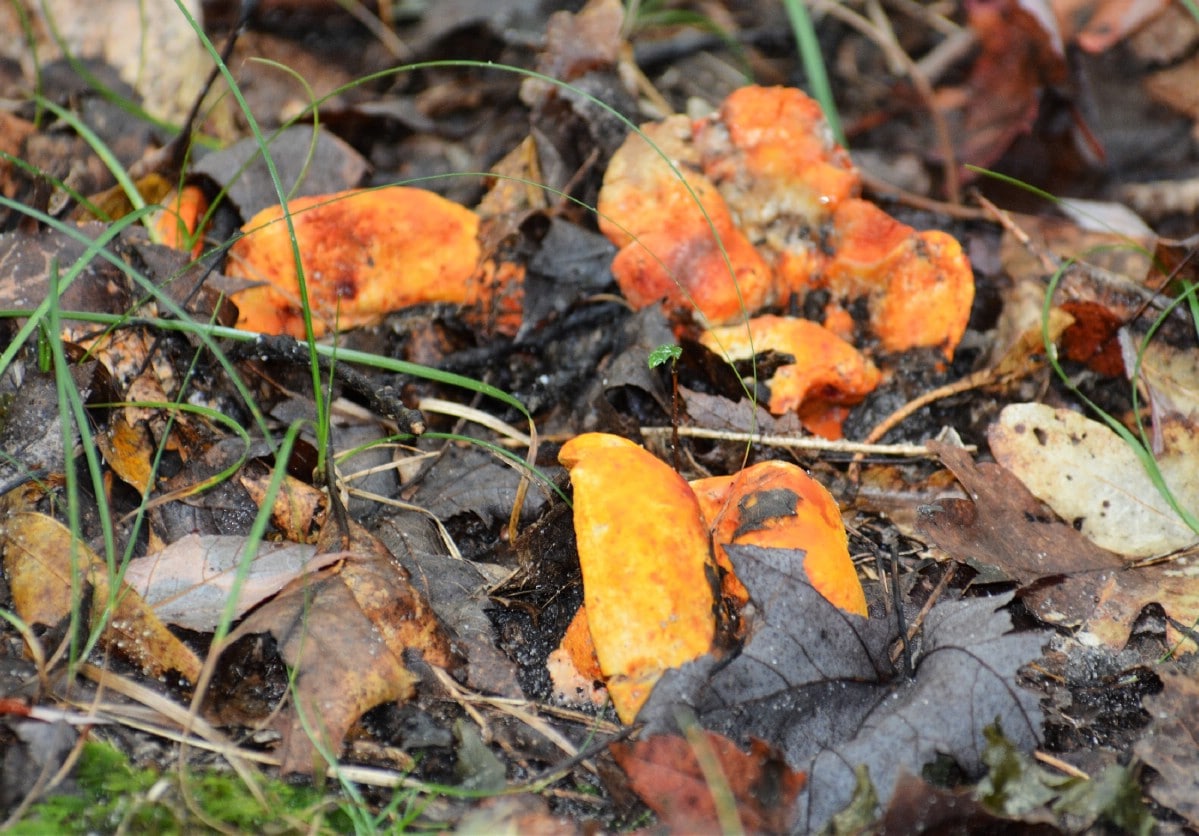
Lobster mushrooms are a fungus that parasitizes another, transforming the host into a dense, firm, slightly sweet edible species. The brilliant red to orange coloring makes them relatively easy to spot, although they often hide under leaf litter, so you still have to be looking carefully. They fruit throughout the summer and return to the same spot year after year.
Where to look: Forest floor. Look for humps in the leaf debris where the mushroom is pushing through before fully emerging. Mark the location for future seasons.
→ [Full lobster mushroom guide]
Hedgehog Mushrooms
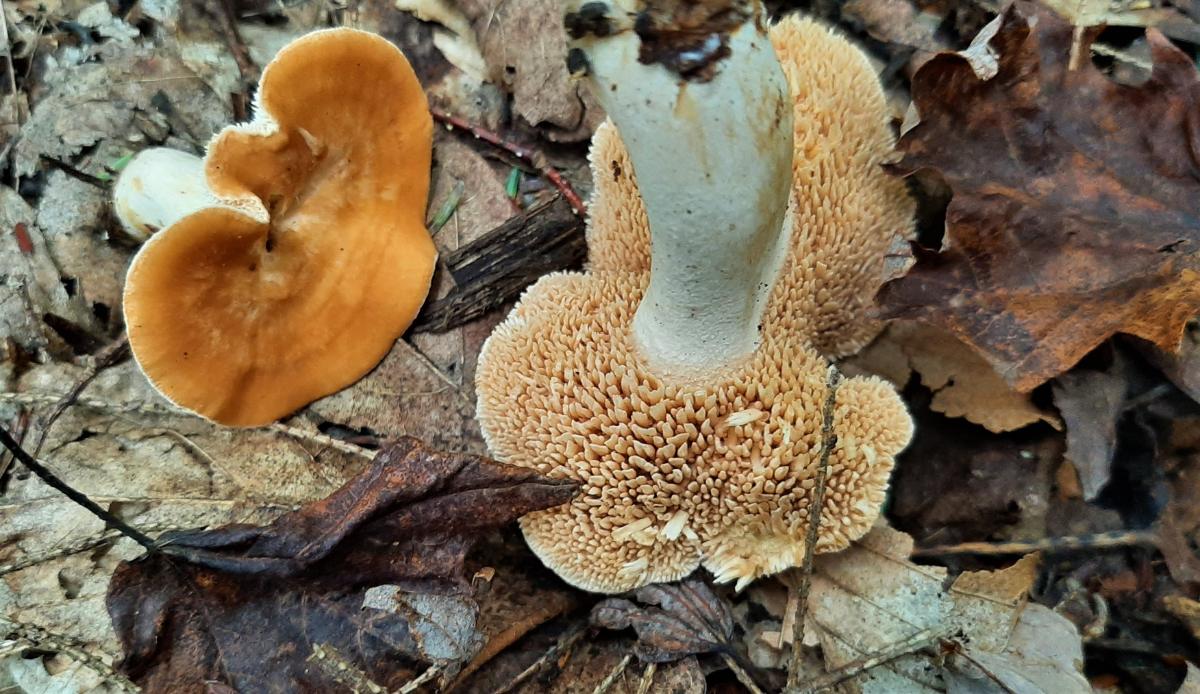
Hedgehog mushrooms have tiny teeth under the cap rather than gills, which gives them their cute name. The cap is tan to buff-white and often so plain-looking from above that it’s easy to overlook it. The flesh is dense and sweet-nutty in flavor, and they are a prized edible species. The older specimens can turn bitter, so always do a quick taste test in the field.
Where to look: Forest floor under hardwoods. Check every plain-looking tan cap for those little teeth. There are often many growing scattered around an area.
→ [Full hedgehog mushroom guide]
Puffballs
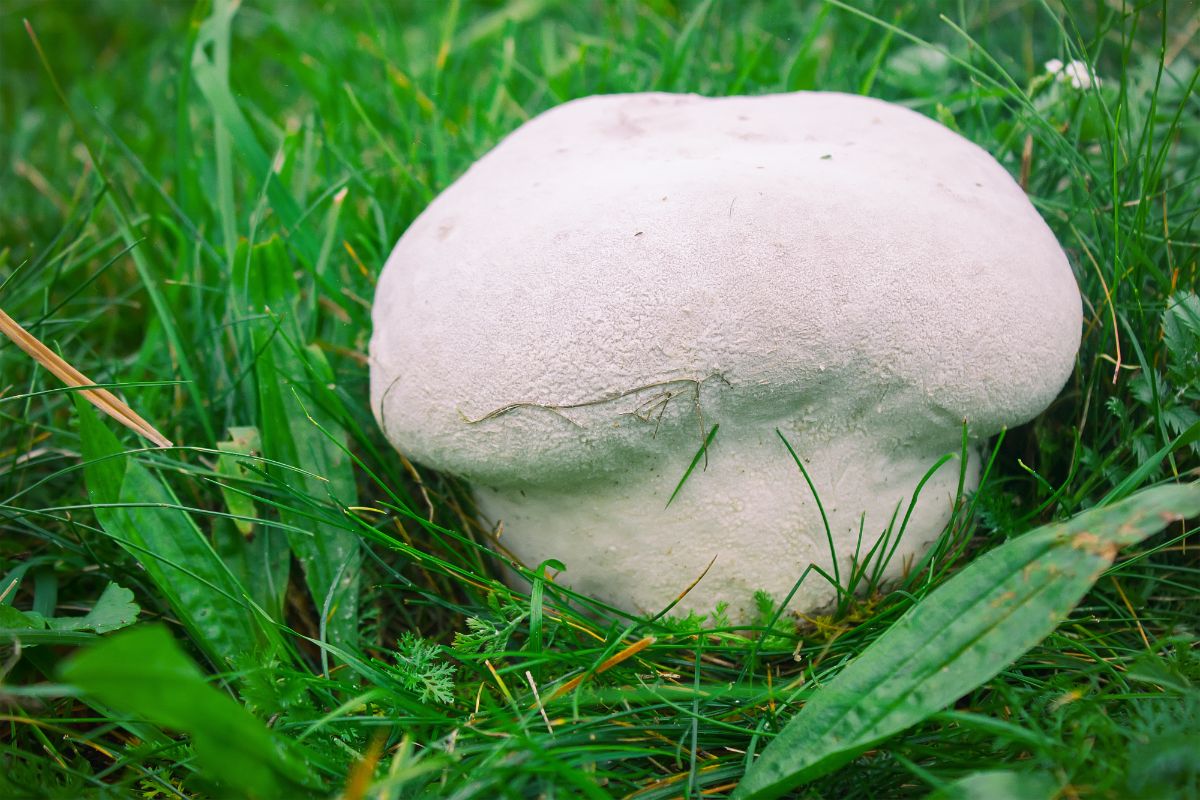
Puffballs start appearing in mid-summer, and there are huge puffballs and small puffballs. Giant puffballs fruit in open grassy areas and get as large as a volleyball; these are hard to miss! Smaller puffball species are also edible and vary widely in size and coloring. All of them, though, are roundish balls with white flesh inside. If it has a yellow or purple interior, the spores have developed, and it’s past prime and will likely make you sick if you eat it.
Where to look: Giant puffballs: open meadows, fields, and grassy forest clearings. Smaller species: mixed habitat including disturbed ground and wood edges.
Yellow Oysters
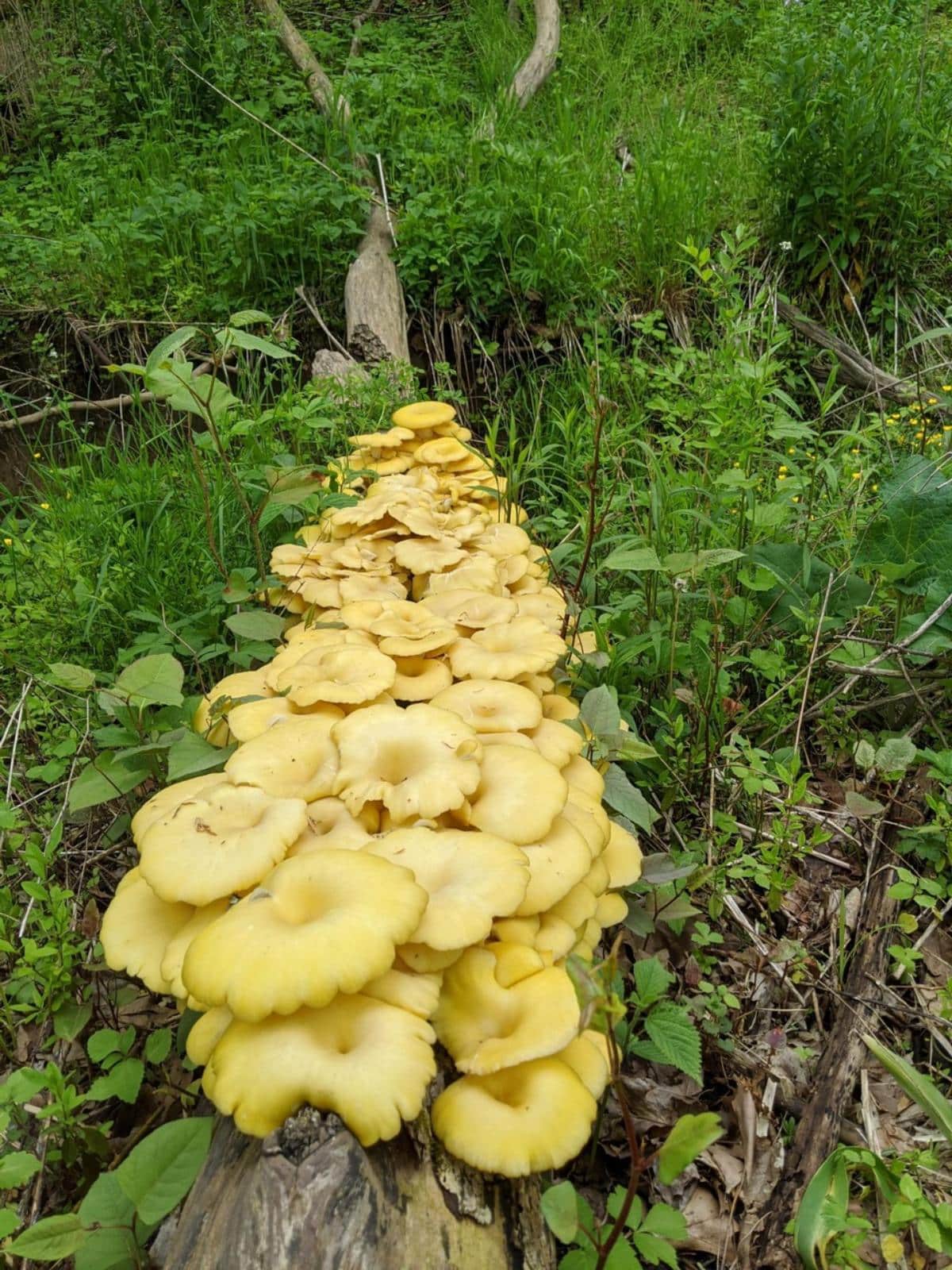
Yellow oysters are an invasive species that escaped from cultivation and are now spreading across the Southeast. They like the warm weather of spring through summer and show up in large (often massive) colonies on hardwood trees. Foraging all of them is fine (and encouraged) since they are not native.
Where to look: Dead hardwood trees, particularly elm. They grow in large, dense colonies and are hard to miss.
→ [Full yellow oyster mushroom guide]
Midwest Summer Mushrooms (Ohio, Indiana, Illinois, Michigan, Wisconsin, and surrounding states)
Summer in the Midwest is hot and muggy, and while it can be challenging to deal with the mosquitoes, it is worth it for many mushrooms. Chanterelles, puffballs, hedgehogs, lobsters, and chicken of the woods are all out at this time, and often in great numbers. The best time to go out foraging for summer mushrooms is two to four days after good rain and before the bugs find the mushrooms.
Chanterelles
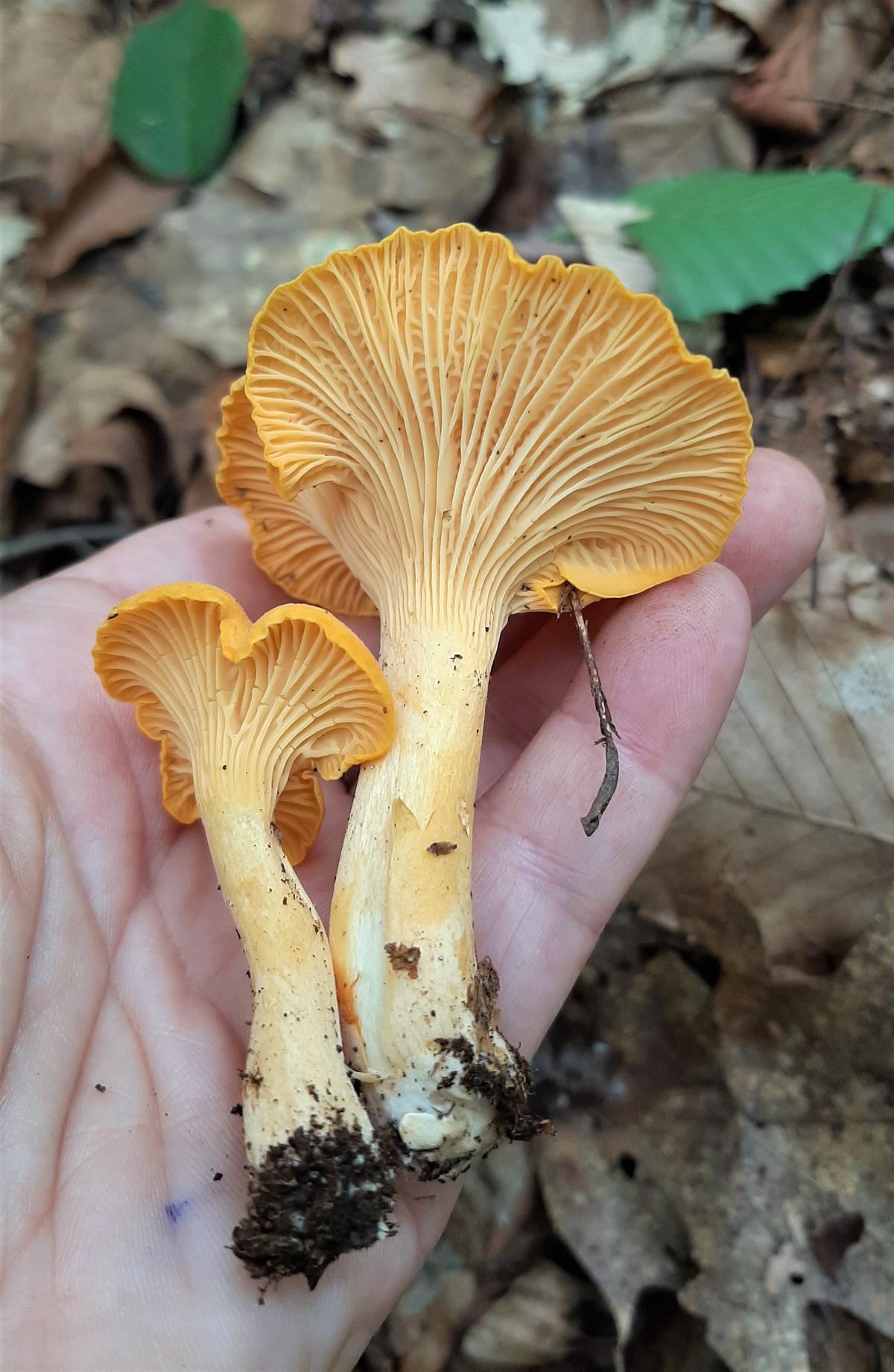
Chanterelle season is July through early September, and they often fruit in large patches after good soaking rains. They return to the same spots each year, so be sure to document the location. The Midwest is a hotspot for chanterelle diversity; there are several species that occur here, and some haven’t been fully described to science yet.
- Cantharellus altipes are golden yellow and fruit in sandy soil in oak and pine forests.
- Cantharellus appalachiensis caps are brownish-yellow, and they grow with oaks and hardwoods (they’re more common in the southern states)
- Cantharellus enelensis is yellow-brown and grows with conifers.
- Cantharellus flavus is golden yellow and fruits in hardwoods and mixed forests.
- Cantharellus lateritius has a smooth underside and grows with oak and hickory; it is more common in the lower Midwest.
- Cantharellus minor is a small, orange-yellow species that grows under oaks.
- Cantharellus cinnabarinus is a standout with red to flamingo pink bodies and grows with oaks, beech, aspen, and hickory.
Where to look: Most species grow under or near oak, but some also grow with conifers or in mixed forests. Look after rain in a shaded, moist forest with a good duff layer.
→ [Full chanterelle identification guide]
Chicken of the Woods
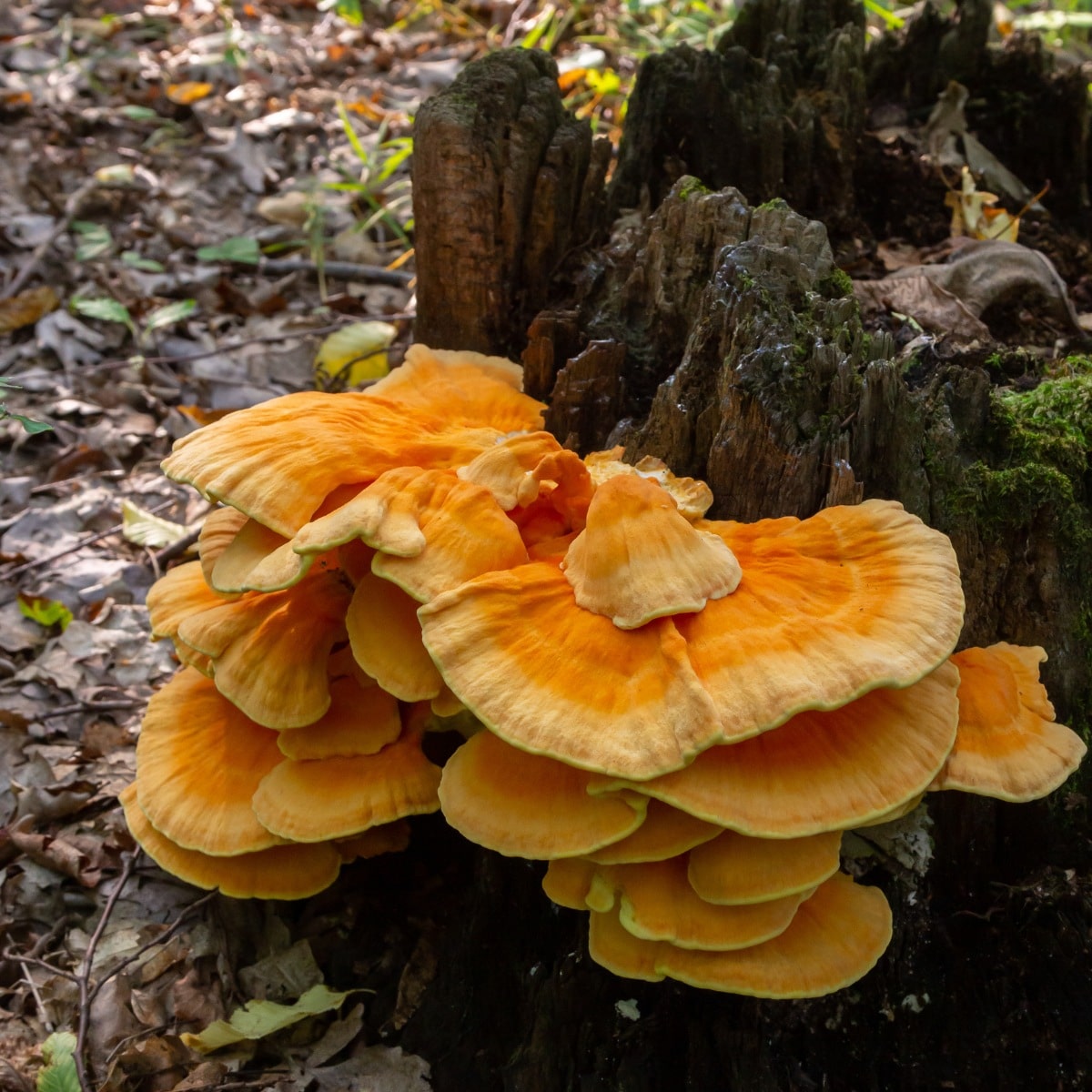
Chicken of the woods is more common in later summer and fall but does start fruiting in late spring; these mushrooms don’t follow a particular season, just their own individual schedule. It grows in dense overlapping clusters on dead and dying wood. There are three species that occur in the Midwest:
- Laetiporus sulphureus is the classic bright orange and yellow, and fruits on hardwoods, especially oak.
- Laetiporus cincinnatus is a peachy orange and grows as a rosette from buried wood near oak trees. It often looks like it’s growing from the ground.
- Laetiporus huroniensis is also the classic bright orange or yellow, but it grows on conifers.
Where to look: Dead and dying hardwood trees and stumps for L. sulphureus and L. cincinnatus. Conifers for L. huroniensis. They will return to the same tree or stump each year.
→ [Full chicken of the woods guide]
Black Trumpets
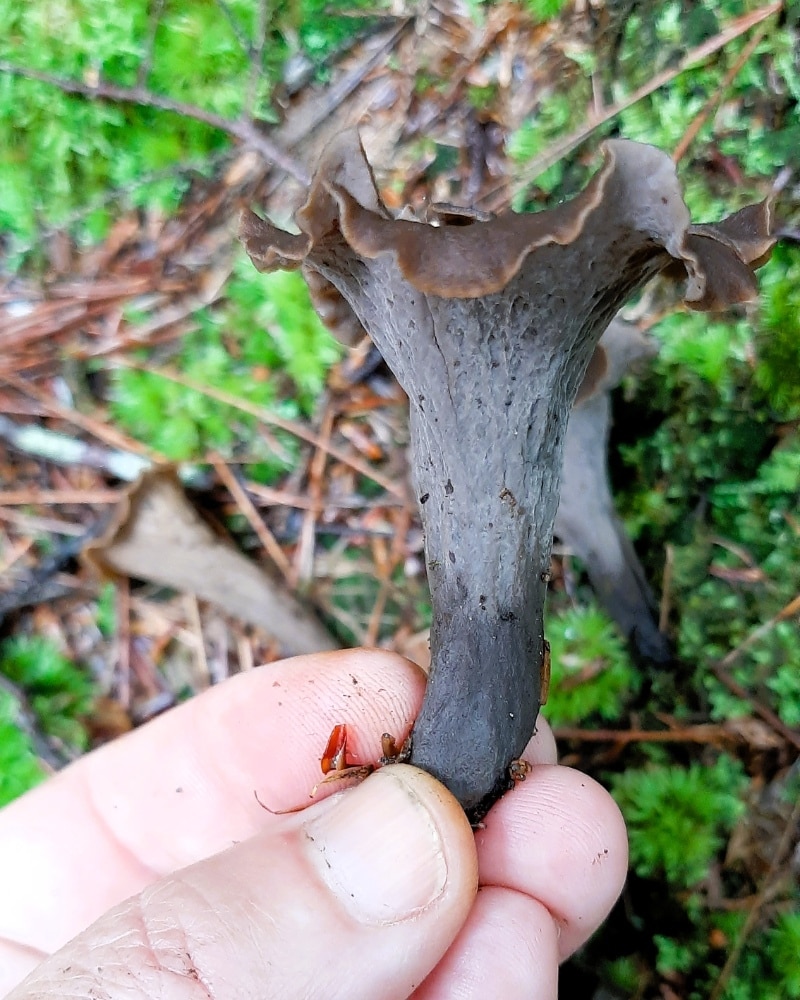
Black trumpet mushrooms fruit from mid- to late-summer species, and they have a smoky, earthy flavor unlike any other mushroom. Their dark coloring blends into the leaf litter, which means they take some patience to find. The fruiting bodies are fragile and should be carried in a separate bag or basket so they don’t get crushed. When you find them, mark the spot; they return each year.
Where to look: Forest floor around oak trees. Yellowfoot chanterelles often fruit in the same area, so if you find yellowfeet, check back for black trumpets a little later.
Yellowfoot Chanterelles
Yellowfoot chanterelles fruit throughout the summer in large dense patches that often cover huge swaths of the forest floor. They are small and less flavorful than true chanterelles, but because they grow so prolifically, they are a great find. They have a hollow stem, unlike true chanterelles, and their caps are yellow-orange, yellow-brown, or brownish depending on species.
- Craterellus tubaeformis has a yellow-brown cap with grayish-brown false gills lighter than the cap; it grows with conifers in mossy and boggy areas.
- Craterellus lutescens is orange-brown with pastel orange or creamy yellow false gills and a bright orange stem; it grows with conifers.
- Craterellus ignicolor is bright orange to orange-yellow with pale yellow to gray false gills. It grows with hardwoods including oak, beech, and birch.
Where to look: Look on the forest floor, especially in mossy areas. Wherever yellowfeet appear, check the same area soon after for black trumpets.
→ [Full yellowfoot chanterelle guide]
Giant Puffballs
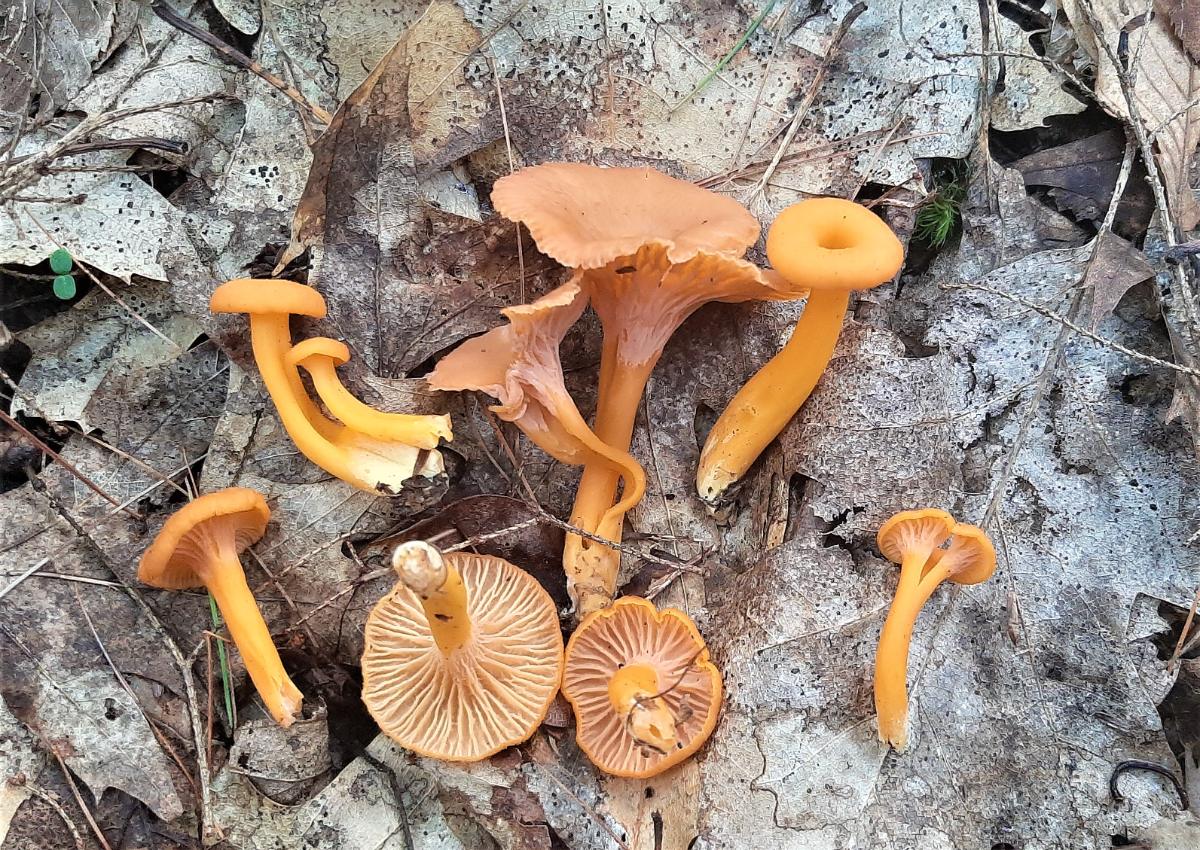
Giant puffballs start appearing in mid- to late summer. The largest species, Calvatia gigantea, grows to be the size of a volleyball and is unmistakable. The smaller species are also edible and fruit around the same time. Any puffball you find must be entirely white inside to be edible; if the inside is yellow or purple, the mushroom is past edible.
Where to look: Open grassy areas, meadows, and forest clearings. The giant puffball is found east of the Rocky Mountains.
Lobster Mushrooms
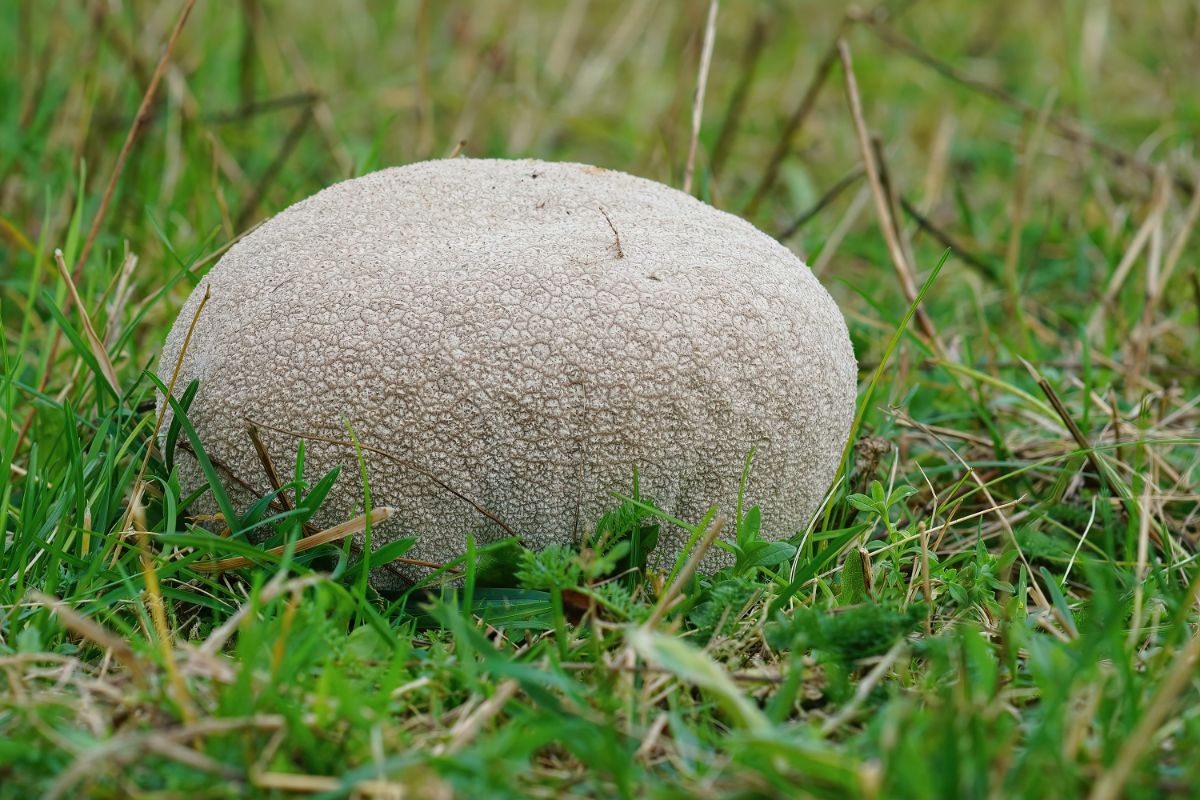
Lobster mushrooms fruit throughout the summer and have the most brilliant red-orange color that makes them relatively easy to spot, though they do tend to hide under the leaf duff. Look for humps and lumps in the forest debris that might indicate a mushroom is pushing through underneath. Lobster mushrooms parasitize Russula species, so areas where Russulas fruit are good spots to look.
Where to look: On the forest floor, look for humps in leaf debris. Mark locations because they will show up in the same place year after year.
→ [Full lobster mushroom guide]
Hedgehog Mushrooms
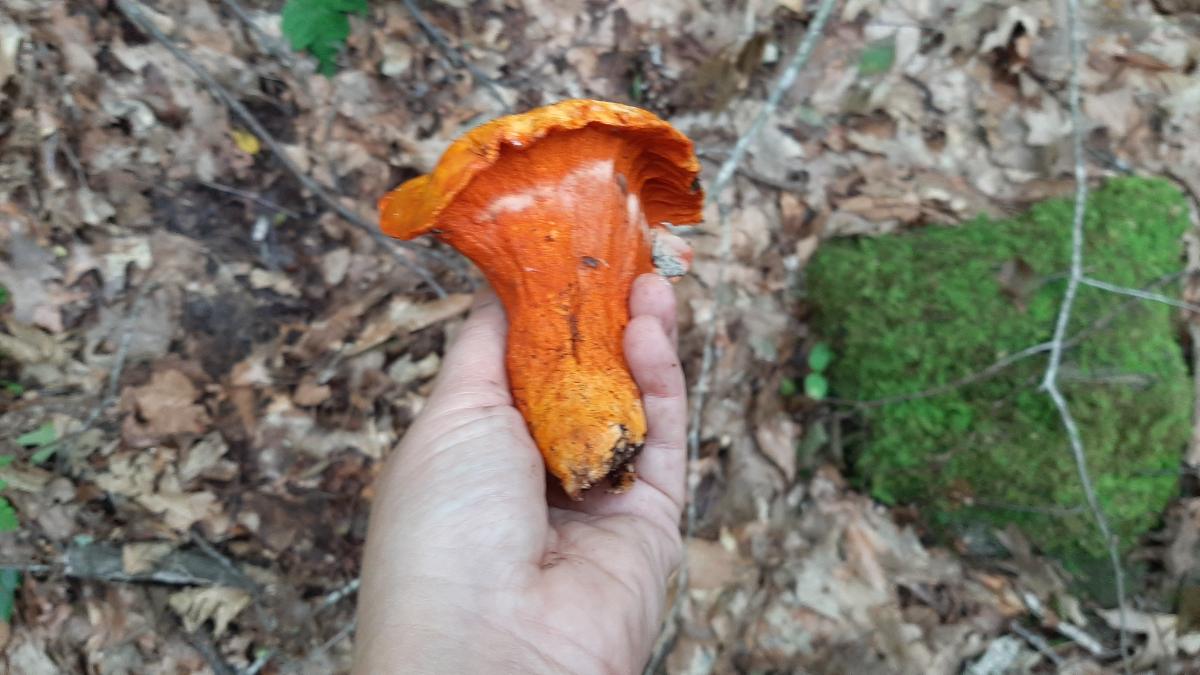
Hedgehog mushrooms are sweet and nutty and a foraging treat. They have dense flesh and teeth rather than gills on the underside. They may be large or small depending on the species. Older ones might be bitter, so a nibble-and-spit taste test in the field is worth doing before collecting any.
Where to look: Forest floor under hardwoods.
→ [Full hedgehog mushroom guide]
Yellow Oysters
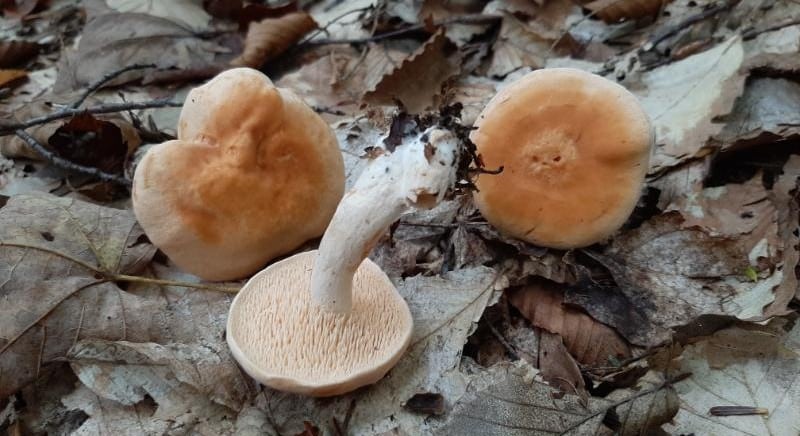
Yellow oysters are an invasive species that escaped from cultivation and are spreading like wildfire across the Midwest. They fruit in large (often massive) colonies on hardwood trees, and it’s not uncommon to find many, many pounds of them. Forage all of them, whenever you see them. Their spread can’t be stopped completely but foraging them may slow them down.
Where to look: Dead hardwood trees, especially elm trees. They grow in enormous, dense colonies and are hard to miss.
→ [Full yellow oyster mushroom guide]
Pacific Northwest Summer Mushrooms (Washington, Oregon, Northern California)
Summer in the Pacific Northwest is hot and dry, especially in July. There are still good summer mushrooms out there, but the season is slimmer than spring or fall. The best places to look, where you’ll likely have more luck, are in high-elevation mountain areas where it is cooler and moister than in the lowlands.
Chicken of the Woods
Chicken of the woods is a late-summer to fall species that starts appearing in August. It is one of the best edible species with dense, meaty flesh. The bright coloring is hard to miss! Two species grow here.
- Laetiporus gilbertsonii grows on hardwoods, mainly oaks and eucalyptus, and tends to stay close to the coast.
- Laetiporus conifericola grows on conifers like fir, hemlock, and spruce.
Where to look: L. gilbertsonii: coastal oak groves and eucalyptus. L. conifericola: conifer forests throughout the region.
→ [Full chicken of the woods guide]
Chanterelles
Chanterelles don’t fully get going until fall, but a few species do appear in late summer. There are a number of chanterelle species in the PNW; each one will grow back in the same location year to year, so mark your spots!
- Cantharellus roseocanus is the rainbow chanterelle, and it tends to appear earlier than others in conifer forests. It has a dull tan to pinkish cap and bright orange false gills.
- Cascade chanterelle (Cantharellus cascadensis) also starts in late summer and grows in association with Douglas fir.
- Pacific golden chanterelle (Cantharellus formosus), Oregon’s state mushroom, is primarily a fall species.
Where to look: C. roseocanus: around spruce and pine, sub-alpine and coastal areas. C. cascadensis: with Douglas fir.
→ [Full chanterelle identification guide]
King Boletes
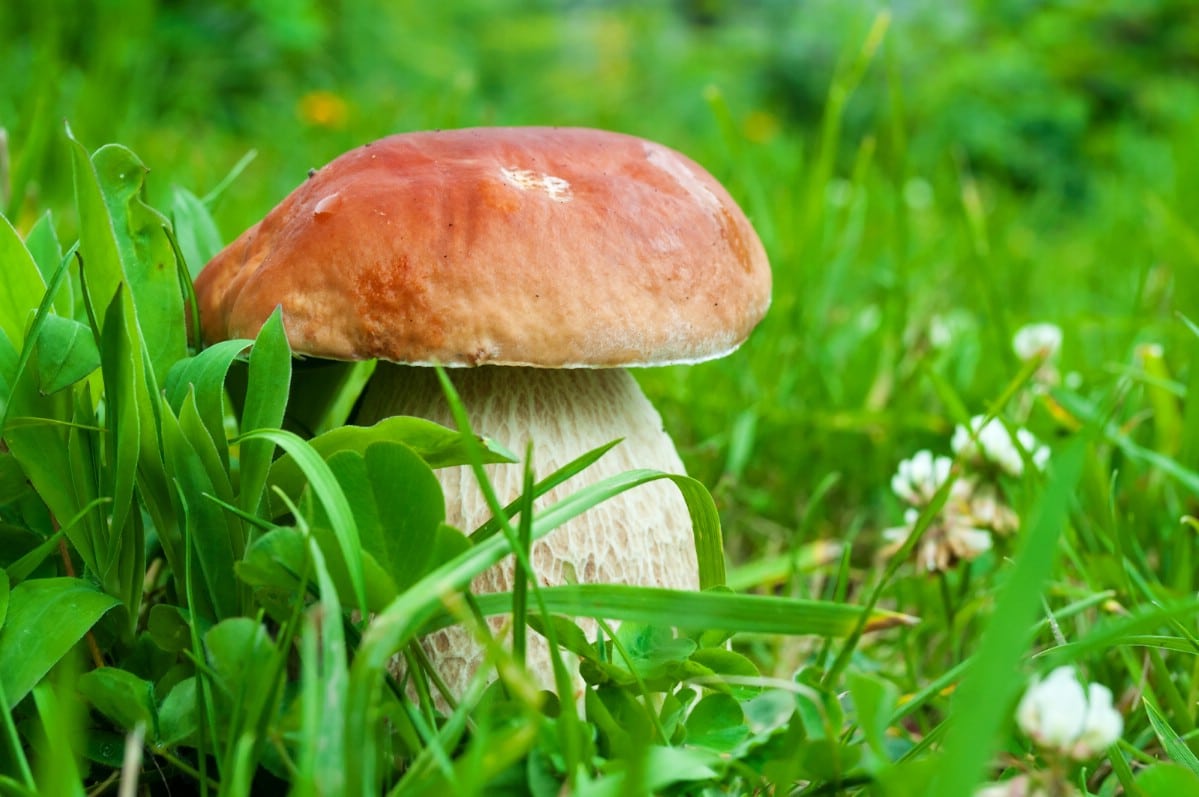
King boletes (porcini) fruit on the ground in association with conifers. They like cool, shady areas and are most reliably found at higher elevations around streams and riverbeds. Slugs also really like them, so you have to be quick to find these summer mushrooms or get lucky.
Where to look: With conifers at higher elevations, especially around streams and in shaded areas. Check early in the season to beat the slugs.
Lobster Mushrooms
Lobster mushrooms fruit from July through October. They are most common around fir and spruce at lower elevations early in the season. They parasitize Russula species, so wherever Russulas are fruiting is a potential area to watch. The brilliant red-orange color is usually visible, but they are often hidden under needle duff and humps in the debris.
Where to look: Around fir and spruce at lower elevations. Look for orange humps under needle duff.
→ [Full lobster mushroom guide]
Saffron Milky Caps
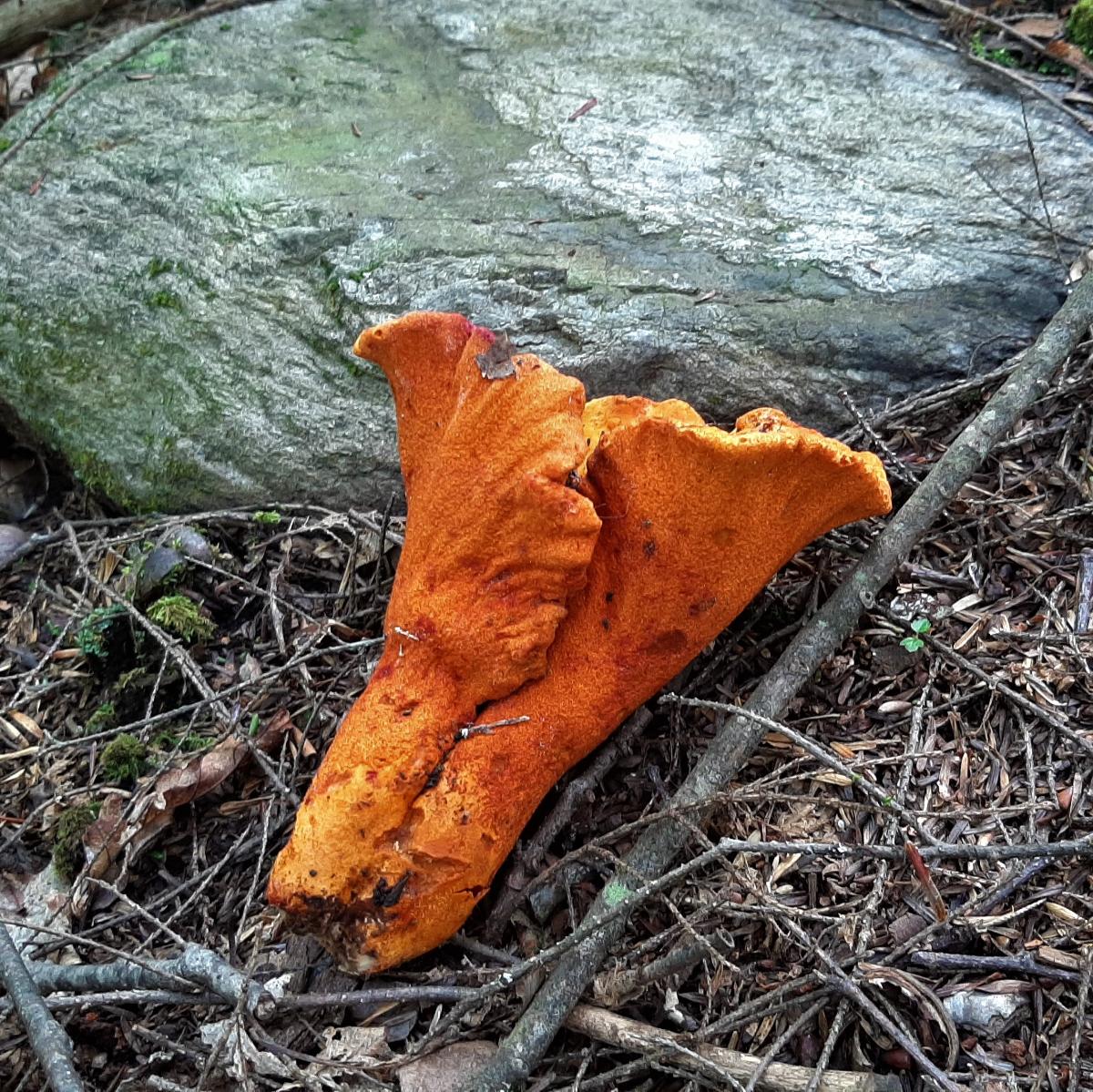
Saffron milky caps are among the most flavorful milky cap species and fruit from mid-summer through fall. They have bright orange to red caps, and when the gills are cut, it bleeds a milky latex. All parts of the mushroom stain green when handled.
Where to look: With Engelman spruce, lodgepole pine, and Douglas fir.
→ [Full saffron milky cap guide]
Giant Puffballs
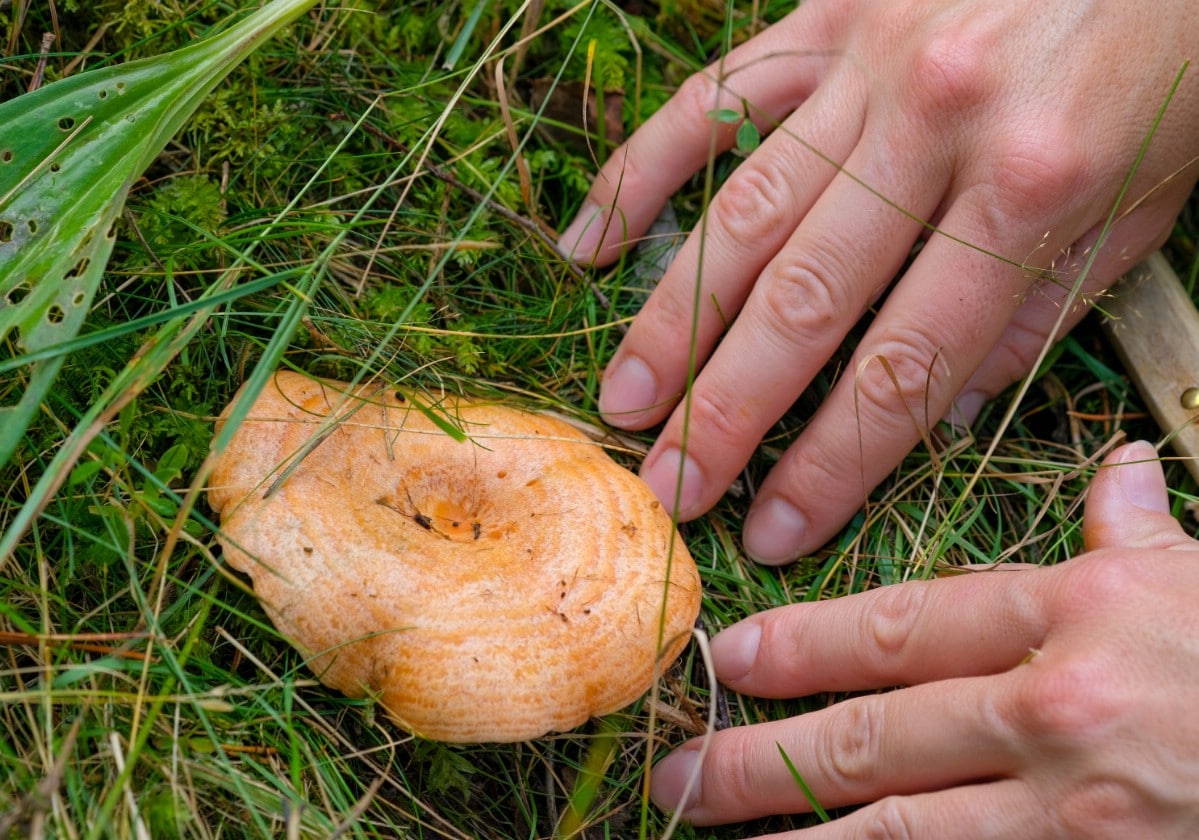
Giant puffballs start appearing in mid- to late summer. They can get massive, like volleyball size, and they like wide-open areas. There are several species worth knowing:
- Giant western puffball (Calvatia boonia) reaches volleyball size or larger, is all white with rough scales.
- Calbovista subsculpta is softball-sized with blunt triangular scales.
- Calvatia sculpta looks similar but has pointed scales on the upper surface.
Where to look: Calvatia boonia: open meadows. Sculpted puffballs: around conifers, often in disturbed areas and along roadsides.
Southwest Summer Mushrooms (New Mexico, Arizona, Colorado, Utah, Nevada)
Summer in the Southwest is actually two distinct seasons. Before the monsoons, it is dry and hot, and very few mushrooms grow. Once the monsoon rains begin in July, the forests start fruiting mushrooms. The huge contrast in elevations (forest vs. desert areas) makes each section of the Southwest its own mini-ecosystem. This can make summer mushroom foraging challenging but certainly not impossible. The best foraging is from July through September in the mountains after consistent rain.
Chanterelles
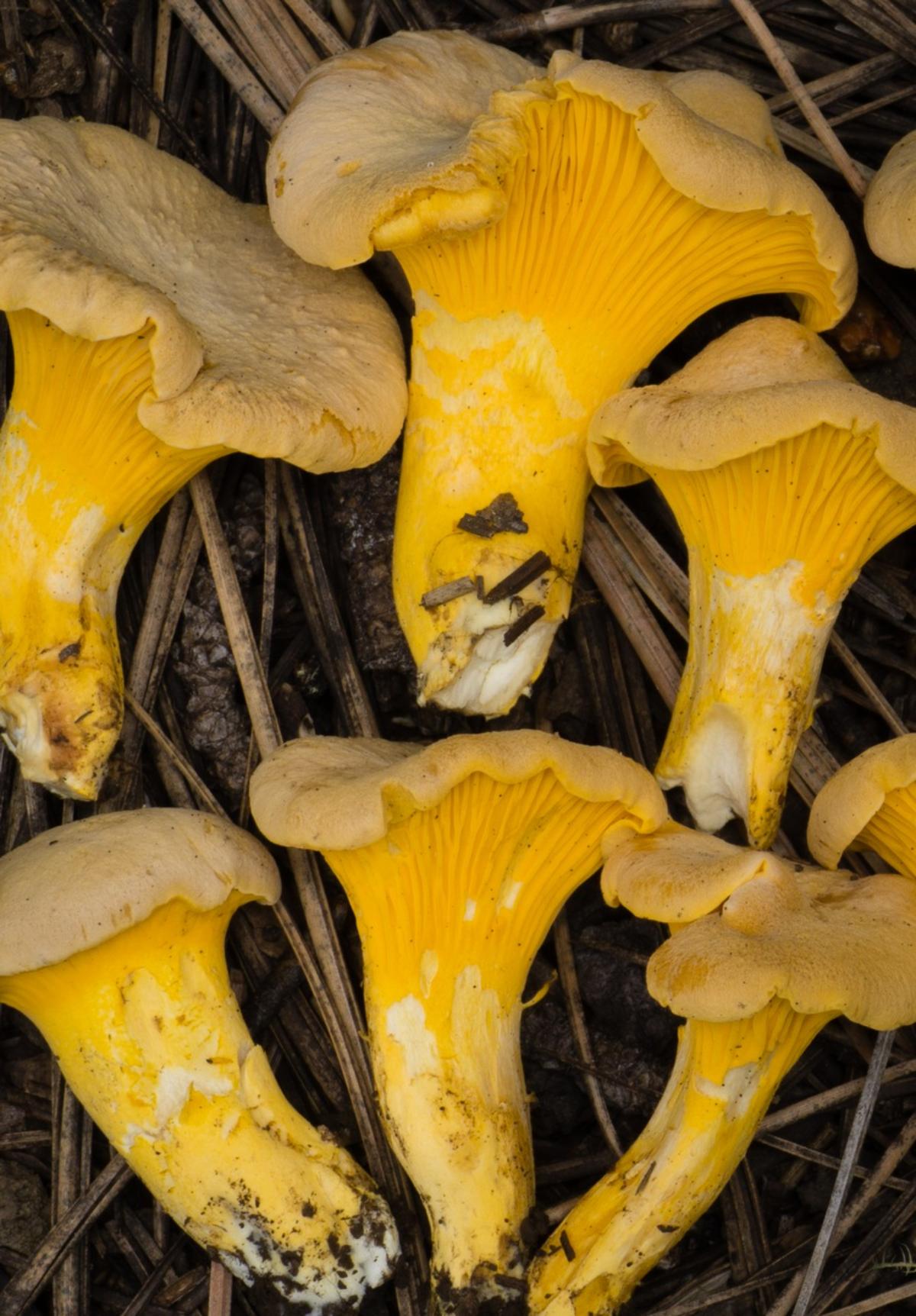
Chanterelles don’t appear until after significant monsoon rain. There are several species that grow here in conifer forests. Chanterelles have a sweet, slighty fruity smell and taste and are worth the effort to hunt.
The primary chanterelle species is Cantharellus roseocanus, the rainbow chanterelle. It is pale orange or yellow, and the false gills underneath are a brilliant orange that stands out clearly. It grows around pine and spruce, specifically Bishop pine, lodgepole pine, jack pine, and Sitka spruce.
Where to look: Around pine and spruce in mountain forests. Wait for significant rainfall before looking.
→ [Full chanterelle identification guide]
Chicken of the Woods
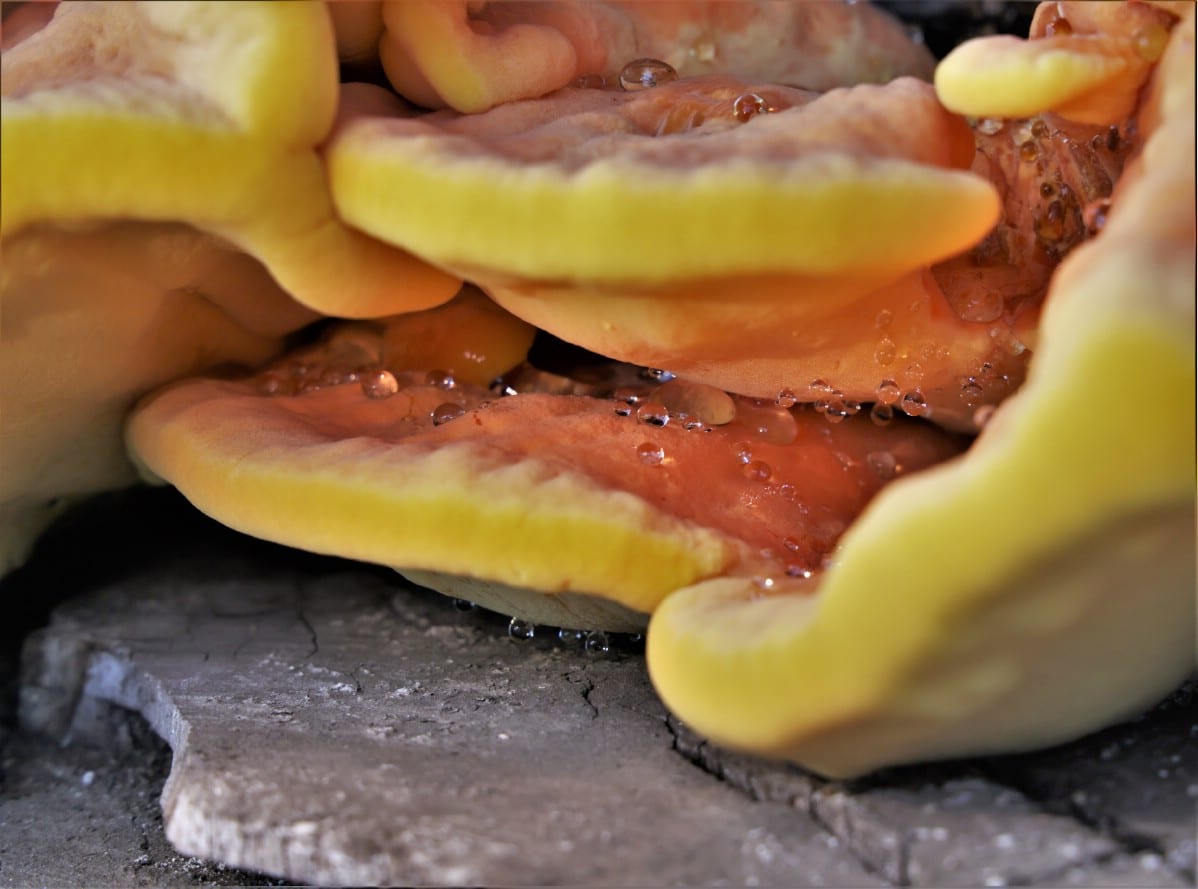
Chicken of the woods (Laetiporus gilbertsonii) starts appearing in mid-summer and continues through fall. It has a bright orange to yellow cap with bright yellow pores. Each fruiting is unpredictable in timing; that’s just how chicken of the woods is, so check the oak and eucalyptus groves regularly for the best success.
Where to look: Dead and dying oak and eucalyptus trees. Returns to the same tree or log each year.
→ [Full chicken of the woods guide]
Puffballs
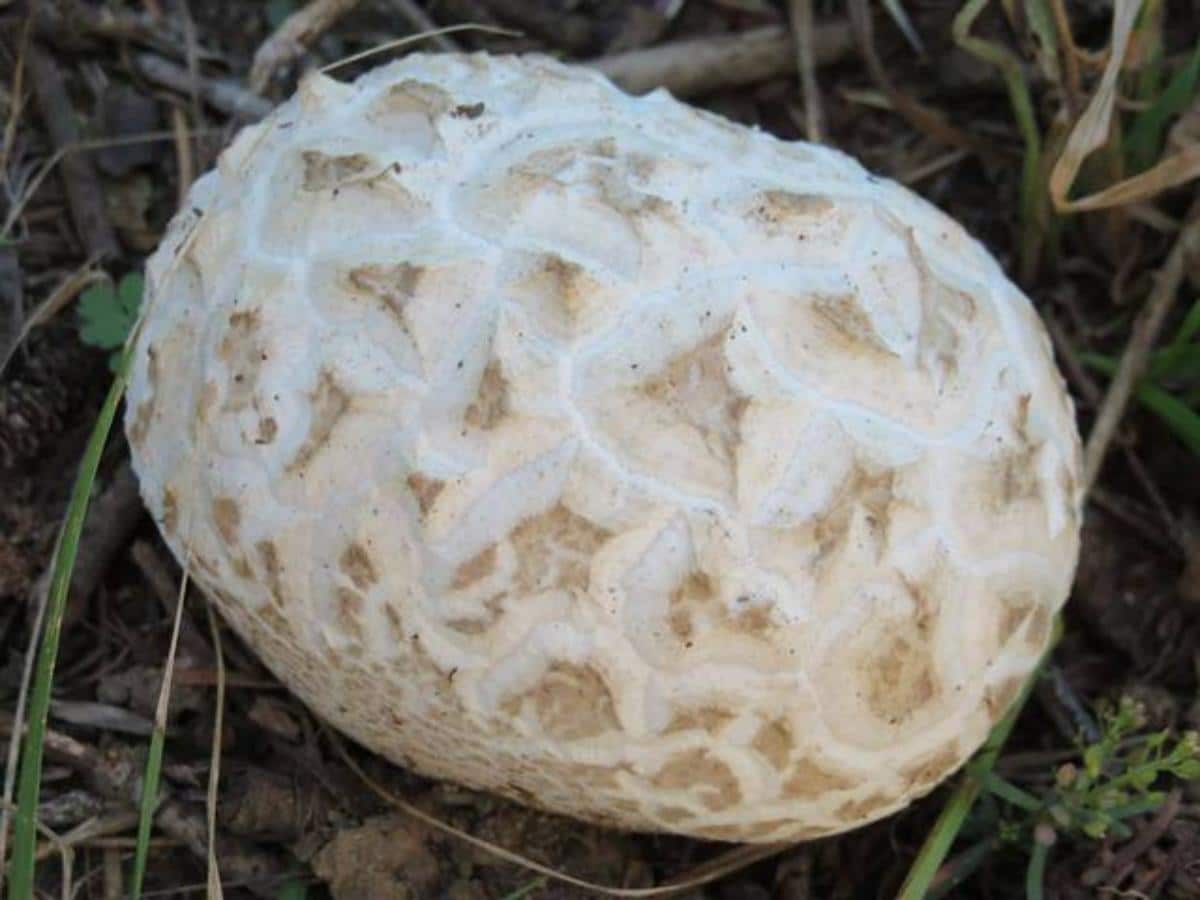
Puffballs appear pretty quickly after the monsoon rains; they love the moisture and are super fast growers. Before foraging any puffballs, check the interior to make sure it is all white. If it is yellow, brown, or purple, it is not good to eat and might make you sick.
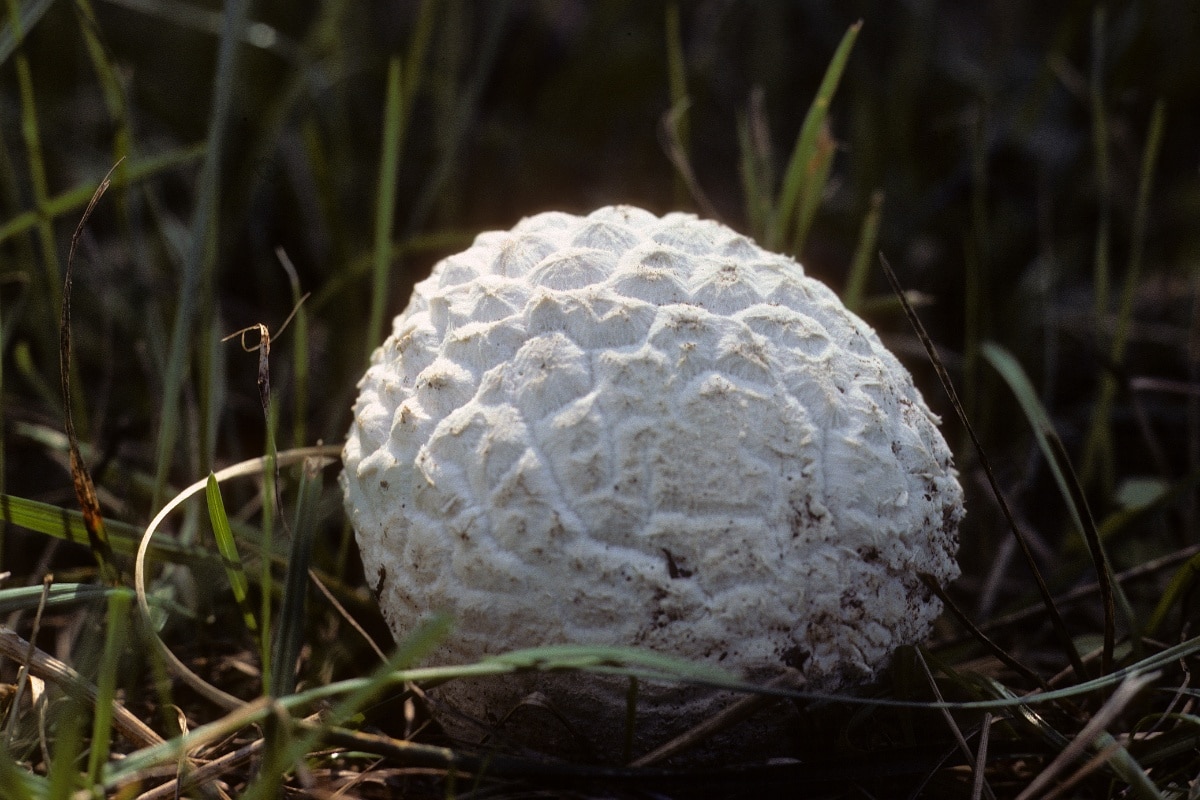
- Giant western puffball (Calvatia boonia) is 6 to 24 inches wide, all white, and round with polygonal points that make it look like it’s about to split.
- Purple-spored puffball (Calvatia cyathiformis) is softball to soccer ball sized and tan or light brown with a scaly outer skin.
Where to look: Open meadows and fields.
Lobster Mushrooms
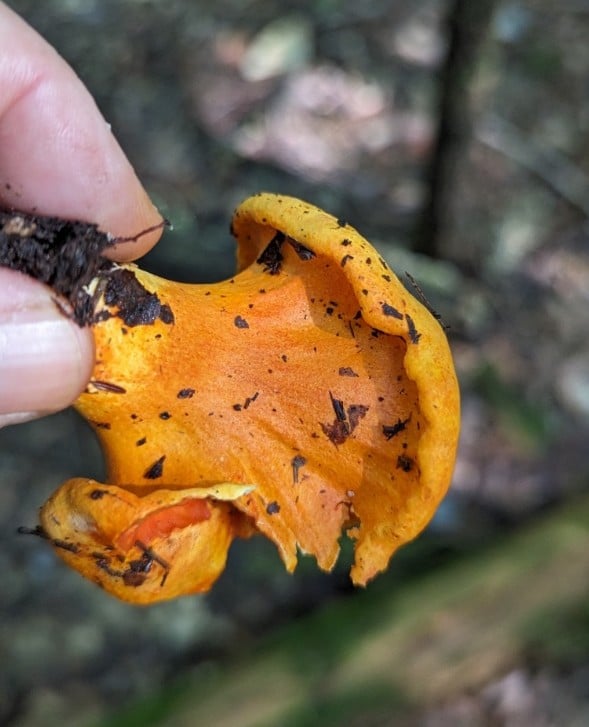
Lobster mushrooms fruit throughout the summer after good rains and return to the same location each year. They parasitize Russula species, so Ponderosa pine forests where Russulas grow are the best places to look. Keep an eye out for their distinctive lobster-shell red coloring poking out of the needle duff.
Where to look: Around Ponderosa pines. Look for humps in the needle debris.
→ [Full lobster mushroom guide]
King Bolete
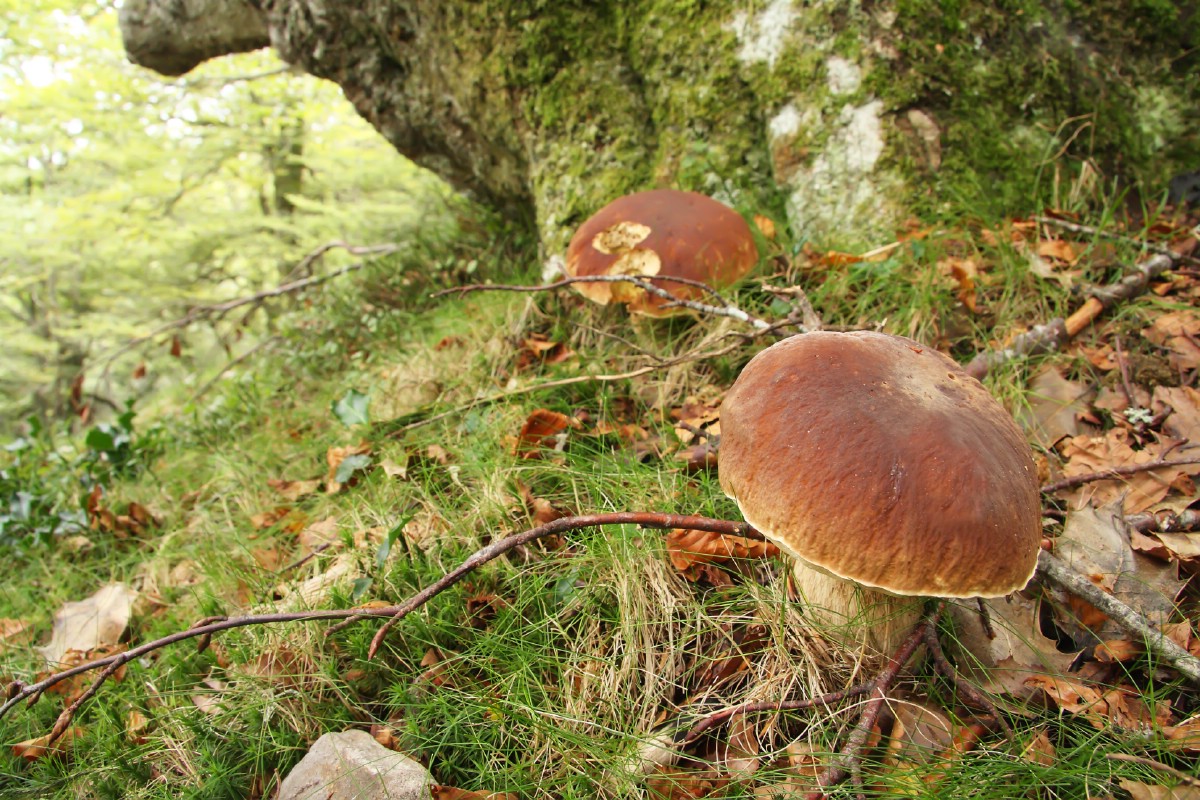
King boletes are summer mushrooms that fruit from late August through fall after lots of rain. They grow with conifers, pines, hemlocks, and firs, and also with beech, chestnut, and chinquapin. A strong monsoon season will bring them out in good numbers. If it is a drought or a low-humidity year, they may not appear at all.
Where to look: With conifers in the mountains.
White King Bolete (Barrow’s Bolete)
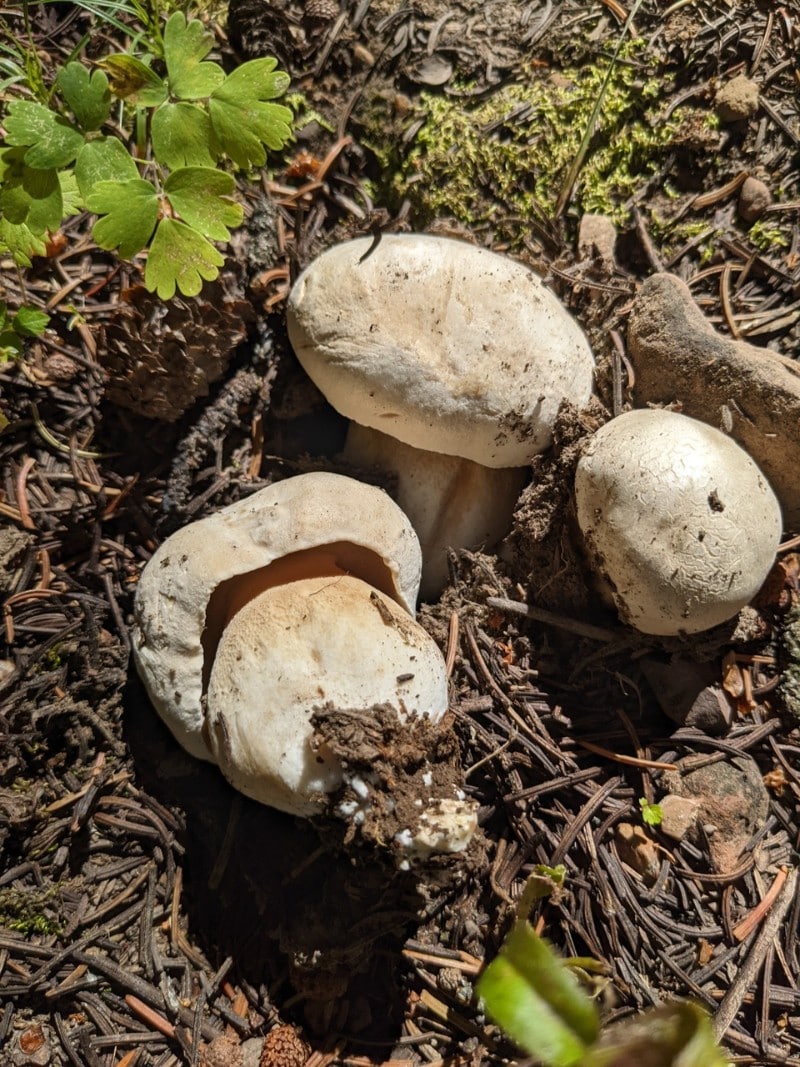
The white king bolete (Boletus barrowsii) is a close relative of the king bolete with an irregularly rounded or lumpy white cap. It appears in mid-August into fall, during or after the monsoon peak. Many foragers consider it better tasting than the standard king bolete. It grows alone or in wide, scattered groupings around Ponderosa pines.
Where to look: Around Ponderosa pines in mountain forests. Appears during or after the monsoon season.
When to Go Out Summer Mushroom Foraging
In summer, the best time to go foraging is two to four days after a good rainstorm. The rain soaks into the forest floor to get the mushrooms fruiting, then, with a few warm days following the rain, the mushrooms will flourish. In the Southeast and Midwest, the insects move in fast once the summer mushrooms are up, so the earlier end of that window, two to three days out, means less competition from slugs and bugs.
In all areas, if there are significant dry stretches, most species don’t show up at all. And, after a week without significant rain, it is generally not worth looking because there won’t be much out. The amount of rain matters as much as the timing. A brief shower is not enough to trigger significant fruiting; the mushrooms need a long, steady rain that penetrates deep into the forest floor.
At higher elevations, the seasonal timing shifts to later. In the mountains of the Pacific Northwest and Southwest, the cooler temperatures extend the mushroom fruiting window well past what lower-elevation sites can expect. In the Pacific Northwest specifically, the peak of the dry season falls in July, and pickings at low elevations are slim until fall. At higher elevations, there is more to find throughout the summer.
The Southwest doesn’t follow the same pattern as other regions. The mountain monsoon season runs from July to September, and the best summer mushroom foraging is after several days of sustained rainfall rather than a single storm. In a drought year or a weak monsoon season, the mountain species may not appear at all.
Leave a Reply