

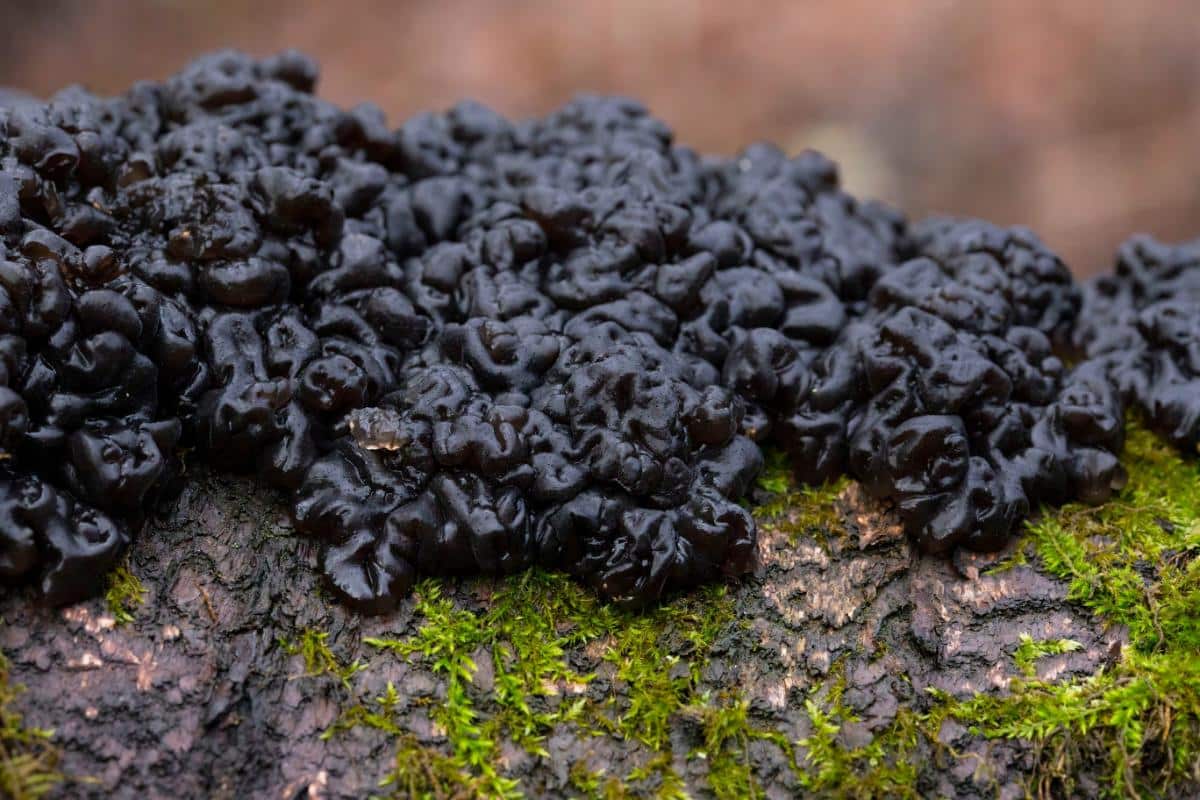
Finding black gelatinous blobs scattered across dead logs can be a little unsettling. They’re slimy and a bit gross, like someone dropped grape jelly on a branch or tried to coat it in tar. There are two species of black jelly-like fungi, appropriately named black witch’s butter (Exidia glandulosa) and warlock’s butter (Exidia nigricans). These two relatives look a lot alike and can easily be confused, but there are some key differences between the two when you look closely.
These two species grow across North America on the dead wood of broadleaf trees in parks, yards, and forests. They are not rare. If you are familiar with the much more well-known bright yellow witch’s butter, then you have a head start on these. They’re pretty much the same thing except they’re just black instead of yellow.
- Scientific Names: Exidia glandulosa, Exidia nigricans
- Common Names: Black witch’s butter, witch’s butter, black jelly roll, warty jelly fungus, warlock’s butter
- Habitat: Dead and dying hardwood branches and logs
- Edibility: Not poisonous
Jump to:
The Two Black Jelly Fungi
The separation between black witch’s butter and warlock’s butter taxonomically took a long time. For centuries, the two species were thought to be one, just with different fruiting forms. And so, they were lumped together under the name Exidia glandulosa.
The French naturalist Jean-Baptiste Bulliard was the first to describe the species to science in 1789 as Tremella glandulosa. The Swedish mycologist Elias Magnus Fries transferred it to the genus Exidia in 1822, creating the name Exidia glandulosa. The genus name Exidia comes from the Latin meaning “to exude” or “to ooze.”
This name from Fries included both forms of this fungus – the globular jelly form and a second, flatter, more spreading species. This muddled definition caused problems for well over a century.
In 1936, German mycologist Walther Neuhoff attempted to separate Exidia glanulosa into two separate species but assigned the names improperly. In 1966, the Dutch mycologist Marinus Anton Donk corrected the error and restored Exidia glandulosa as the name for the original species. The second species became Exidia plana, which was later renamed Exidia nigricans.
More recently, there has been even more confusion. Black witch’s butter and warlock’s butter are so similar under a microscope that you can’t tell them apart with just that. There were DNA studies done in 2001, and that study is commonly cited as saying they are two distinct species. There is a problem, though. That study doesn’t say anything of the sort.
So, what does this all mean? For some interesting insight, here’s more discussion on the subject. Whether future DNA research will confirm them as truly distinct or collapse them into a single species remains an open question.
The clearest evidence for treating them as separate species (if they actually are) is what can be seen in the field — they look slightly different, grow differently on the wood, and favor different host trees.
The name “witches’ butter” is tied to a folk belief that witches milk cows by night and scatter the butter they make in the process around, and that the dark blobs on dead branches were the evidence left behind. The name has also been applied to other gelatinous fungi as well, including the yellow Tremella mesenterica, which is part of why the common names surrounding these species have been so long confused.
Exidia nigricans was eventually given the separate common name Warlock’s Butter — a male counterpart to the witch — to distinguish it from Exidia glandulosa, the Black Witch’s Butter.
Black Witch’s Butter Identification (Exidia glandulosa)
There are many common names for this species. It’s commonly called just Witch’s Butter, but that can be confusing because of the yellow Exidia species that goes by the same name. It’s also known as Black Witch’s Butter, Black Jelly Roll, or Warty Jelly Fungus. The reason for “butter” in the name is because it feels greasy and smooth when it’s wet.
The species name glandulosa is from the Latin word glandula, meaning “little gland” or “acorn.” This is a reference to the small gland-like warts scattered across the upper surface of the fruit body.
Synonyms for Exidia glandulosa include Tremella glandulosa, Tremella spiculosa, Exidia truncata, Exidia spiculosa, and Gyraria spiculosa.
Season
Black witch’s butter can be found year-round in many places. It is most common in autumn and early winter, though.
Habitat
This is a wood-rotting fungus that grows on dead attached branches of broadleaf trees. It is most common on oak trees. It occasionally grows on hazel or beech but is rarely found on other tree species. It is what is known as a pioneer species — it can colonize recently dead wood and start the decomposition process earlier than many other fungi species. It is one of a small community of fungi involved in the early decay of dying branches on living trees.
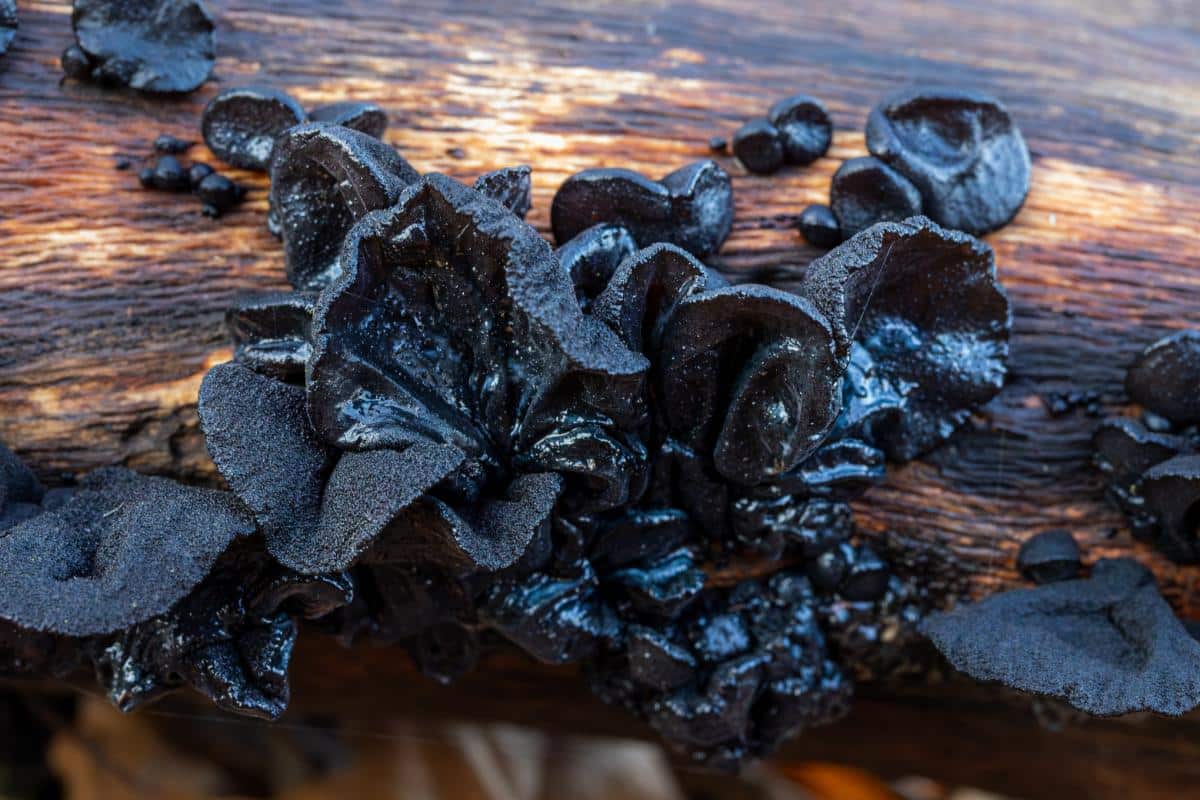
Black witch’s butter always grows on wood, never on the ground or from the soil. It commonly shows up in large, dense mats or clusters. It may fruit on its own, but more commonly, the fruiting bodies are so close together that they merge into one rubbery mass. It continues growing on fallen branches and logs even after they have fallen to the ground.
When it is rainy or wet out, the mushrooms will be at their full size — plump and jelly-like. In dry times, the fungus shrinks to a thin, hard black crust on the wood to conserve water. It often goes unnoticed when it’s like this. As soon as rain arrives, though, the bodies quickly revive and plump up again. The fruit bodies can expand and contract many times over the course of a season.
The exact distribution of this species isn’t entirely known, since it’s been so commonly confused with Exidia nigricens, the warlock’s butter. On iNaturalist, it is common east of the Rocky Mountains, and along the west coast, but seems uncommon in the rest of the western states. The species is widespread and common throughout the UK, Ireland, and most of mainland Europe.
Identification
Bodies
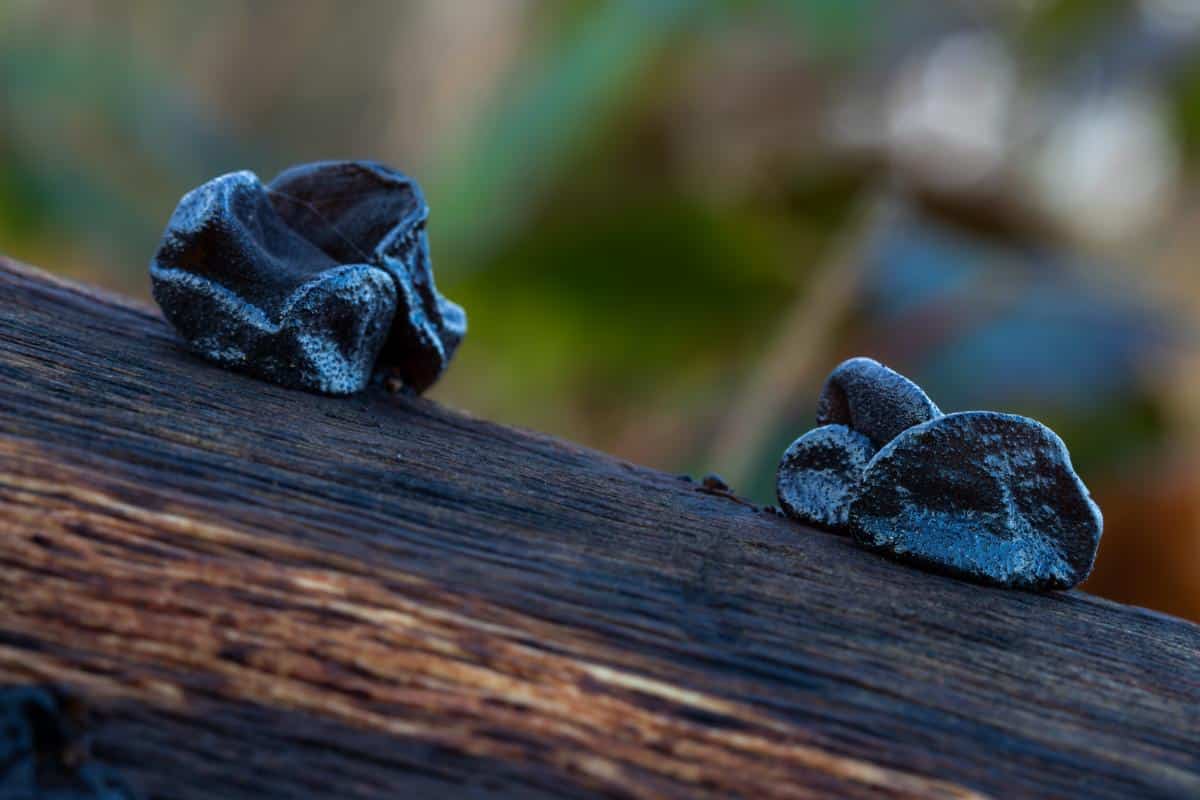
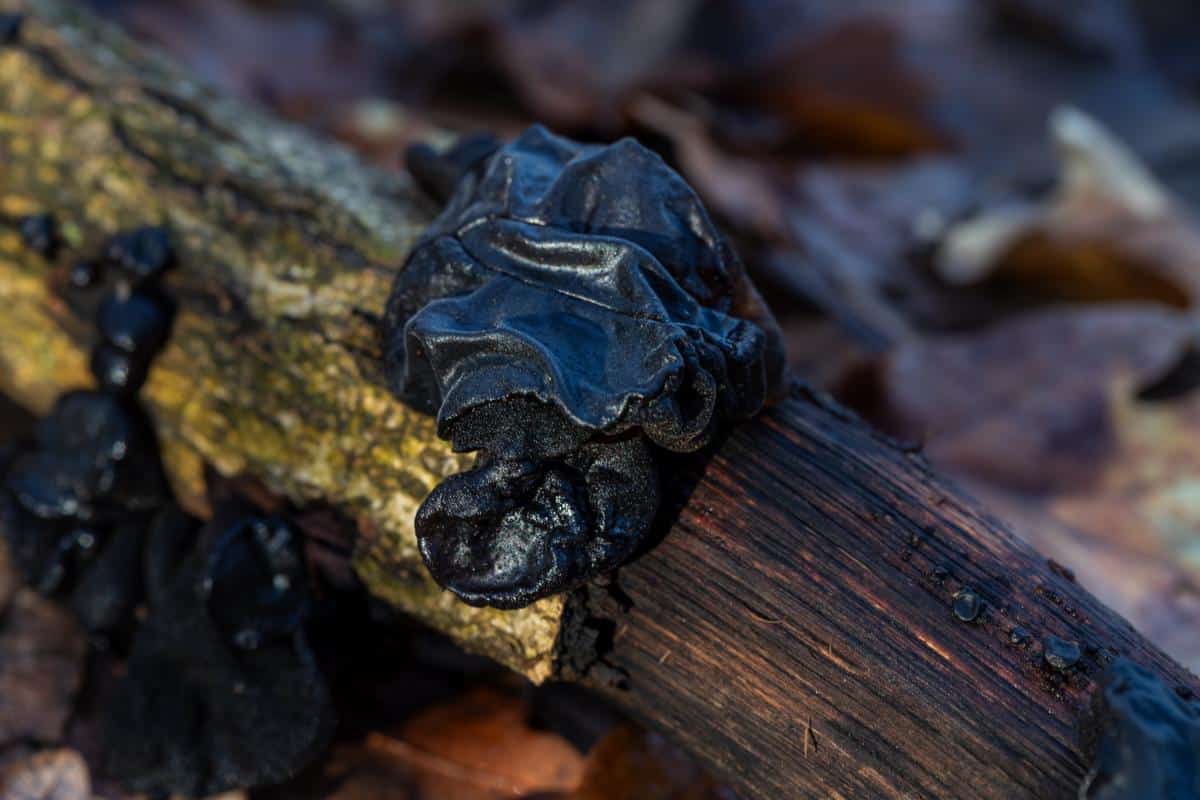
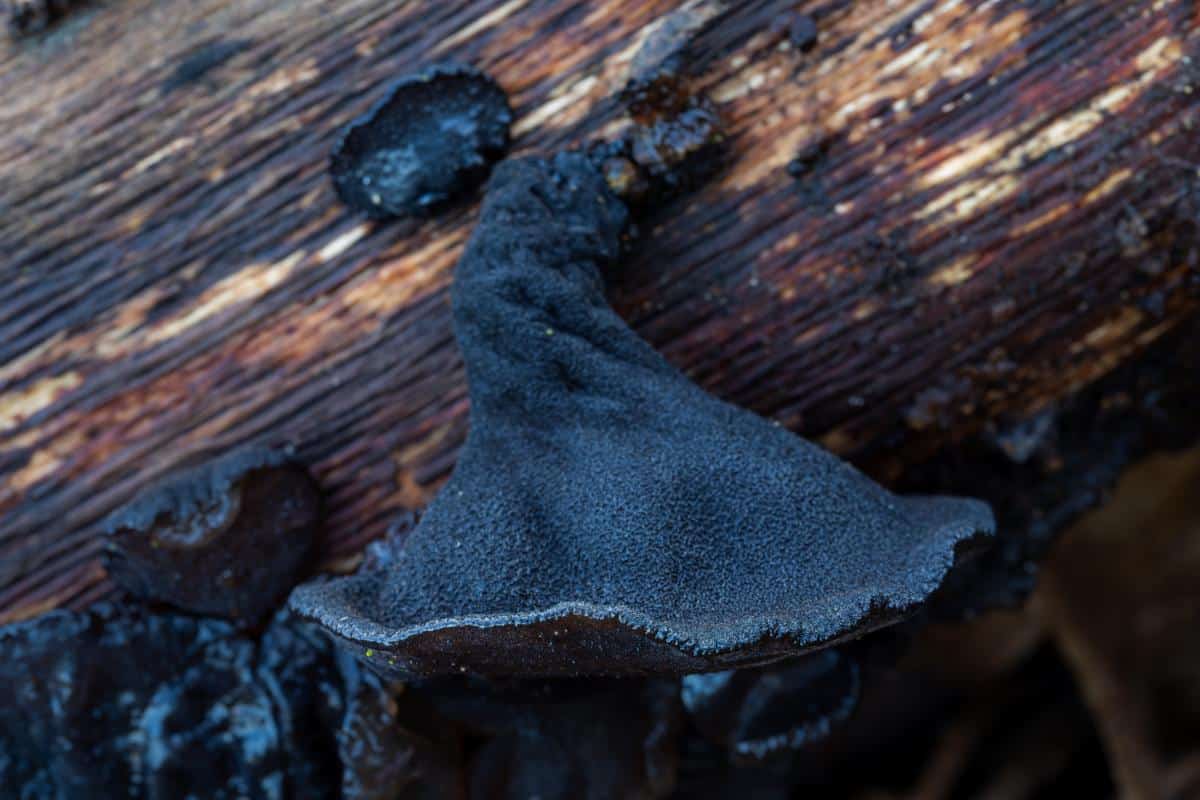
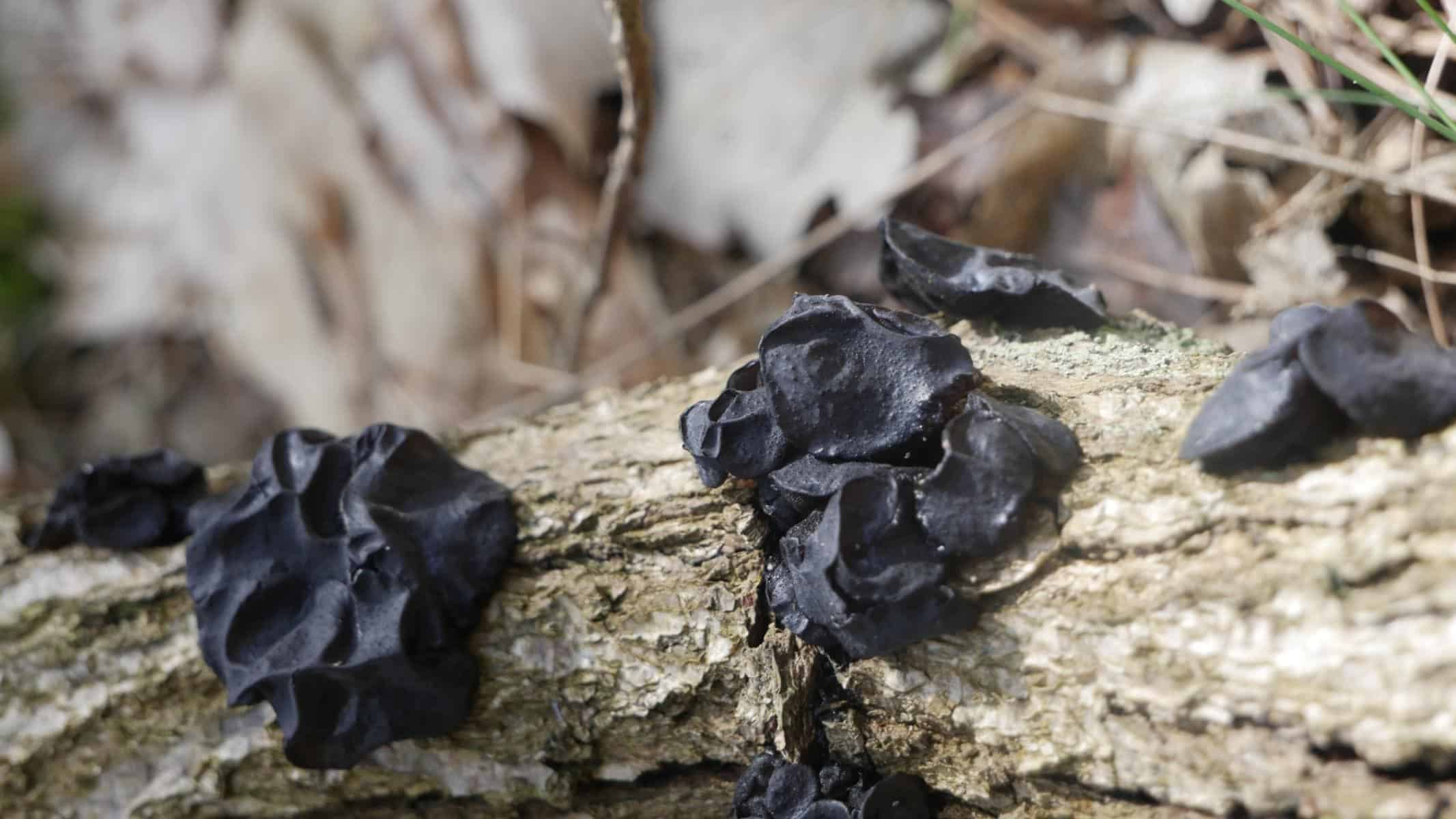
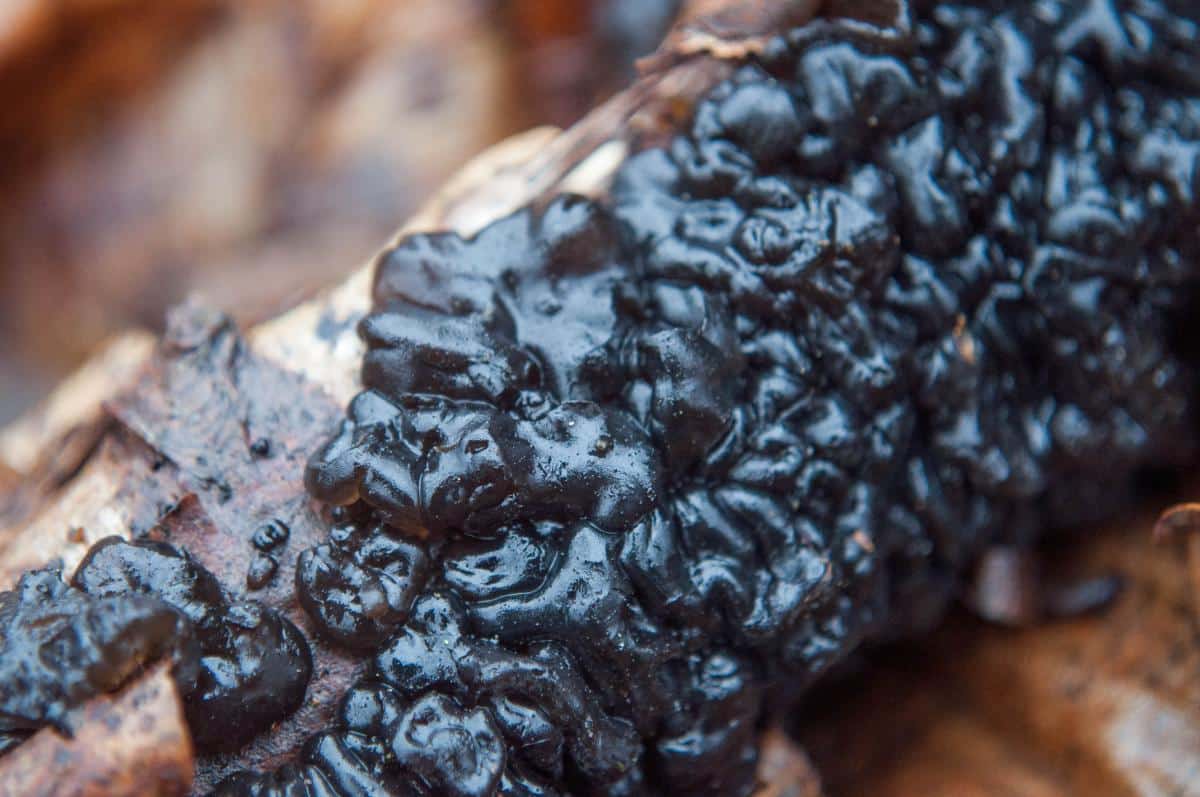
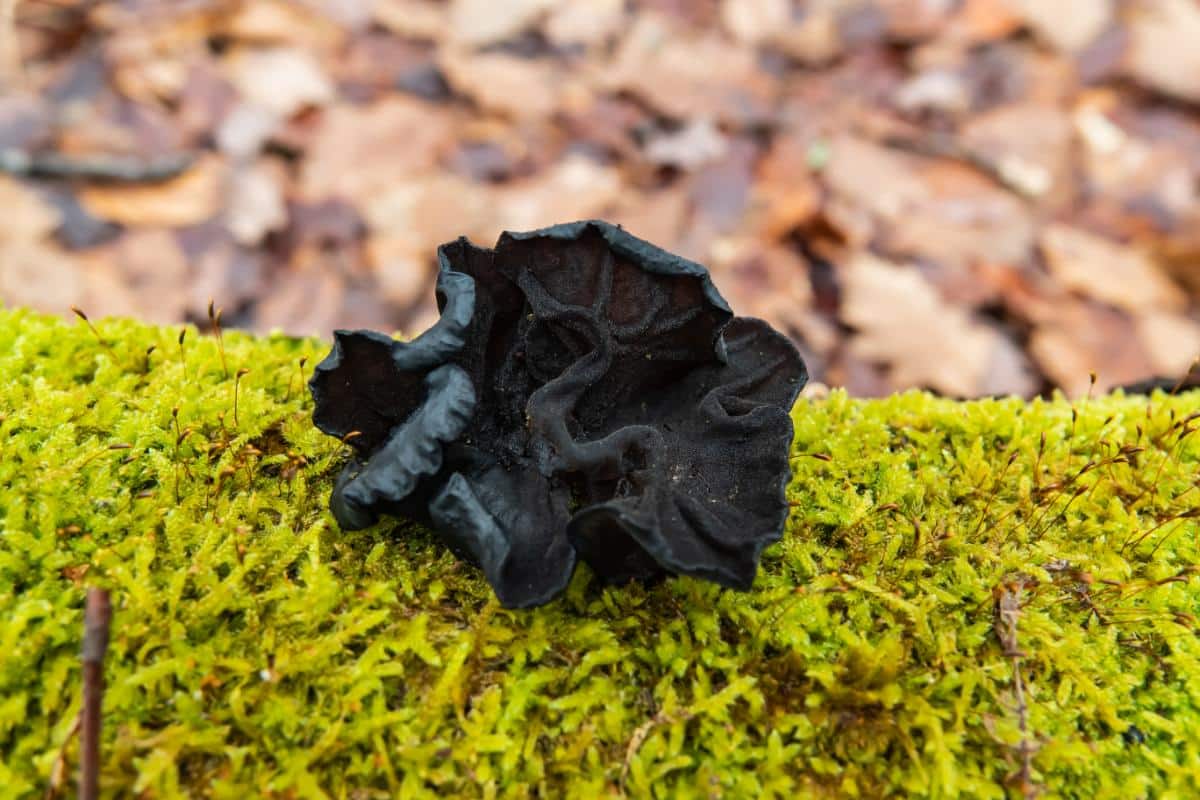
This is a jelly-like mushroom without a separate cap, stem, or gills or pores. It forms as one singular mass. The individual fruit bodies are top-shaped — they are wider at the top and narrow to where they attach to the wood. This makes them look like an inverted cone or an old-fashioned spinning top.
The fruit bodies grow up to about 1.2 inches across, and when they’re fresh, they are firm and rubbery. The texture is akin to gumdrops. With age or long periods of wet weather, the fruit bodies lose their defined shape and become gloopy and distorted.
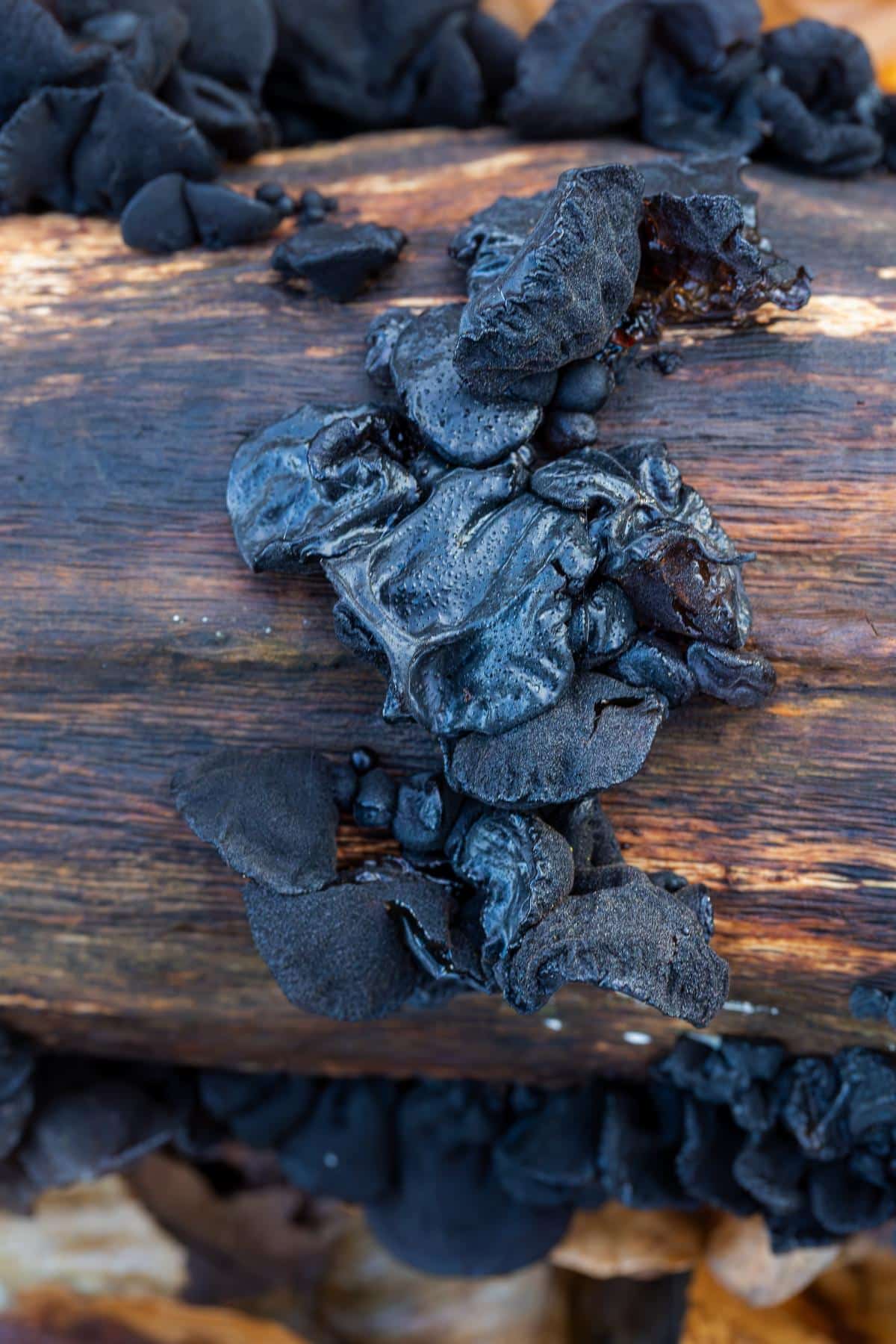
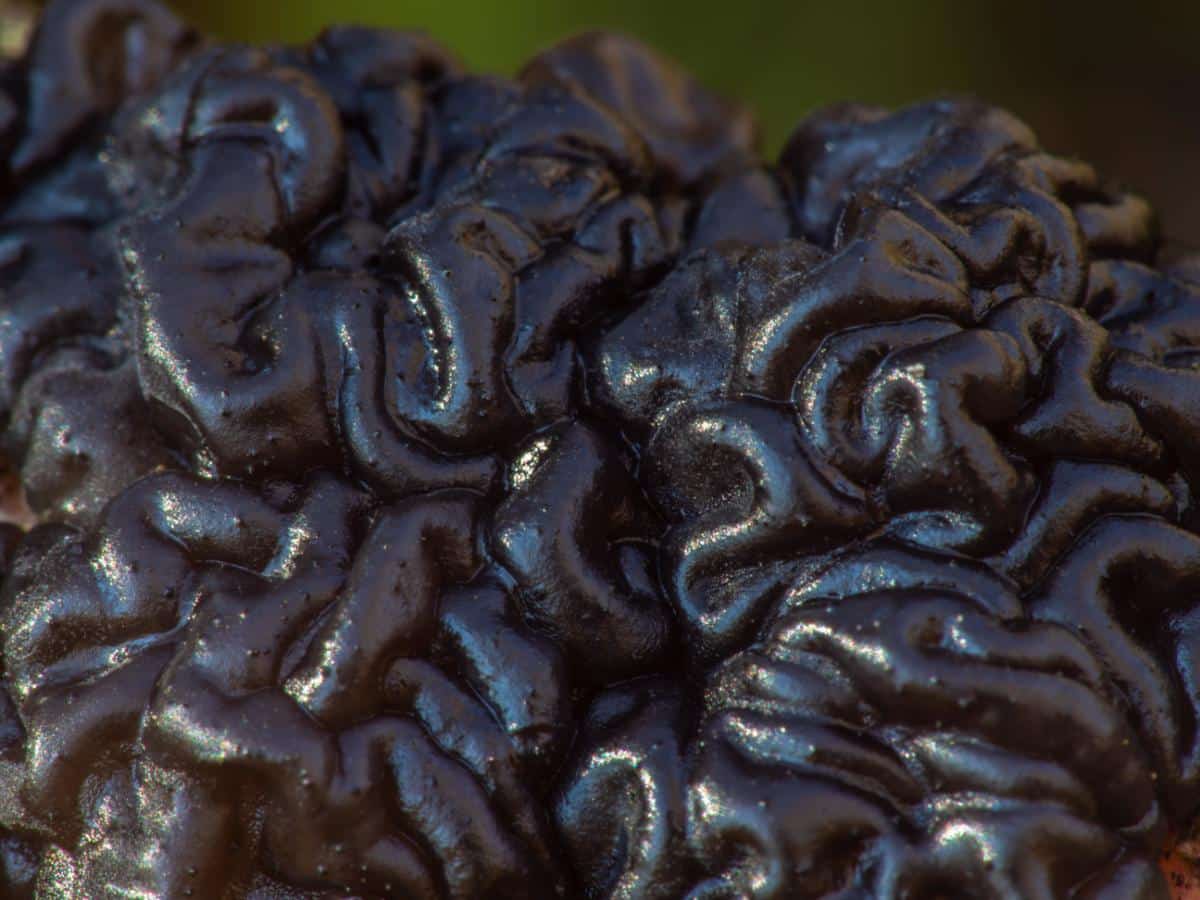
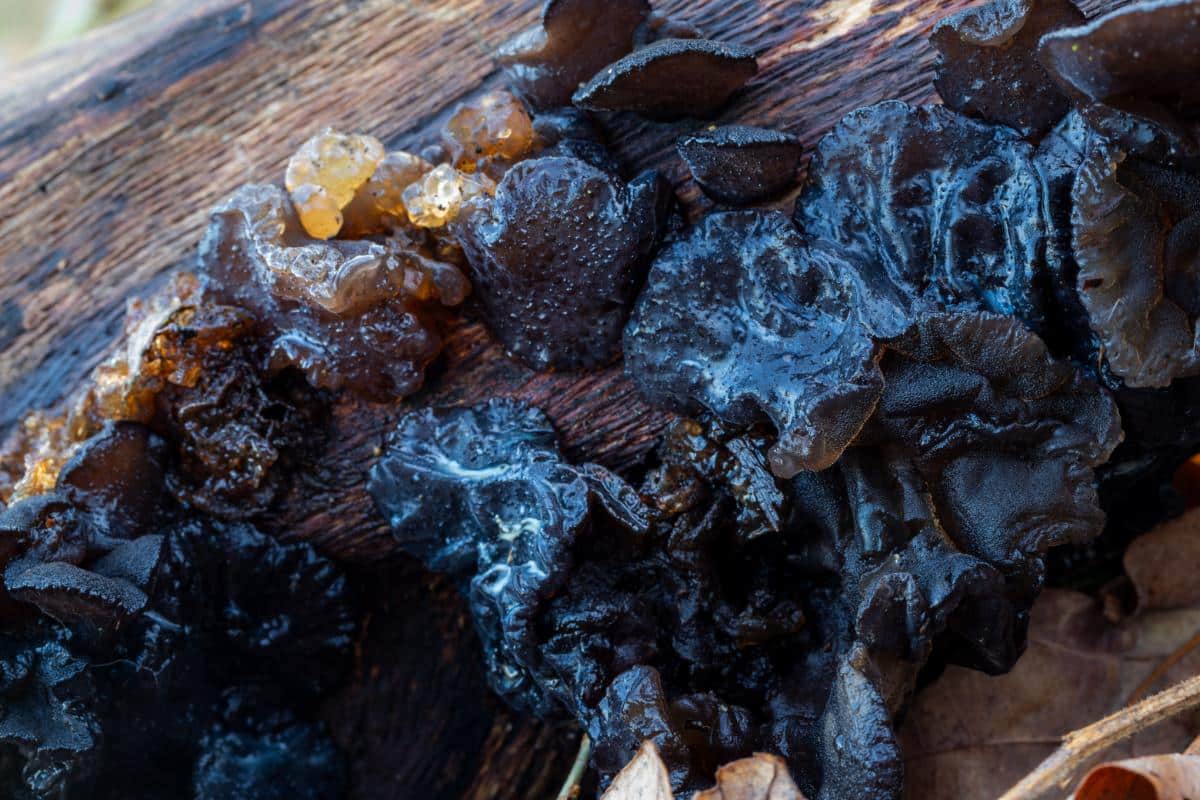
The upper surface of the black witch’s butter is shiny and ranges in color from dark sepia brown to jet black. It is covered in scattered small warts or pimples — these are the gland-like structures that give the species its name.
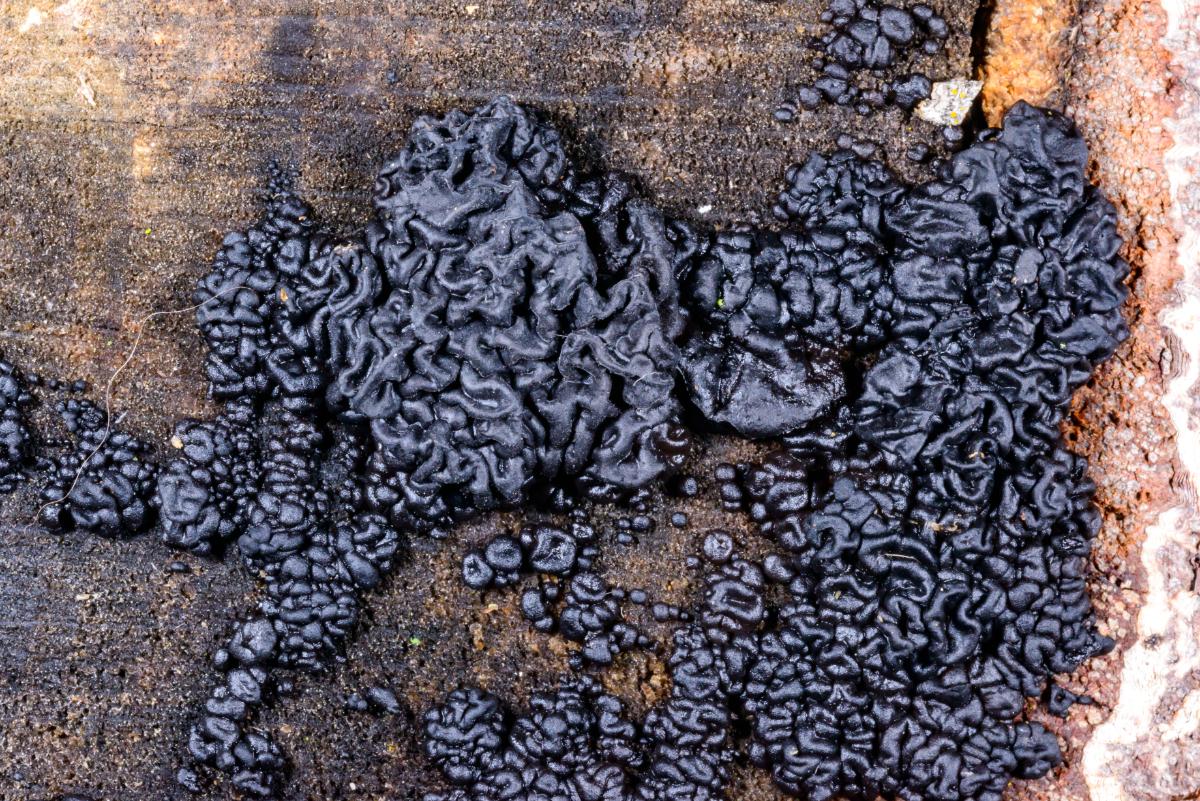
The underside of the fruiting body starts out smooth and matte but develops a covering of tiny gelatinous spines over time. The fruit bodies often grow in clusters and may fuse into elongated masses up to about 8 inches long. In dry conditions, they shrink dramatically. They will literally collapse and turn into flat, hard, olive-brown to black crusts barely visible against the wood surface.
Each fruit body is attached directly to the wood at its base by a small pinched point of contact. There is no stem.
Taste and Smell
Black witch’s butter has a mild smell and a bland, undistinctive taste.
Flesh Color and Staining
The flesh is dark sepia colored. It is rubbery and translucent when fresh, and hard and crusty when dry. It does not stain or change color when cut or handled.
Spore Print
The spore print is white.
Warlock’s Butter Identification (Exidia nigricans)
The species name nigricans comes from the Latin nigricare, meaning “to become black” or “blackening.” This is a straightforward reference to the fungus’s deep, dark color.
Synonyms include Tremella nigricans, Tremella plana, and Exidia plana. The name change is recent enough that many field guides and databases still list this fungus under Exidia plana.
Season
Warlock’s butter can be found throughout the year, but is most common and visible in autumn and early winter. Like black witches butter, it shrinks and hardens during dry periods, then revives rapidly once rain returns.
Habitat
This mushroom grows on dead attached branches and fallen logs of a wide range of broadleaf trees. Unlike black witch’s butter, it avoids oak and is most commonly found on beech, ash, and hazel, though it grows on many other deciduous species as well.
Warlock’s butter always grows on wood, never on soil or from the ground. It may fruit alone, but more often it fruits in large groupings and also often merges together to create one long black mass.
As with black witch’s butter, the exact distribution of this species in North America is difficult to establish because of the historical confusion between the two black jelly fungi. Also, like with black witch’s butter, warlock butter seems to grow widely east of the Rocky Mountains and then along the Pacific coastline, but is otherwise virtually absent in the western states.
The species is common and widespread throughout the UK and Ireland, across most of mainland Europe, and throughout much of the Northern Hemisphere.
Identification
Body
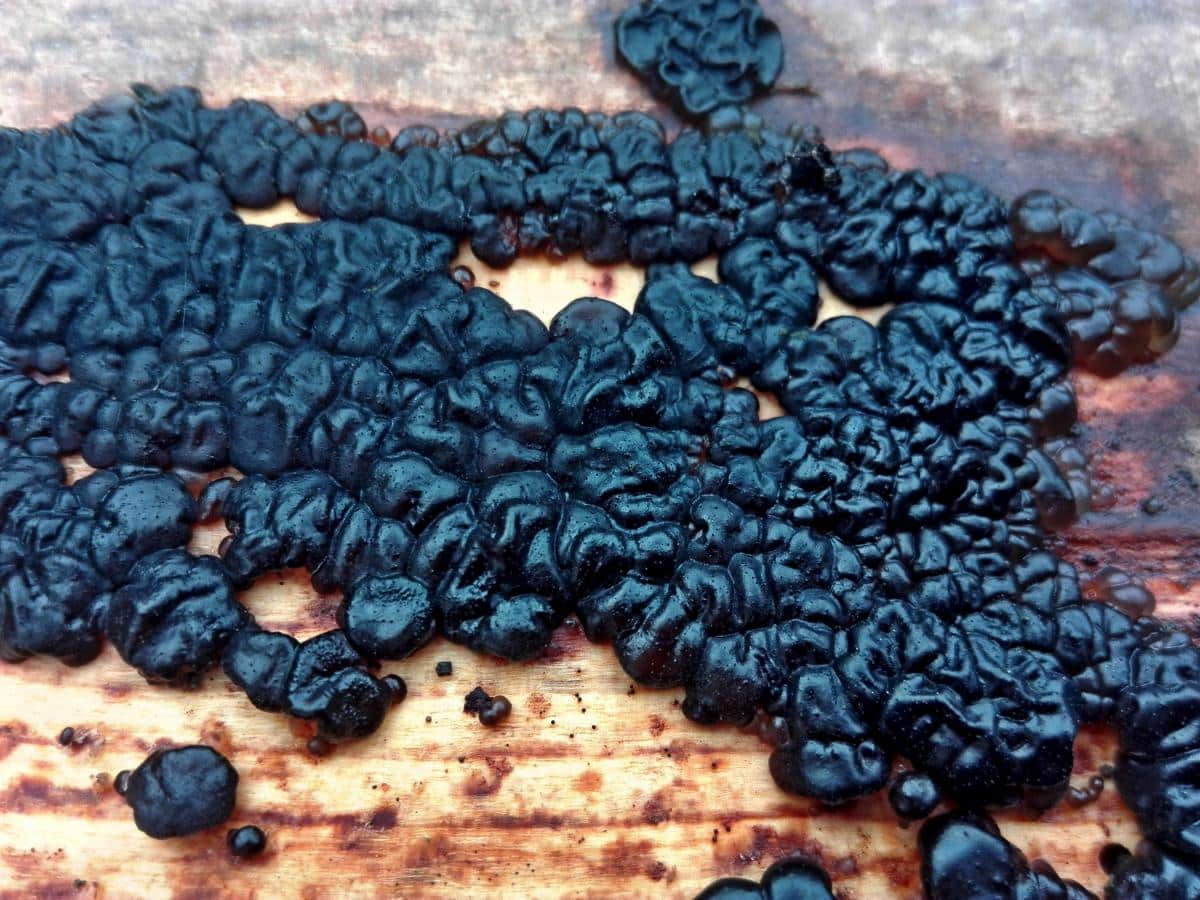
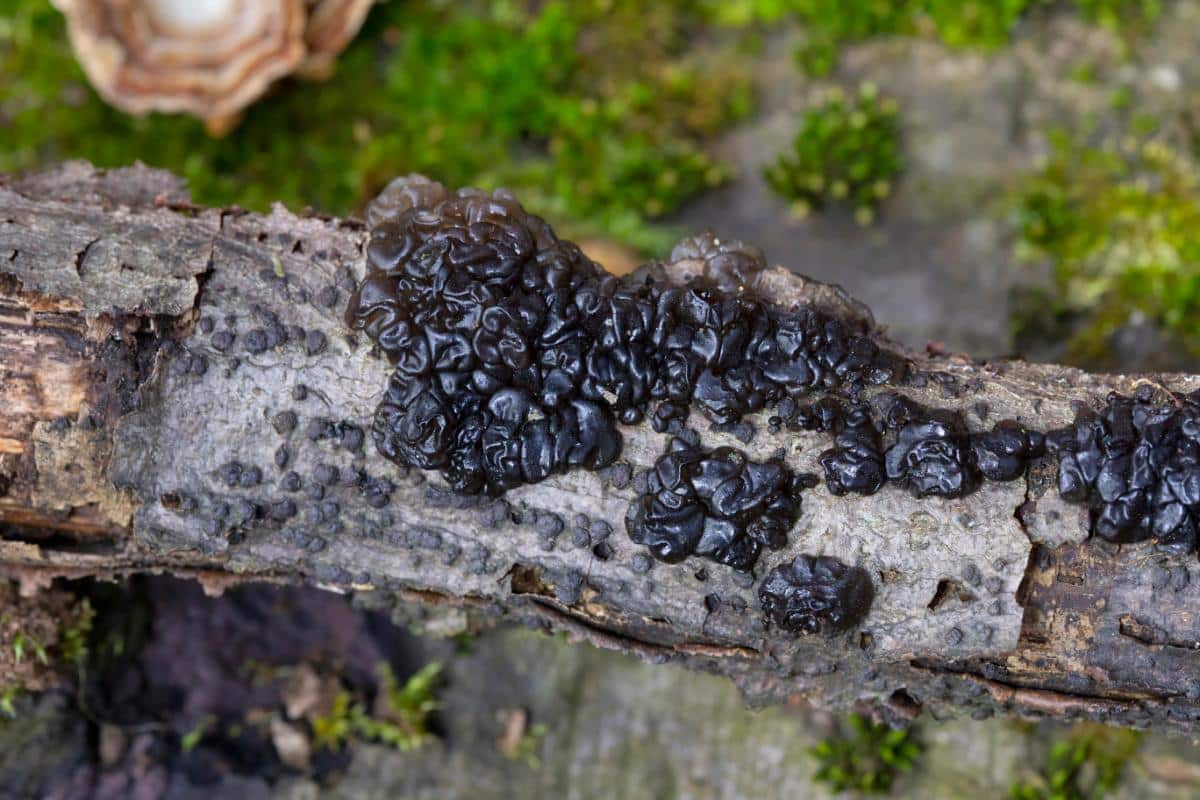
Warlock’s Butter is a jelly fungus with no gills, stem, or pores. Its fruit body attaches directly to the wood. The individual fruit bodies of this mushroom start out as small, rounded, button-like blobs roughly 0.4 to 0.8 inches across. They are dark sepia to jet black and have a shiny, gelatinous surface dotted with small pimples or pegs.
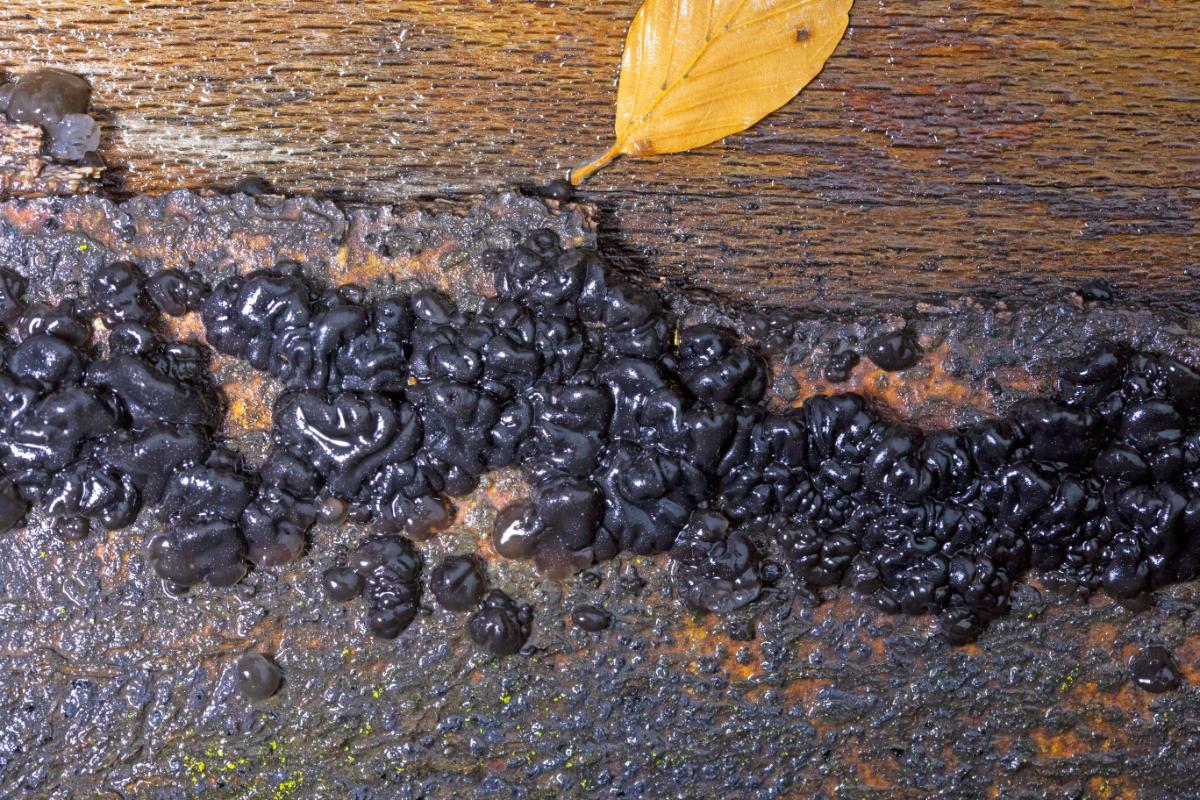
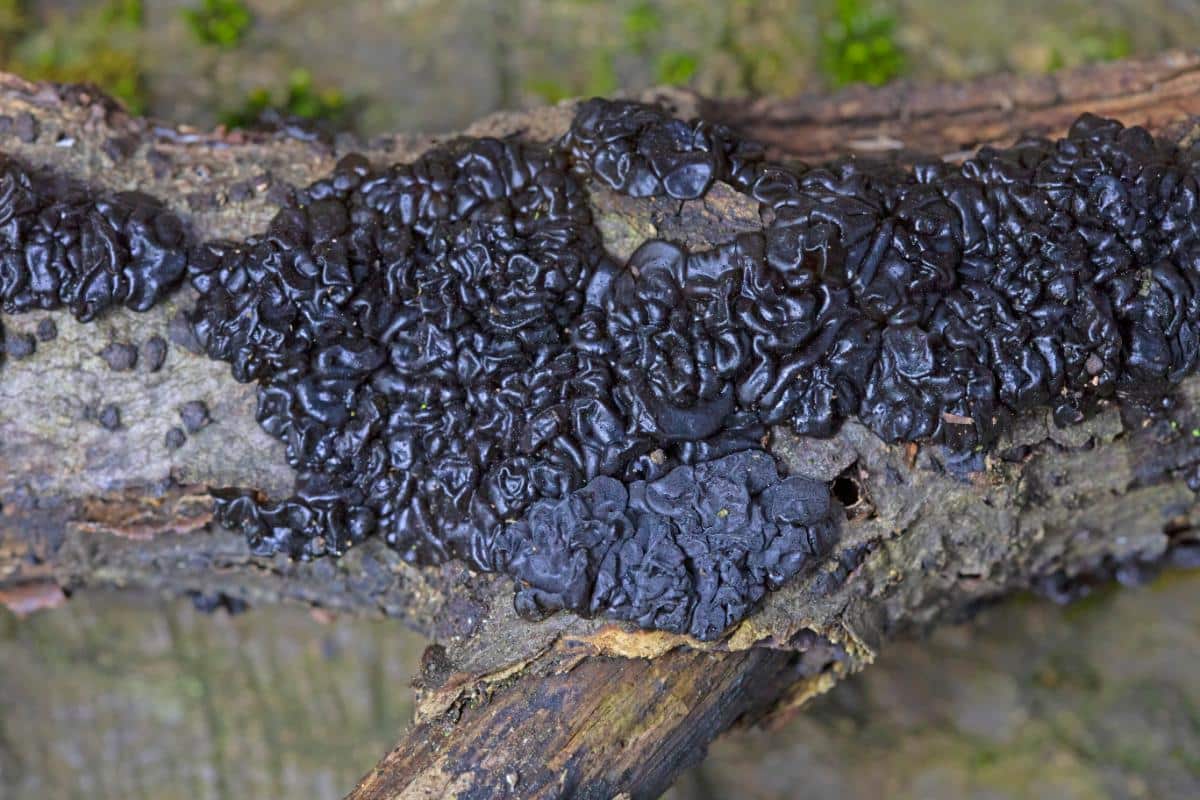
As the fungus matures, the individual buttons collapse outward and fuse together. They spread into a large, irregular, brain-like mass that can reach 8 inches or more across. This fused together form hugs the wood surface tightly, creating an extensive dark patch with brain-like wrinkles and folds. The merged mass will still retain the small pegs on its surface.
In dry weather, warlock’s butter shrinks to a thin, dark crust and then rehydrates and re-expands in rain.
Taste and Smell
Warlock’s Butter has no distinctive taste or smell.
Flesh Color and Staining
The flesh is black and gelatinous throughout. It does not stain when cut or handled.
Spore Print
The spore print is white.
Lookalike Species
Black Jelly Drops / Black Bulgar (Bulgaria inquinans)
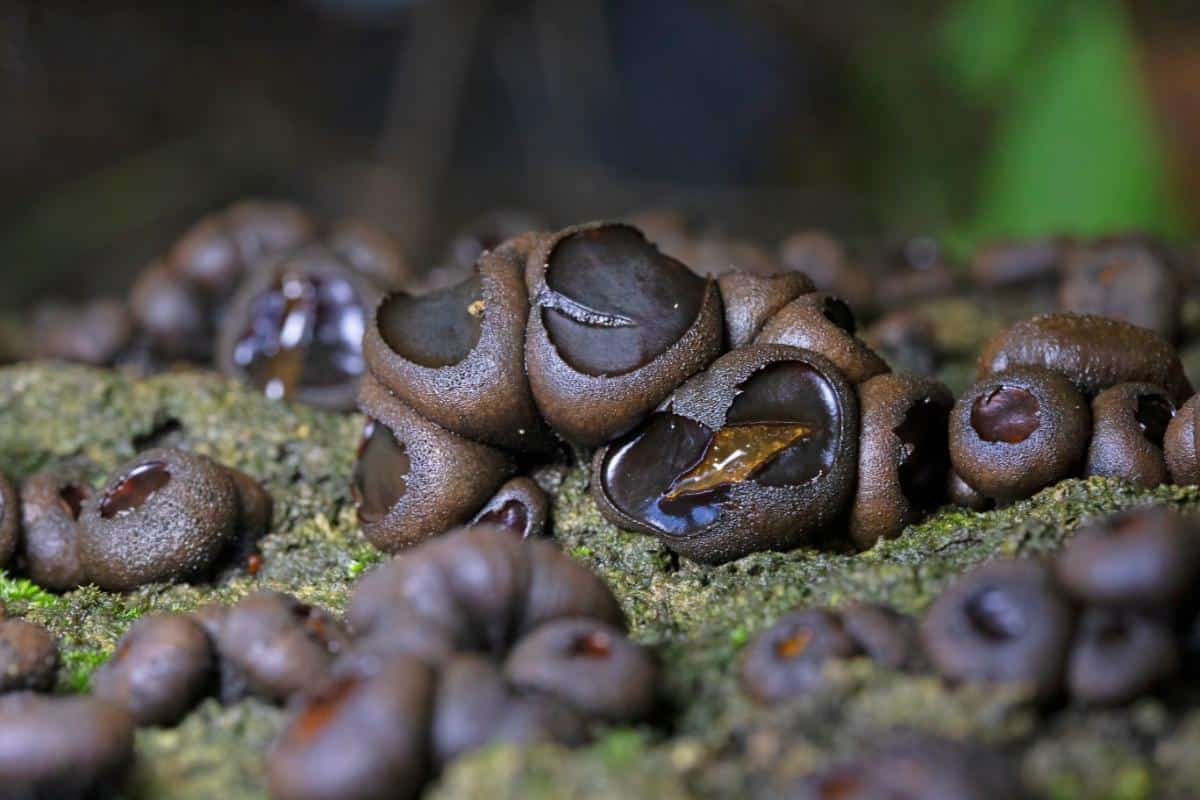
Black jelly drops, aka black bulgar, or rubber buttons, are also black and grow in clusters on dead oak and other hardwoods. It is also roughly the same size and shape as black witch’s butter. The two can even grow on the same logs.
However, black jelly drops are a cup fungus, not a jelly fungus, and the differences are clear on close inspection. The fruit bodies of black jelly drops are shaped like small, round cups or discs. They have a rough outer surface and an entirely smooth upper surface — no warts or pimples of any kind. Black jelly drops also have black spores that will stain the hands when the fungus is mature, and they have a black spore print. Black witch’s butter has a white spore print and does not stain.
Willow Brain/Amber Jelly Roll (Exidia crenata)
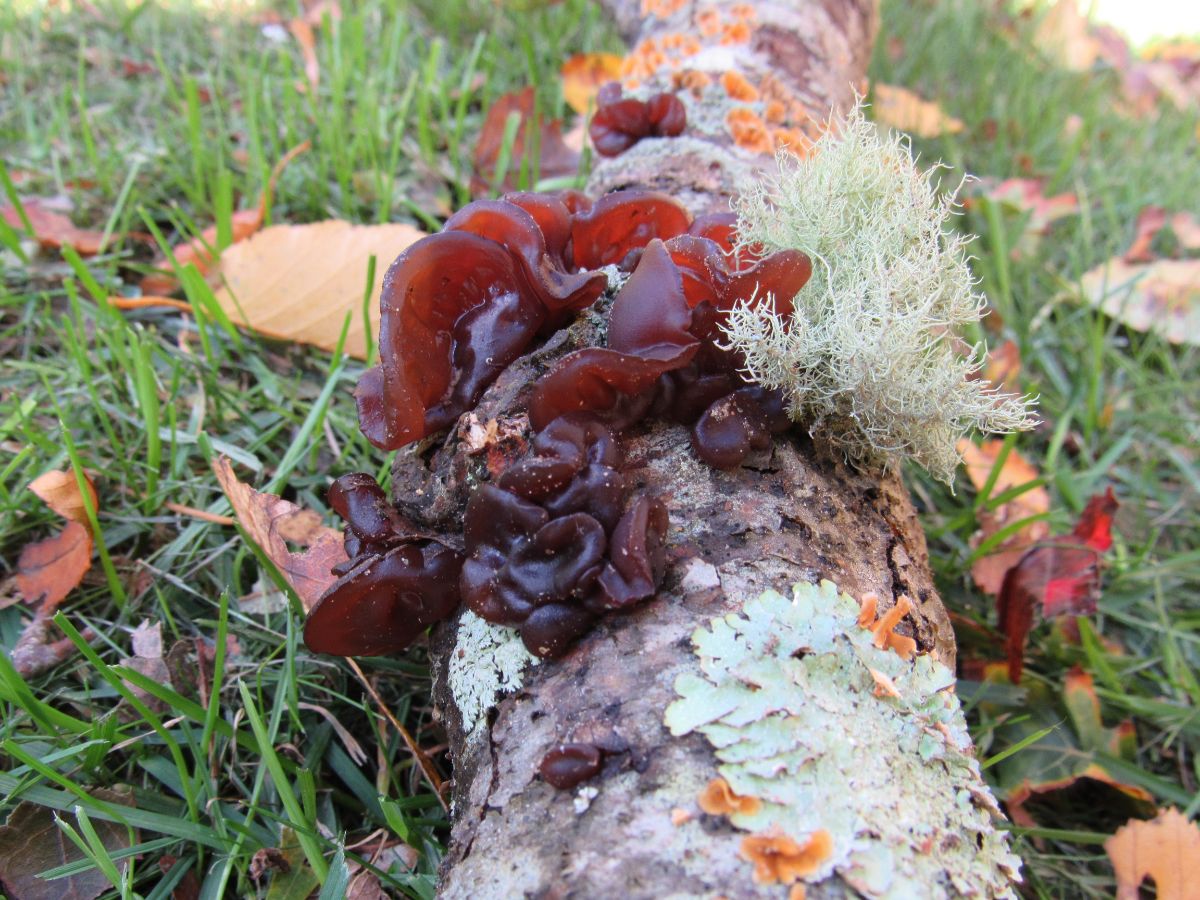
The willow brain is a close relative that grows on dead willow and alder branches. It has the same gelatinous texture as witch’s butter but is a lighter color. It ranges from reddish-amber to reddish-brown to dark brown.
Willow brain fruit bodies also tend to sit more erect, with a more rounded or cushion-like shape. They aren’t as gelatinous or globular. The surface of these mushrooms also lacks the distinct small warts that are on black witches’ butter. The lighter color alone is usually enough to separate the two.
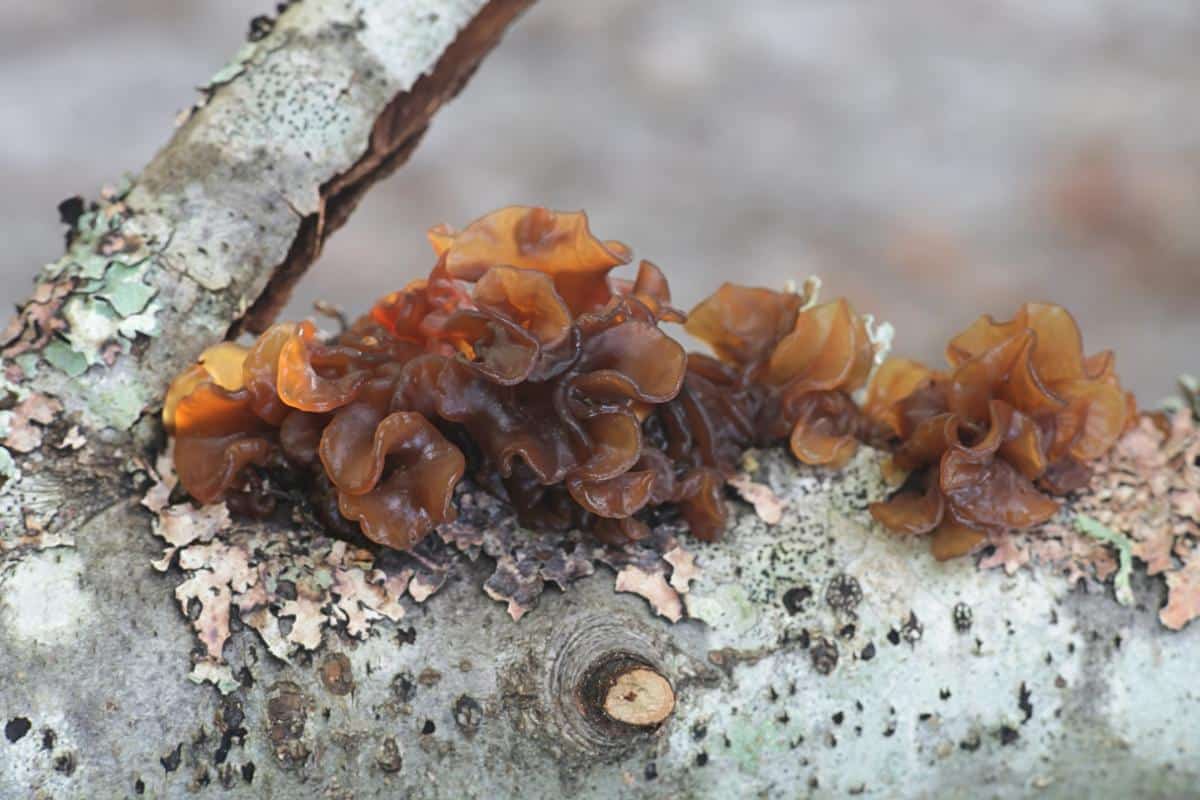
Leafy Brain Fungus (Phaeotremella foliacea and Phaeotremella frondosa)
The leafy brains are also gelatinous species that are usually brownish, but can also be dark sepia to black in color. They have a distinctly different growth form, though. Their fruit bodies are lobed or frond-like and look like ruffled leaf lettuce or a brain with pronounced flat lobes. They never have the small warts or pegs on the surface that both Exidia species have.
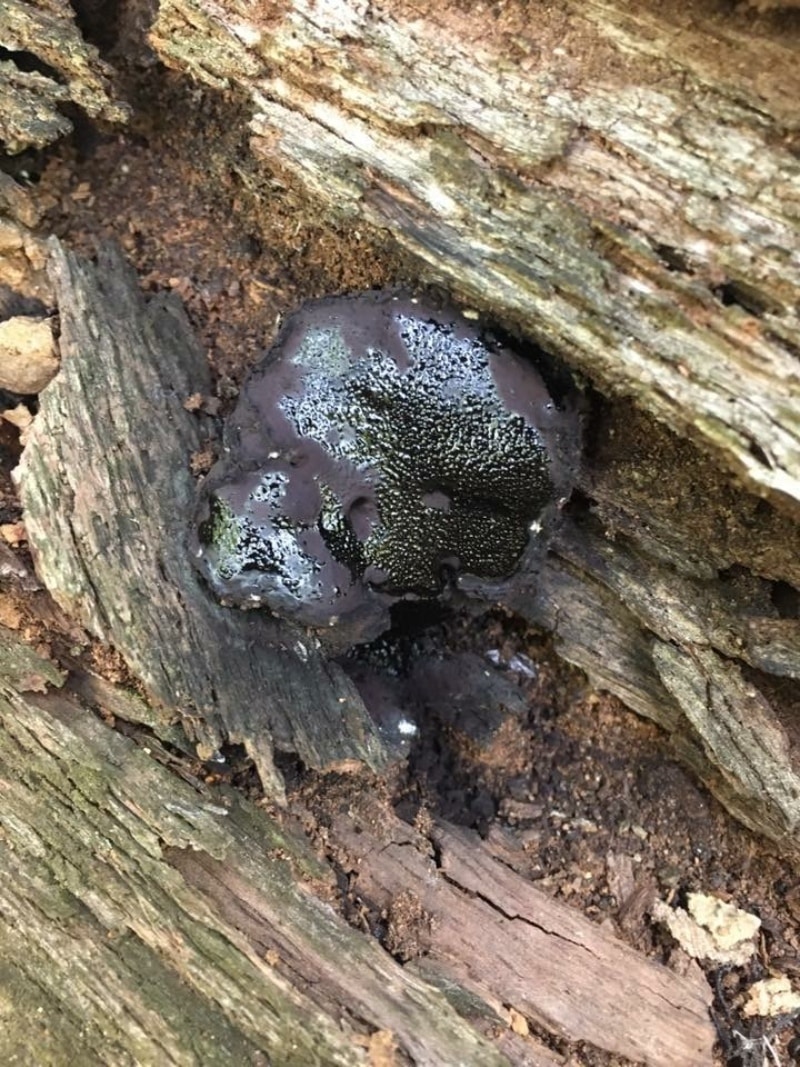
Non-Gelatinous Black Fungi (Annulohypoxylon, Biscogniauxia, Hypoxylon)
Several other fungi produce black, crust-like growths on dead hardwood that could briefly be mistaken for dried-down witch’s or warlock’s butter. Annulohypoxylon, Biscogniauxia, Camarops, and Hypoxylon are all ascomycetes that form hard, non-gelatinous black crusts or cushions on bark. They do not have the rubbery, bouncy feel of a jelly fungus, and they do not rehydrate and swell in rain the way Exidia species do. Running a finger across the surface or pressing gently will usually make the texture difference obvious, even when the warlock’s or witches butter is mostly dried out.
Culinary Uses
Most guides list these species as inedible. They’re not poisonous or toxic. It’s just their texture, bland taste, and small size don’t spark a lot of culinary interest. However, their sister species, the yellow witches butter, is often foraged to make jelly candies and add as filler to soups.
There are reports of foragers collecting black witches butter and warlock’s butter to give them the same jelly candy preparation with good results. All in all, there isn’t a lot of information about folks collecting these for any culinary purpose.
Comparing Black Witch’s Butter and Warlock’s Butter
How to Tell Them Apart
DNA studies have confirmed (for now) that black witch’s butter and warlock’s butter are distinct species, but under a standard microscope, they are effectively identical. The differences are visible to the naked eye, but can be hard to separate out depending on the age and condition of the specimen.
Shape
Shape is the single most reliable difference. Black witch’s butter tends to form individual, three-dimensional, top-shaped (turbinate) fruit bodies that keep their individual form even when growing in close groups. Each one is rounded at the top and pinched at the base, like a spinning top or an inverted cone.
Warlock’s butter starts as small, rounded buttons but almost immediately collapses and spreads outward. The individual blobs merge into a flat, brain-like, spreading mass that coats the surface of the wood.
Once fully developed, warlock’s butter looks like a patch of dark, wrinkled, spreading jelly, while black witch’s butter looks more like a group of separate, raised, black blobs.
Host Tree
Host tree preference is the second most useful field character. Black witch’s butter grows primarily on oak. Warlock’s Butter avoids oak and is more likely to be on beech, ash, or hazel. When the host tree can be identified, it might give some clue as to the species.
Surface Texture
Both species have small warts or pegs on the upper surface, so this feature does not distinguish them. However, the surface texture of warlock’s butter is more likely to have pronounced brain-like folds and wrinkles. Black witch’s butter’s upper surface may have pit-like depressions between the warts. In practice, these differences are subtle.
Common Questions About Black Witch’s Butter Fungus
Is black witch’s butter medicinal?
There are no studies exploring the medicinal potential of Exidia glandulosa or Exidia nigricens.
Are Black Witch’s Butter and Warlock’s Butter the same mushroom?
They are two distinct species that have been confused with each other for centuries. Both are black, gelatinous, and grow on dead hardwood. However, DNA research has confirmed they are separate species (for now).
Is black witches butter mushroom edible?
Both black witch’s butter and warlock’s butter are classified as inedible in most field guides. They are not toxic, but they are almost entirely water-filled gel with no flavor or nutritional value.
Leave a Reply