
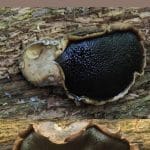
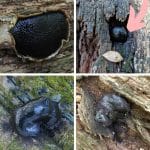
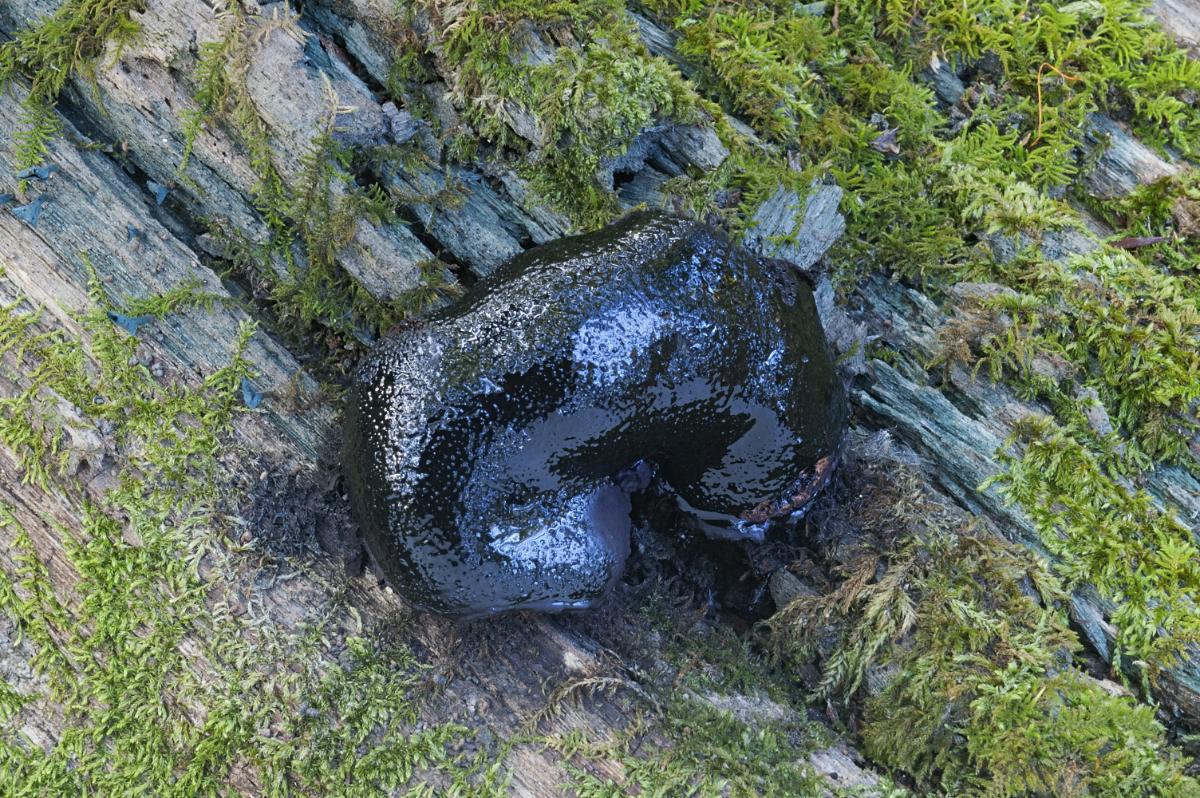
The dog’s nose fungus (Camarops petersii) is for sure one of the most bizarre-looking fungi species found in the woods. This fungus has an uncanny resemblance to an actual dog’s nose: the surface is black, wet, shiny, and covered with tiny pimples, just like the snouts of the real thing. Maybe this is Mother Earth’s ode to our beloved canine companions? Even though it has no place on the dinner table, we love finding dog’s nose fungus because it is a sweet reminder of our furry companions.
This species grows primarily in eastern North America, from New England down through the Appalachian Mountains and west to Kansas. And it is reported from Cuba, Japan, Russia, and parts of Europe. It was once considered quite rare in the Northeast, but it has become more frequently spotted in recent decades. This may be because foragers have learned what to look for, combined with the fact that old forest logs tend to stay undisturbed in the forest longer than they once did.
The dog’s nose fungus looks like a mushroom but is actually a completely different type of fungus (not all fungi are mushrooms). Instead of producing spores on gills or pores like mushrooms do, it grows spores inside its body in tiny chambers buried within its flesh. It is called a perithecial ascomycete fungus.
- Scientific Name: Camarops petersii
- Common Names: Black licorice drops, eyeball fungus,
- Habitat: Decaying oak logs
- Edibility: Inedible
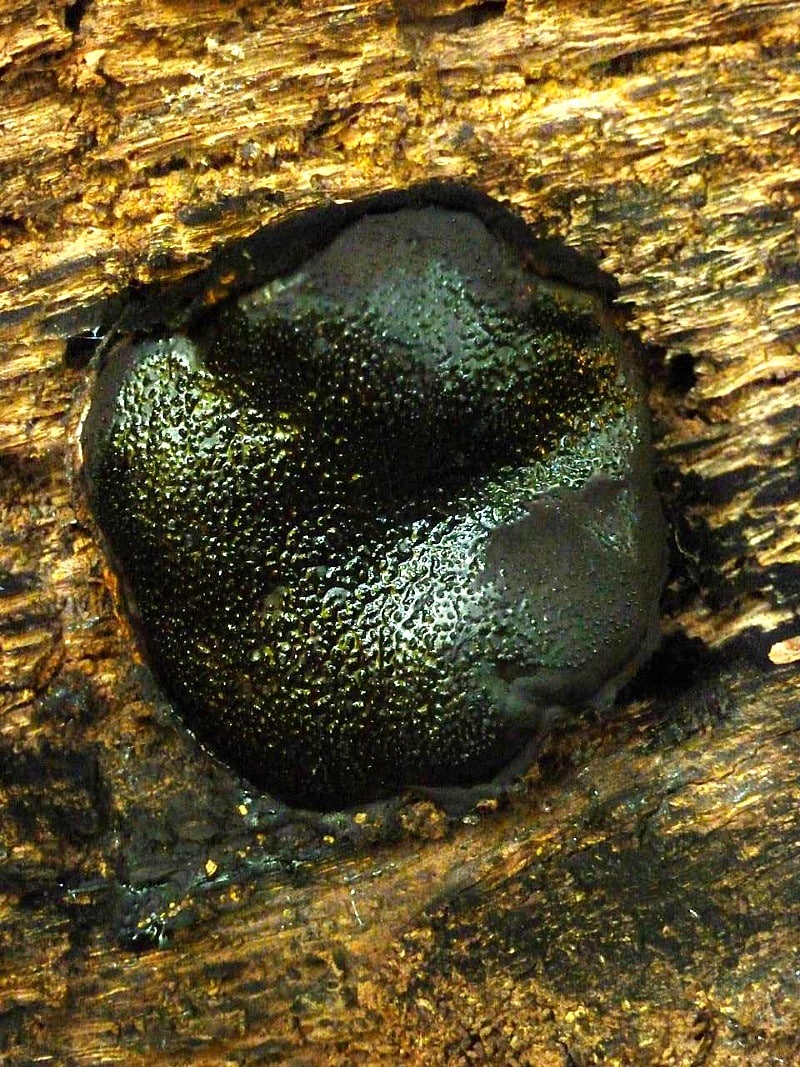
Camarops petersii by William Tanneberger on Mushroom Observer
All About Dog’s Nose Fungus
This species was first described to science in 1869 based on specimens collected in Alabama during the 1800s. The genus name Camarops comes from Greek and means arched or vaulted, which is a reference to the chamber-like structures in the fungus’s body where spores develop.
Dog’s nose fungus has been moved around genuses many times over the years. DNA evidence, though, eventually “settled” the debate by confirming its placement in Camarops. Though some mycologists still argue for the separate genus Peridoxylon based on its distinctive veil structure.
Historical records show that dog’s nose fungus used to commonly grow on chestnut logs. But, in the early 1900s, the American chestnut blight devastated chestnut forests and practically eliminated the fungus’s host.
Not to be discouraged, the dog’s nose fungus adapted, and today it appears almost exclusively on oak logs in the Northeast. Sometimes, it does grow on elm, cottonwood, and hemlock, too. The shift from chestnut to oak brings up interesting questions about how fungi respond to changes in forest composition and whether the fungus might prefer certain tree species over others.
The recent rise in sightings of this species likely reflects more than just greater awareness. As oak logs age, they create a more appealing habitat for the dog’s nose fungus, and the species capitalizes on the situation. With modern forest management practices leaving fallen logs in place, the potential growing sites for this fungus have increased.
The Spore Dispersal Theories
It seems the exact spore dispersal strategy of dog’s nose fungus remains something of a mystery. Most ascomycetes forcibly shoot their spores into the air like tiny cannons. But that’s not what the dog’s nose fungus does. It doesn’t even have the ability to anymore.
Instead, the spores dissolve into the sticky black slime and just sit on the surface of the fungus’s body. This seems counterproductive since spores exist specifically to spread the fungus to new locations. When it’s all sticky and sitting there without a plan, then the spores aren’t going anywhere.
One popular theory is that insects carry the spores away, similar to how stinkhorns use smell and slime to attract flies, which then distribute the spores to new areas. However, observers have rarely seen insects visiting the dog’s nose fungus, which raises questions about this theory.
Another theory that, if true, repairs the issues with the previous one, is that the fungus once depended on a specific insect tied to American chestnut trees. And, when the trees largely disappeared, so did that insect species, and that might explain why the fungus rarely has insect visitors.
The spores are getting around, though, somehow, because new patches pop up. It’s likely there is a combination of rain, wind, and insect travel that does it now, but possibly not to the degree to which they spread in the past.
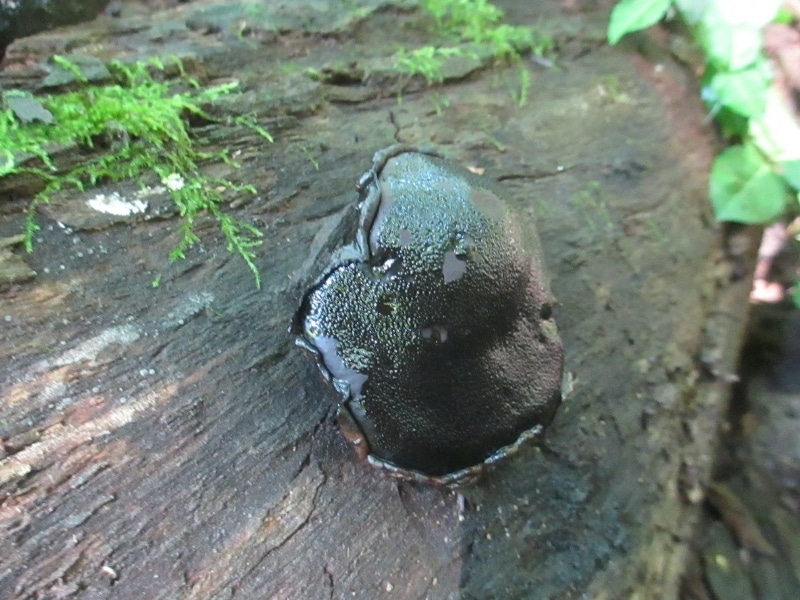
Camarops petersii by Vincent F. Andwan on Mushroom Observer
Dog’s Nose Fungus Identification Guide
Season
The dog’s nose fungus fruits in late summer into fall, usually from July through November. It may fruit as early as May in warmer climates. Once a fruiting body develops, it can last for weeks or even months on the same log. Gradually, it will dry out and crack.
Habitat
Dog’s nose fungi are saprobic and grow on well-rotted, decorticated (barkless) hardwood logs on the forest floor. Oak logs are their most common host, and they prefer areas with large or formerly old-growth trees.
It does not grow from the ground or from living trees. Dog’s nose grows alone or in small groups on the same log. Sometimes, there will be multiple specimens in various stages of development on the same log.
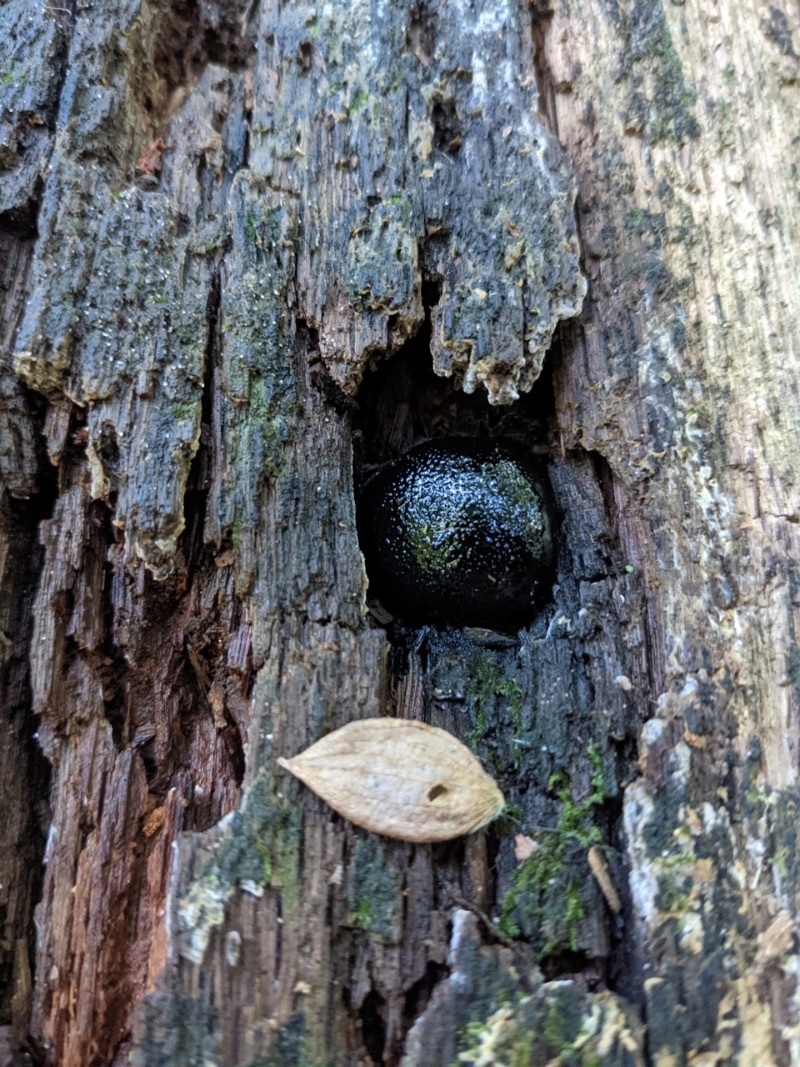
Camarops petersii by Melissa on Mushroom Observer
Identification
Fruiting Body
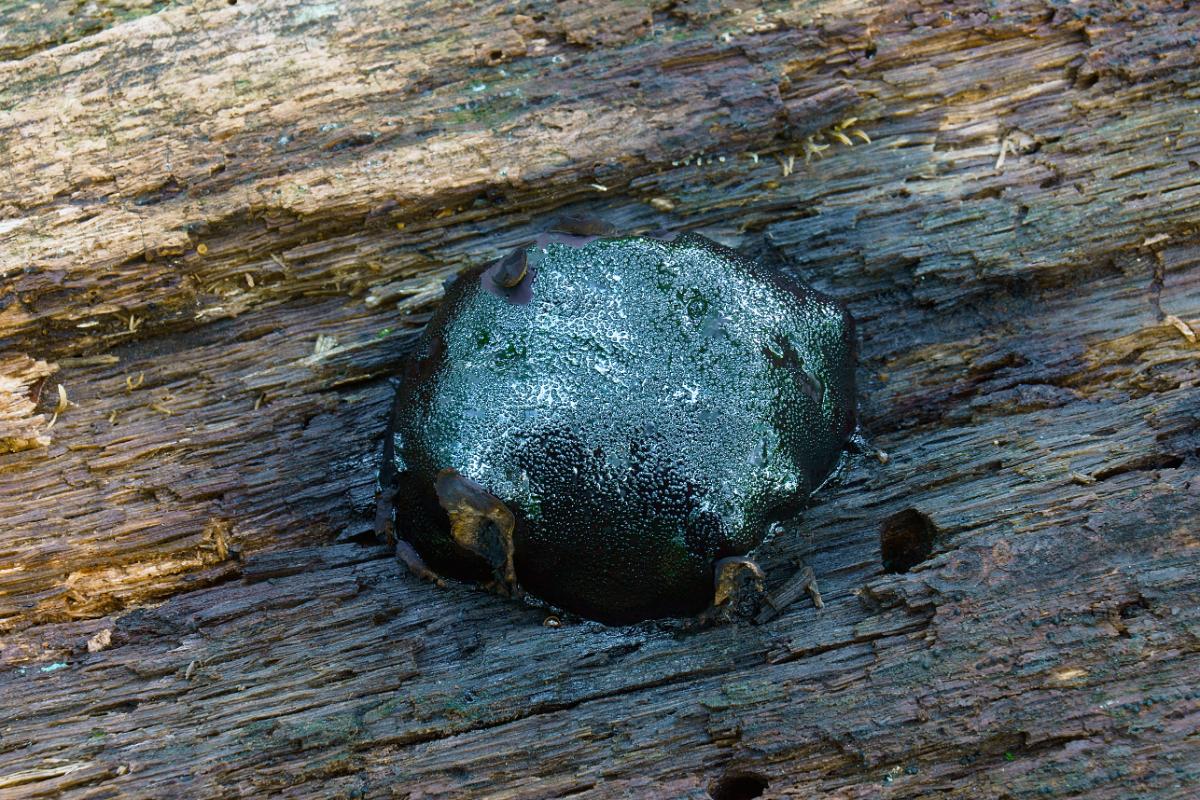
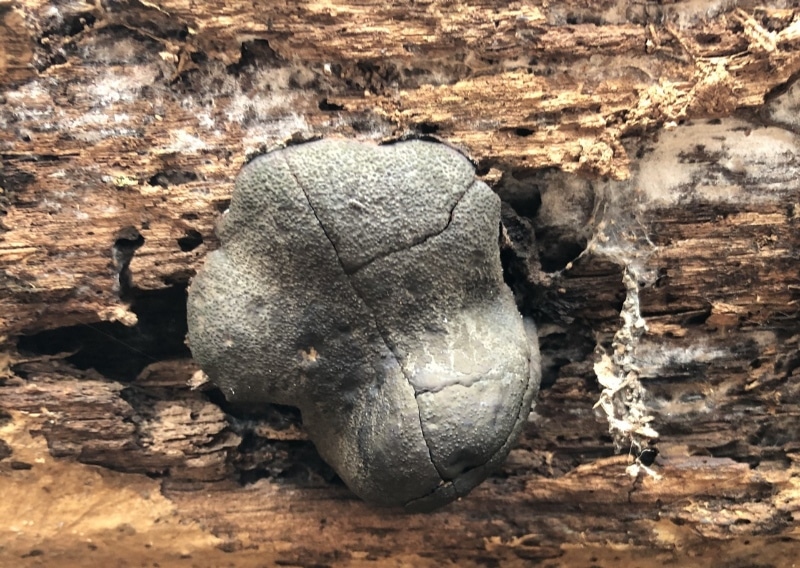
The fruiting body starts out quite small and can grow to a good size. It ranges from 0.75 to 5 inches wide and might be thin or bulbous. The young bodies are completely encased in a grayish-brown to yellowish-brown felt-like veil. There is also often guttation (droplets of liquid) on the body when it is covered in the veil.
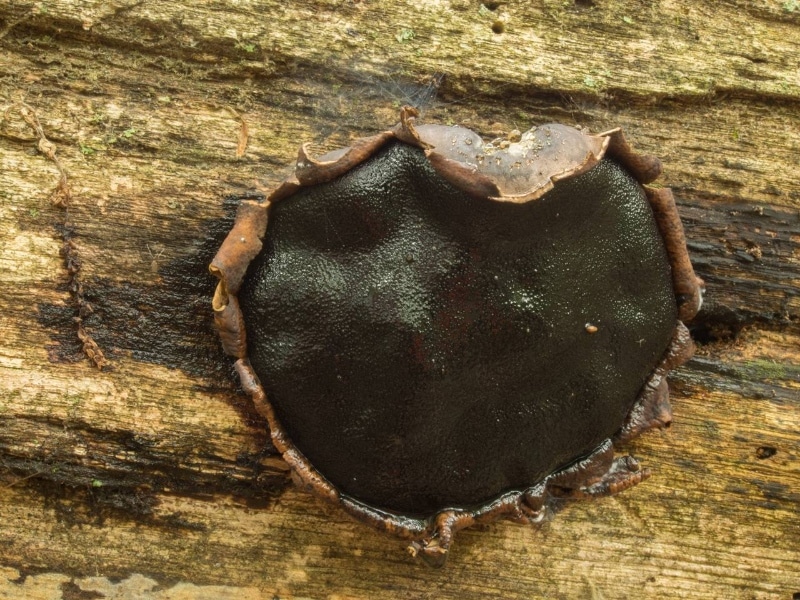
As the fungus matures, this veil ruptures and pulls back to form a ragged-edged collar or ring around the base and sides. This also leaves the top surface exposed. The two phases, young fungus covered in grayish veil and dark black exposed “nose” look like two completely different mushrooms. Helpfully, there is usually more than one specimen in any one place and you find the dog’s nose in both stages.
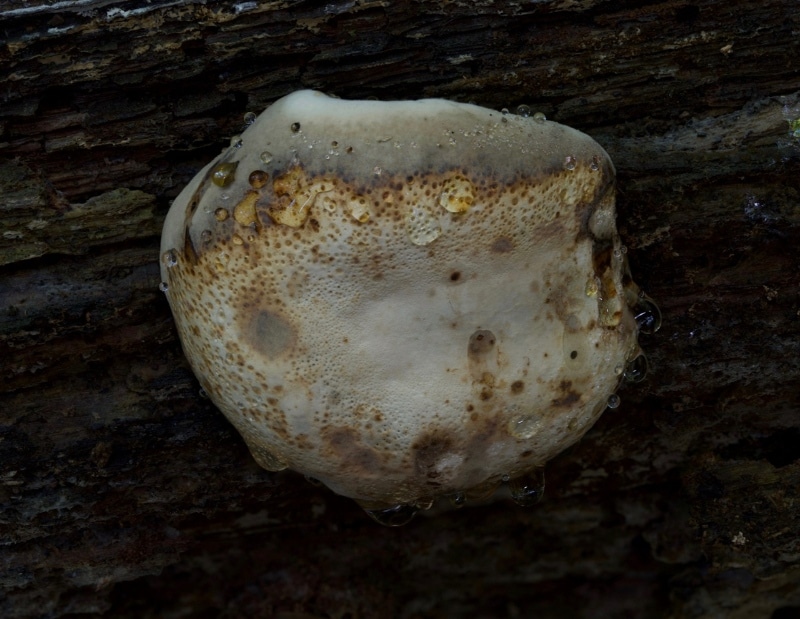
Camarops petersii by MarkB on Mushroom Observer
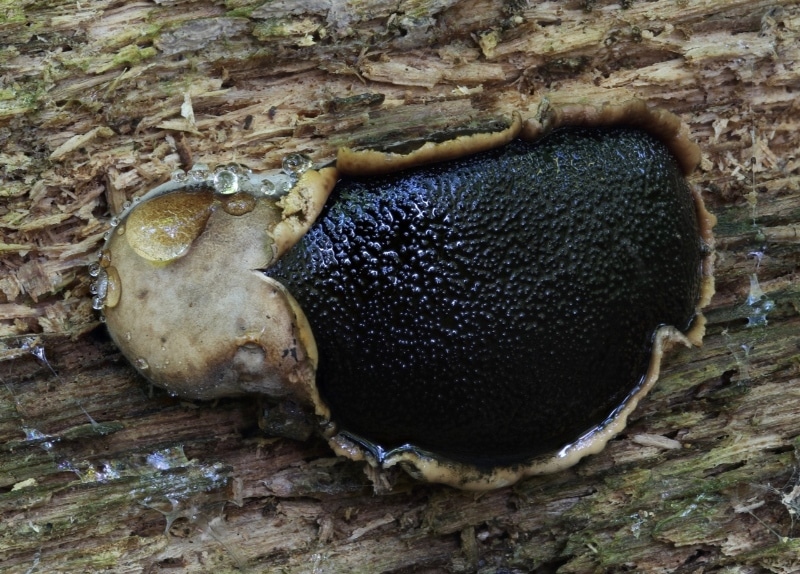
Camarops petersii by MarkB on Mushroom Observer
The body of the dog’s fungus is cushion-shaped and rounded, or it can be raised up with a narrowed base, sometimes described as turbinate or shaped like a spinning top. The top surface of the fungus is jet black, shiny, and distinctly wet-looking. It’s also dotted all over with tiny pimples.
These pimples are the openings where spores develop beneath the surface. When the dog’s nose fungus is actively producing spores, black slime oozes from these pimples and covers the entire surface, making the entire thing glossy. This slime is sticky to the touch and will coat your fingers with inky black sticky residue that is difficult to wash off and will stain your fingers (you’ve been warned!).
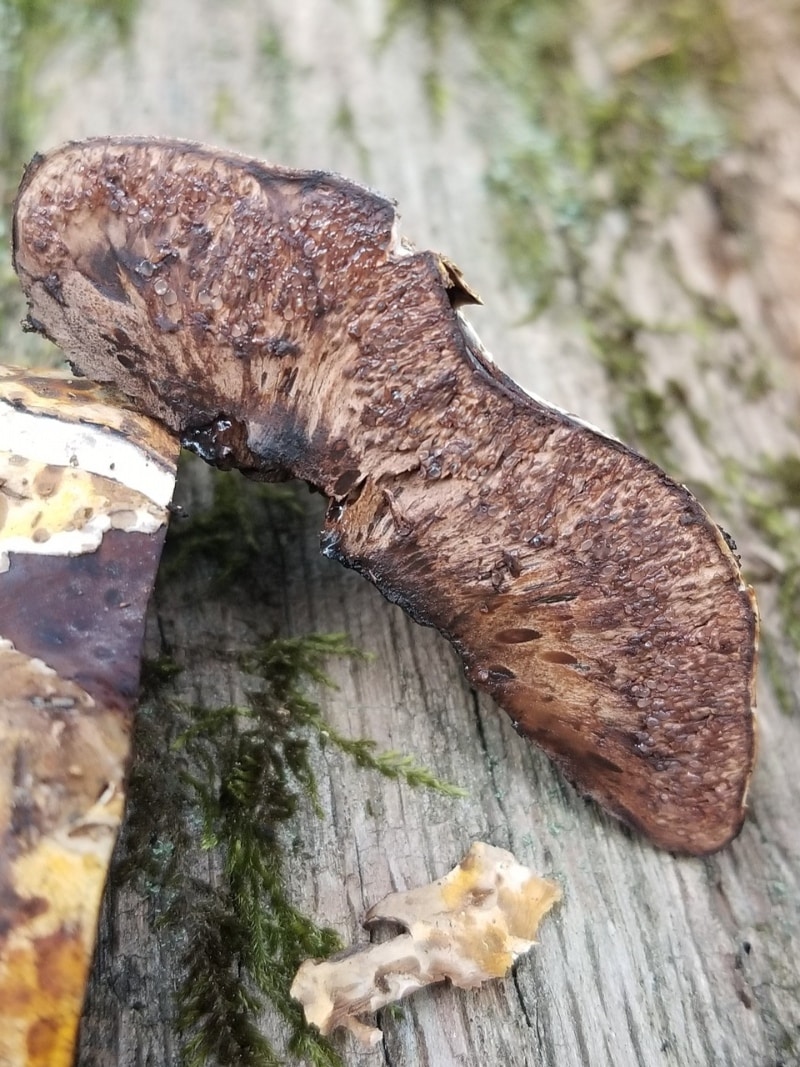
This species has no gills or pores. Instead, it produces spores inside tiny flask-shaped chambers buried within its tough flesh. Each chamber connects to the surface through a narrow tube that ends at one of the visible surface pimples. As the spores mature, they break down into the black slime that oozes out through these openings.
The dog’s nose fungus also doesn’t have a true stem. It attaches to the log through a narrow base or small stalk-like connection, but the connection is usually hidden beneath the log surface or gets cut when the species is foraged. The fruiting body looks like it is sitting directly on the wood.
This appearance of this fungus has also been wonderfully compared to a bulging black eye peering out from a dead log, complete with what looks like eyelids. The eyelids are the protective veil that splits open as the fungus matures. Whether you see a dog’s nose or eyeball, the physical appearance of this species is peculiar and entirely captivating.
Taste and Smell
Fresh dog’s nose fungi have a somewhat foul smell, a bit like coal tar. This smell is more noticeable when the fungus is cut or bruised. The smell has also been variously described as earthy, flowery, and sweet by different foragers, but the coal tar comparison is the most commonly reported. It might be that it is fresh-smelling when it is young, but it gets stinkier with age.
Flesh Color and Staining
The flesh is tough and brownish and filled with blackish channels and pockets that are sharply noticeable, especially in a cross-section. The flesh also turns darker toward the base.
Spore Print
Traditional spore prints don’t work with this fungus because the spores are released in a gelatinous black slime rather than as dry powder that would fall onto paper.
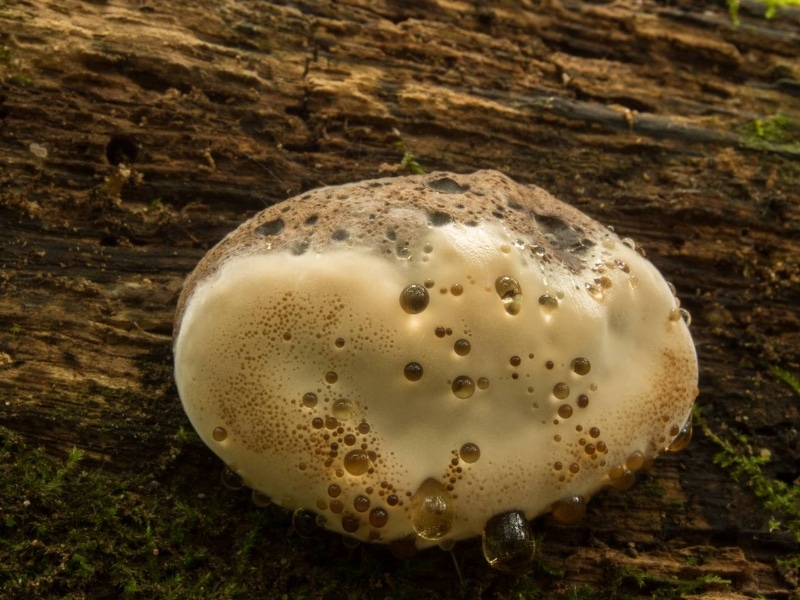
Camarops petersii by Josh KC on Mushroom Observer
Camarops petersii by Josh KC on Mushroom Observer
Camarops petersii by Carissa Mendez on Mushroom Observer
Camarops petersii by Rich Clark on Mushroom Observer
Dog’s Nose Fungus Lookalikes
Other Camarops Species
Several other Camarops species look similar enough that it can get confusing. They also have cushion-shaped bodies with a black “nose” and lots of pimples. None of them, however, has the felt-like veil when they’re young or the sticky black spore slime with age. They can still be tricky to tell apart, depending on age and condition, and a microscope might be needed.
- Camarops polysperma
- Camarops ohiensis
- Camarops tubulina
- An undescribed species found on birch logs in the Appalachians.
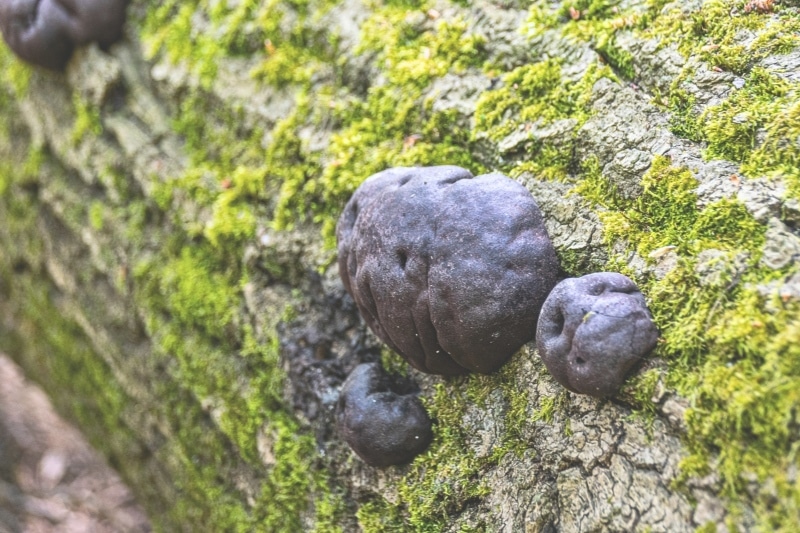
Coal Fungus (Daldinia childiae)
This lookalike is rounded and black, like dog’s nose fungus, and also grows on wood. There are several key differences, though. The coal fungus does not have the felt-like veil that the young dog’s nose fungus has. It also has a dry, hard surface rather than the wet, slimy appearance of dog’s nose fungus.
When you cut the coal fungus in half, it has distinctive concentric rings that look like tree rings. The interior of dog’s nose is very different, with channels and pockets. If you’re ever not sure, cut the fungus in half.
Dog’s Nose Fungus Edibility
The tough, woody consistency makes this species inedible, and the coal tar smell makes it unappealing to consider. It is not known to be toxic or poisonous.
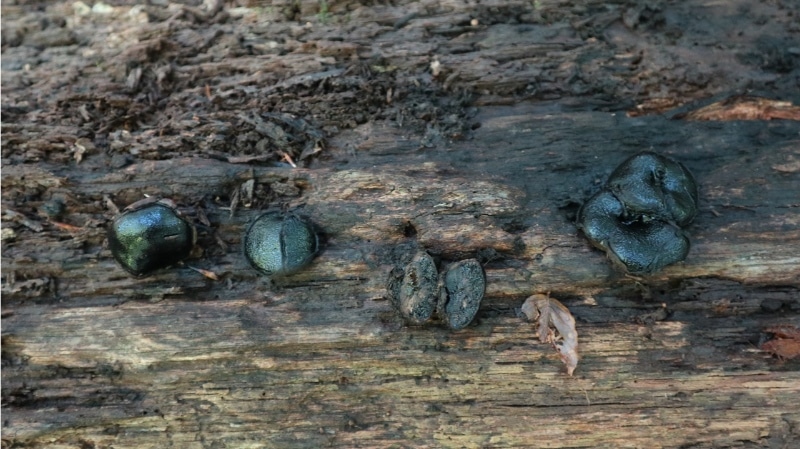
Camarops petersii by Ryan Patrick on Mushroom Observer
Common Questions About Dog’s Nose Fungus
Is the dog’s nose fungus medicinal?
No documented medicinal uses exist for the dog’s nose fungus.
Is dog’s nose fungus edible?
The dog’s nose fungus has a tough, woody flesh that makes it inedible.
Why does the dog’s nose fungus look wet all the time?
The black surface is covered in spore slime that oozes from tiny pores, giving it a permanently wet appearance even in dry conditions.
Is the dog’s nose fungus rare?
It is an uncommon species, but the dog’s nose fungus is probably less rare than older records suggest. Sightings have increased over the years.
Leave a Reply