


Usually, the first sign of artillery fungus (Sphaerobolus stellatus) is not the fungus itself; it is so small that it commonly goes unnoticed. You have to be looking for it, but more often than not, it will make itself known to you in a very annoying fashion. Artillery fungi do what their name suggests — they shoot, and at a mind-blowing speed that is hard to fathom for such a small fungus.
In this case, they are shooting their spore sacs, and those tiny brown spore sacs might end up bonded to car doors, house siding, or patio furniture. Each sac is about the size of a sesame seed, and even though they’re tiny, they can cause a bit of damage. They are very difficult to remove! These mushrooms grow on wood mulch, decaying wood, and organic debris, and they are not dangerous or toxic, just messy.
- Scientific Name: Sphaerobolus stellatus
- Common Name: artillery fungus, cannon fungus, shotgun fungus, sphere thrower, cannonball fungus
- Habitat: Decaying wood, mulch, and sawdust
- Edibility: Inedible
All About Artillery Fungus
The firing mechanism of the artillery fungus is super impressive. It generates an estimated 1/10,000 horsepower, and the distance it goes is incredible. For a six-foot-tall person to throw a baseball with the same relative force, the ball would have to travel nearly 1.5 miles into the air and almost 2 miles away.
This fungus is not poisonous or toxic to humans or animals, and there are no documented adverse reactions from contact with the fungus or its spore sacs. The only harm it causes is cosmetic. The peridioles, once stuck to a surface, are coated in a natural adhesive that makes them extremely difficult to remove without scratching the paint or siding beneath them.
There are no known fungicides that are effective against Sphaerobolus. If they’re hitting your car or house, the most reliable management strategy is to remove any wood-based mulch nearby. It can be replaced with materials the fungus finds less hospitable, such as large-nugget pine bark, Atlantic white cedar chips, or cypress mulch. These are more water-repellent and won’t be as attractive to the artillery fungus.
The genus was first described to science in 1729, and given the name Carpobolus. In 1801, mycologist Christiaan Hendrik Persoon gave it the name Sphaerobolus stellatus.
The genus name Sphaerobolus comes from the Greek words sphaira, which means “sphere,” and bolos, meaning “to throw.” This is a great description of how the artillery fungus flings its spore sac outward. The species name stellatus comes from the Latin stella, meaning “star.” It refers to the star-shaped structure left behind after the spore sac has been fired.
The fungus goes by several common names, including artillery fungus, cannon fungus, shotgun fungus, sphere thrower, and cannonball fungus.
Three species of Sphaerobolus grow in North America, and they all look nearly identical to the naked eye.
- Sphaerobolus stellatus is the most common and most widely distributed of the three. It has peridioles roughly 1/16 inch across.
- Sphaerobolus iowensis is as common as S. stellatus in North America. Its peridioles are also roughly 1/16 inch across, making it indistinguishable from S. stellatus without a microscope.
- Sphaerobolus ingoldii is the only one of the three that can be separated in the field. Its peridioles are about 1/25 inch across, noticeably smaller than the other two.
Artillery Fungus Identification
Season
Artillery fungus fruits from spring through fall. The fruiting bodies won’t form if the temperatures are above 77°F, so the most active times are the cool, wet days of spring and autumn.
Habitat
The artillery fungus is a saprobic, wood-decaying fungus. It grows on decaying wood, landscape wood mulch, sawdust, weedy debris, and dung. It grows in moist organic matter and prefers open areas with some light. The fungus is found on every continent except Antarctica and is widely distributed across North America, Europe, Asia, Africa, and Australia.
In North America, it is especially common to find this mushroom in landscaped areas, like wood-based mulch used in yards, driveways, and garden beds. It’s also commonly found on semi-fresh cow and horse dung. The fungus prefers wet conditions. Often, its presence isn’t known until the ejected spore sacs are spotted on nearby surfaces.
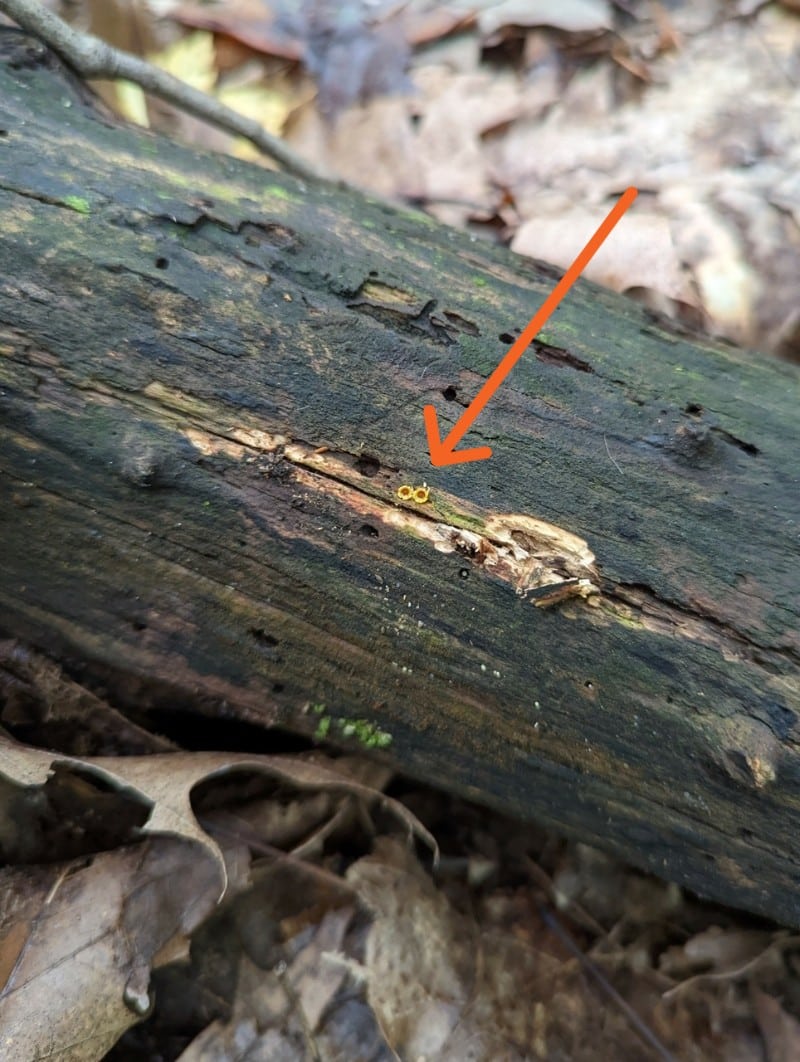
Sphaerobolus stellatus by ReccaAnt on Mushroom Observer
Identification
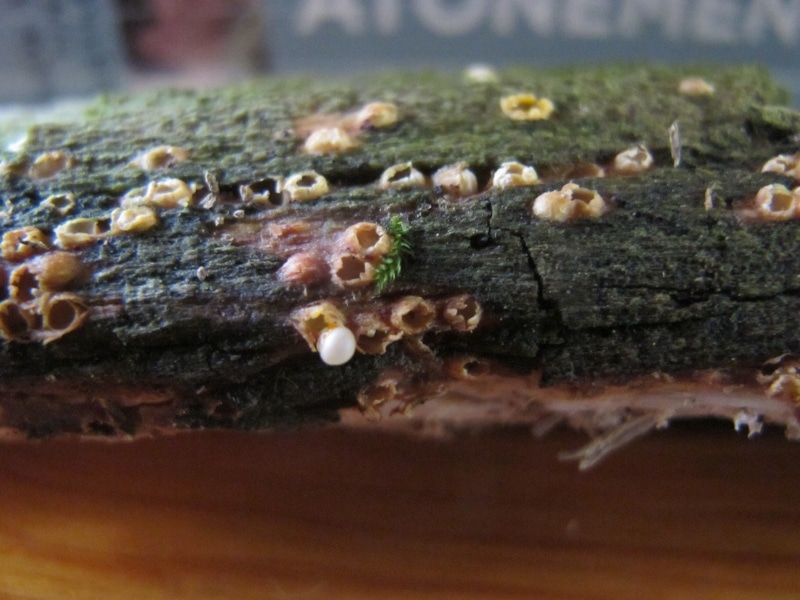
The artillery fungus is a gasteroid fungus. This means its spores develop inside a sealed structure inside the body. There are no gills, pores, or a stem. The fruit bodies of this mushroom are extremely tiny, growing only about 1/8 inch across.
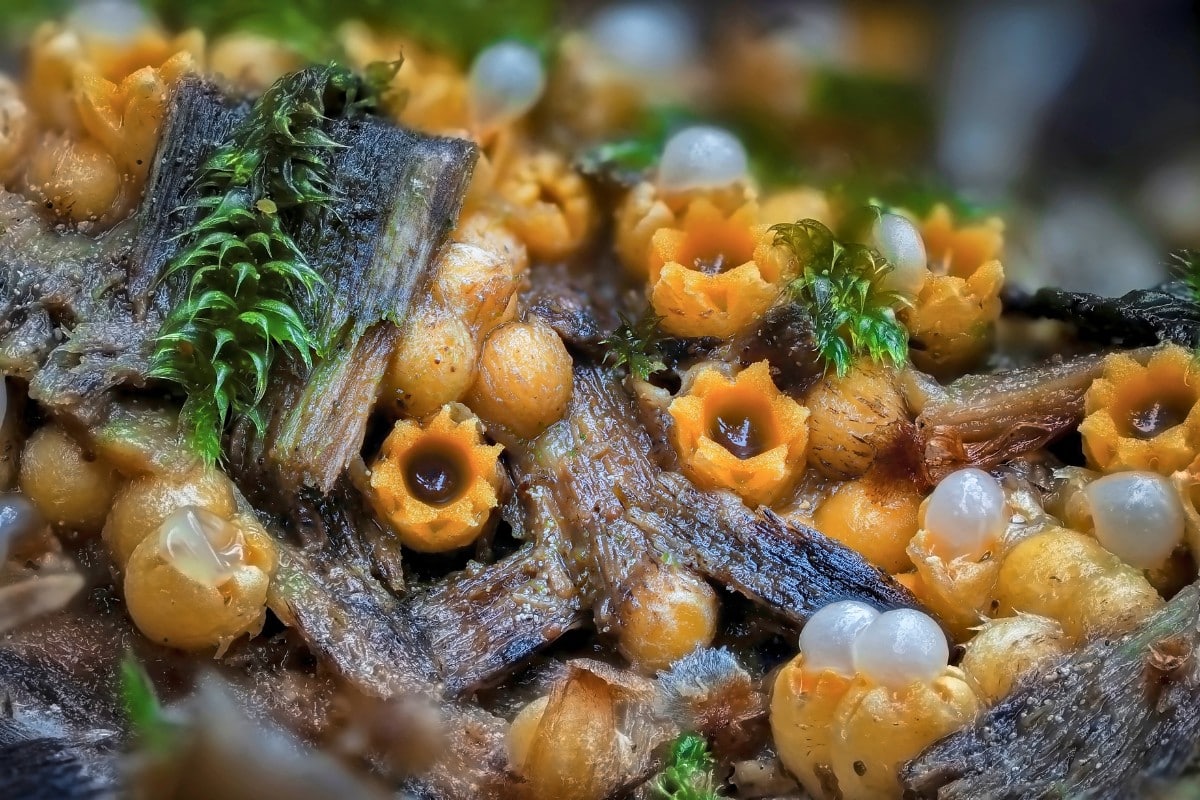
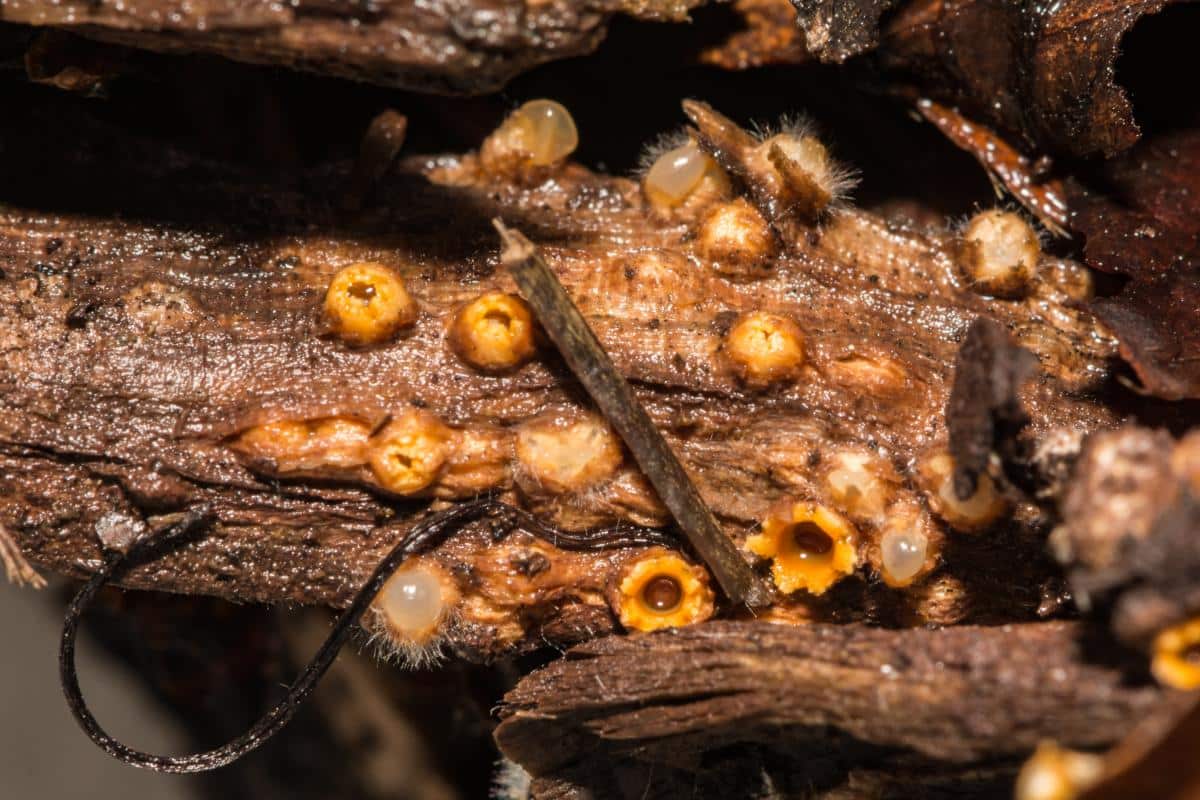
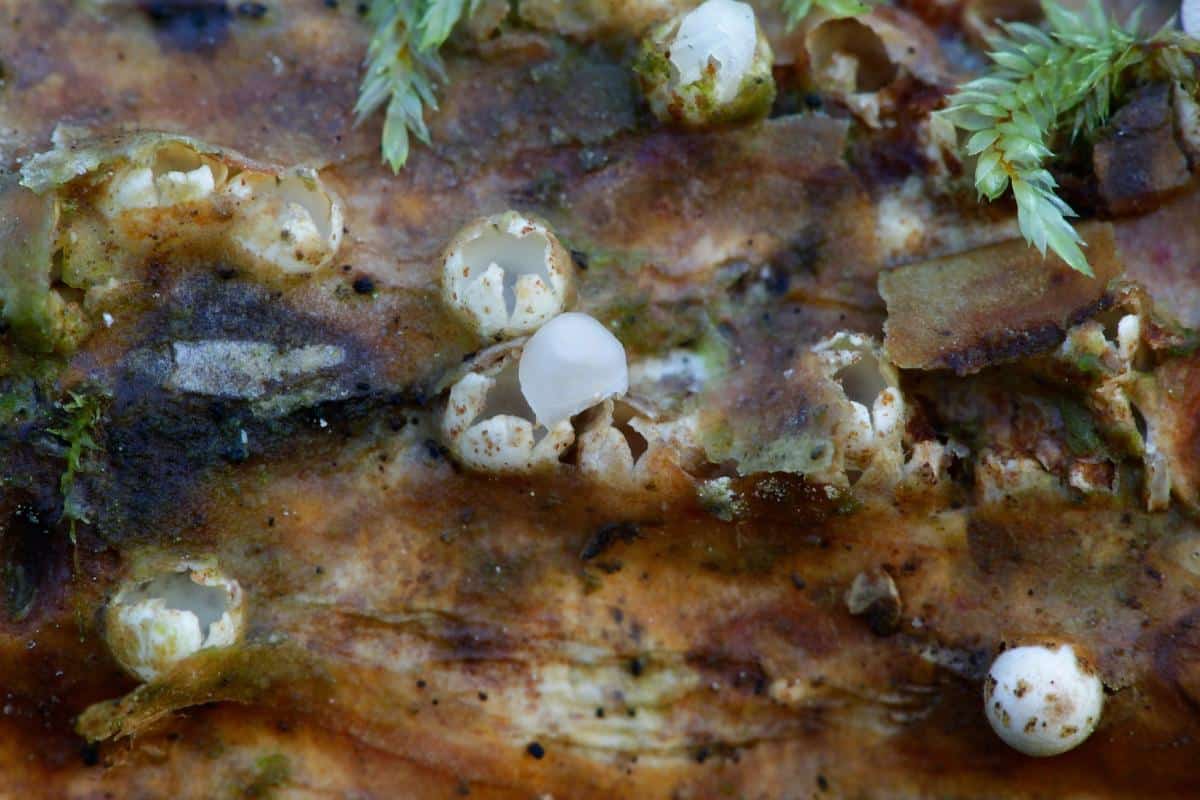
The young fruit bodies are small and round or might be slightly egg-shaped. They look like minuscule blobs and range in color from white to pale buff or cream-colored. As the fruit body matures, the outer layer splits open at the top into four to nine short, triangular, star-shaped rays. Inside the opened cup, the inner surface is orange to yellow.
A single spore sac — the peridiole — sits in the bowl of the cup. It is dull yellow when young, and then it darkens to reddish-brown and then dark brown as it matures. The spore sac is only about 1/16 inch across. When the fruit body is fully ready, it fires the peridiole outward with a small audible pop. The inner cup layers flip inside out, and the peridiole launches into the air like a cannonball.
After the shot, a translucent, balloon-like everted membrane remains attached to the ray tips. If you find a specimen like this, it means the spore sac has already been ejected. The empty star-shaped cup remains on the substrate.
The ejected peridiole is sticky and glues itself to any surface it strikes, leaving a dark brownish-black spot roughly 1/10 inch across.
Stem
There is no stem. The fruit body attaches directly to the substrate at its base.
Taste and Smell
There is no distinctive smell or taste.
Flesh Color and Staining
The outer layers of the fruit body are pale cream to whitish, and the inner flesh is orange to yellow. The ejected peridioles leave a dark brownish-black stain on whatever they hit, which is extremely difficult to remove without damaging the surface.
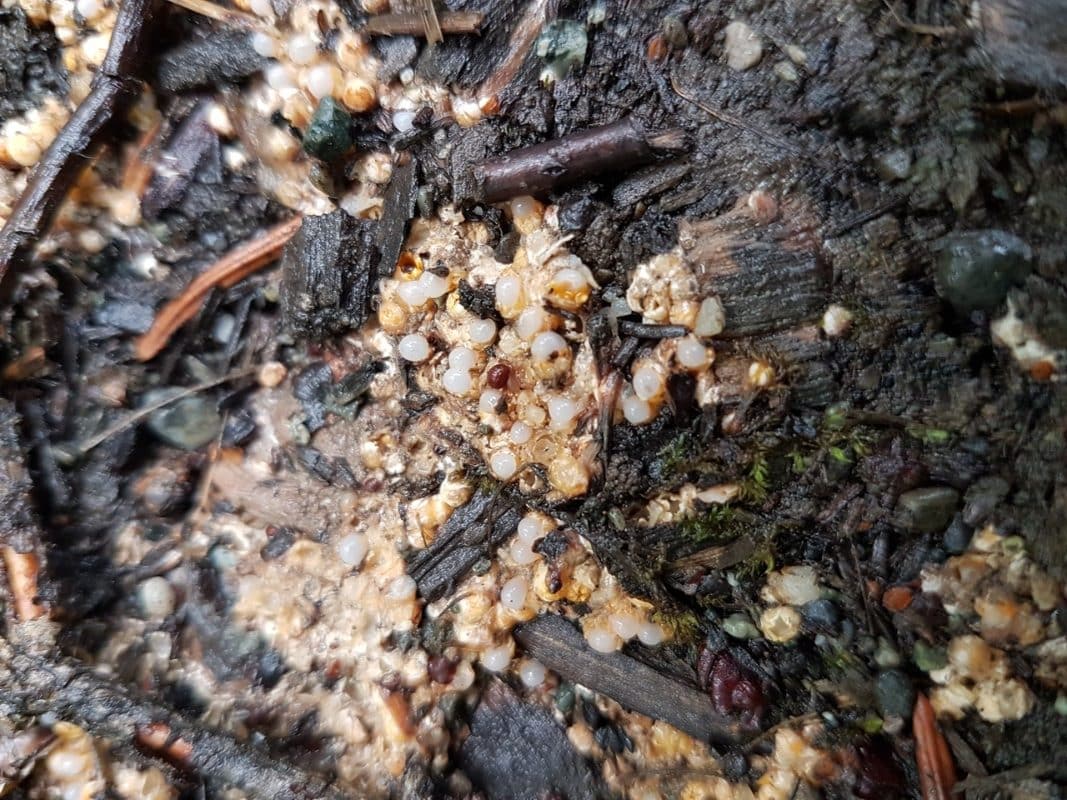
Sphaerobolus stellatus by Christin on Mushroom Observer
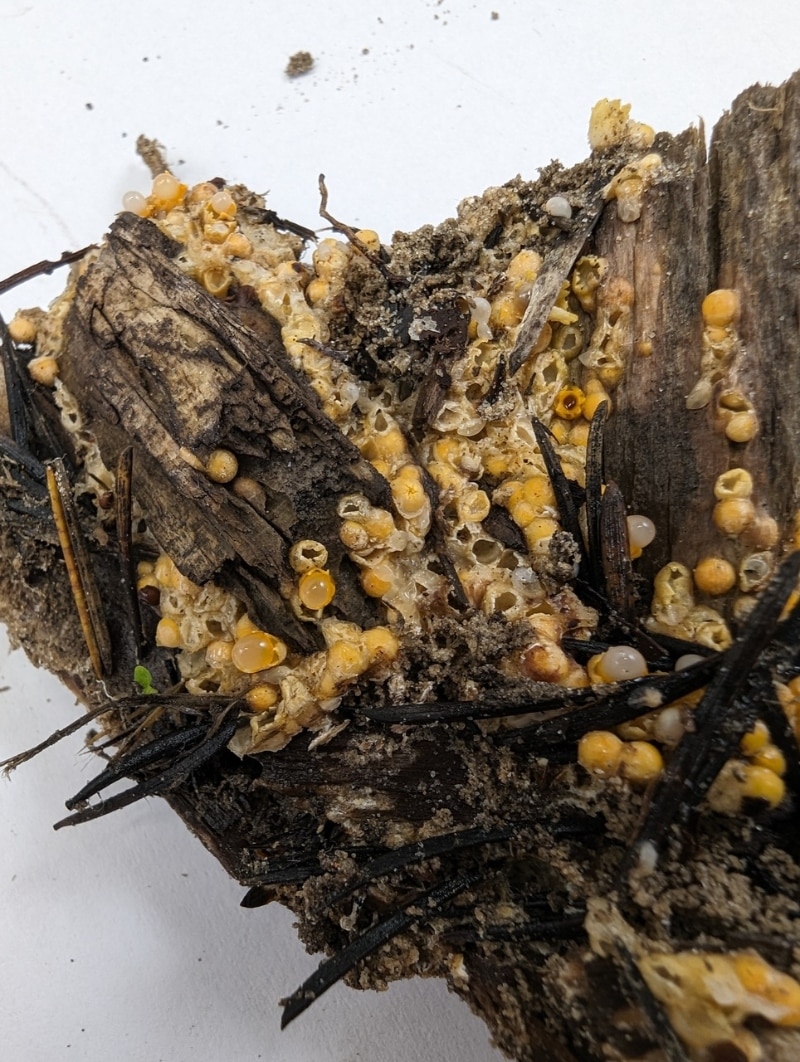
Sphaerobolus stellatus by George Riner on Mushroom Observer
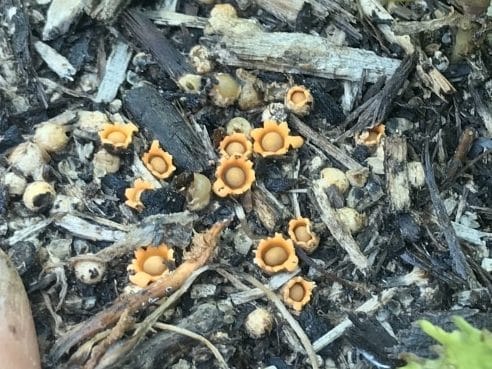
Sphaerobolus stellatus by Andy on Mushroom Observer
Artillery Fungus Lookalike Species
Bird’s Nest Fungi (Crucibulum laeve, Cyathus striatus, and related species)
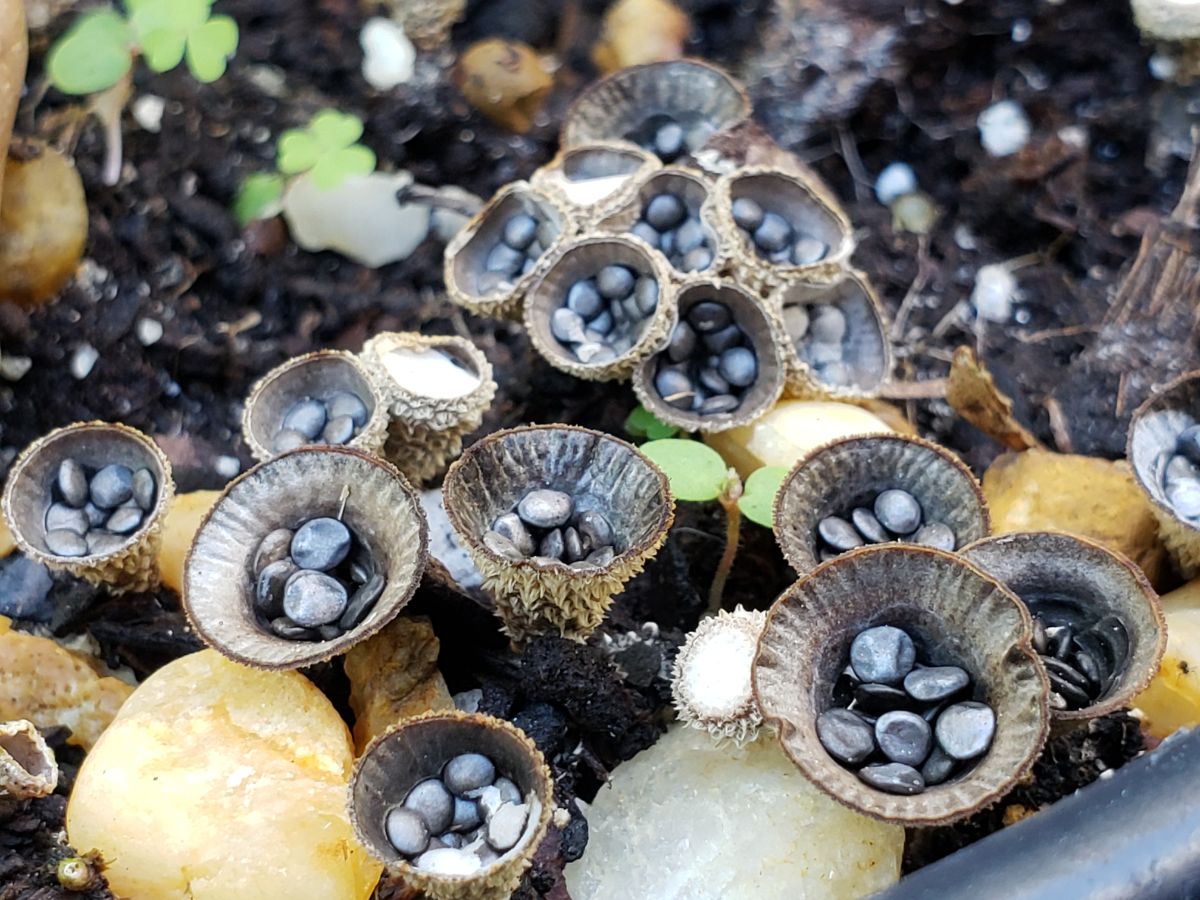
Bird’s nest fungi are also small, cup-shaped fungi that grow on wood mulch and organic debris. The two groups were historically placed in the same order, Nidulariales, but it turns out they are not closely related.
The primary difference is the number of “eggs” inside the cup. Bird’s nest fungi have multiple small peridioles arranged inside the cup, so each fruit body literally looks like a tiny nest with several to many eggs inside it. Artillery fungus has only one peridiole per cup.
Bird’s nest fungi also do not fire their peridioles — they rely on rain splashing into the cup to knock the eggs out. The cups of bird’s nest fungi are also larger, typically reaching 1/4 to 1/2 inch across.
The Cannonball Mechanism
The launch itself slowly builds up. After the outer layer of the fruit body splits open, it takes about five to six hours for enough pressure to build up inside the inner cup to the point where the peridiole fires. When it goes, it goes fast! The shot is accompanied by a small audible pop, and then the spore sac is gone.
This launching mechanism generates an estimated 1/10,000 horsepower. And, the peridiole can travel up to 18 feet horizontally and reach a height of 14 feet. That’s roughly the equivalent of a quarter being thrown half the length of a football field.
The fruit bodies orient themselves toward the nearest source of light before firing. This is why car doors, pale house siding, and windows end up covered in spots. The fungus isn’t targeting your car; it’s targeting brightness, like the shiny surface of your car. Once a peridiole sticks, it is almost impossible to remove it without damaging the surface underneath.
And these little peridoles are tough. The ejected peridioles have been found to still be viable up to 11 years after landing. Which means that if you scrape them off a wall and drop them back into the mulch bed, you put live spores right back where the problem started.
Common Questions About Artillery Fungi
Can you eat the artillery fungus?
The mushroom isn’t toxic, but the fruit bodies are so small that they are not practical to harvest.
Is the artillery fungus medicinal?
There are no known or documented medicinal uses for artillery fungus.
Sphaerobolus stellatus by damon brunette on Mushroom Observer

Leave a Reply