
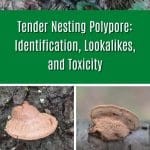
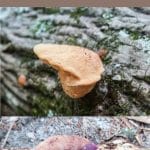
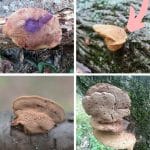
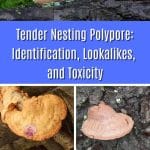
The tender nesting polypore is a soft, fleshy fungus with a warm cinnamon-orange color that blends right into the dead branches it grows on. It’s easy to walk past without noticing. It isn’t edible, it’s actually toxic, but it has a long history of being used to make natural dyes. It produces some beautiful purples.
The tender nesting polypore grows across much of the eastern United States and into the Southwest. It also grows across Europe, parts of Asia, and North Africa.
- Scientific Name: Hapalopilus rutilans syn. Hapalopilus nidulans
- Common Names: Tender nesting polypore, purple dye polypore, cinnamon bracket.
- Habitat: Decaying hardwood
- Edibility: Toxic
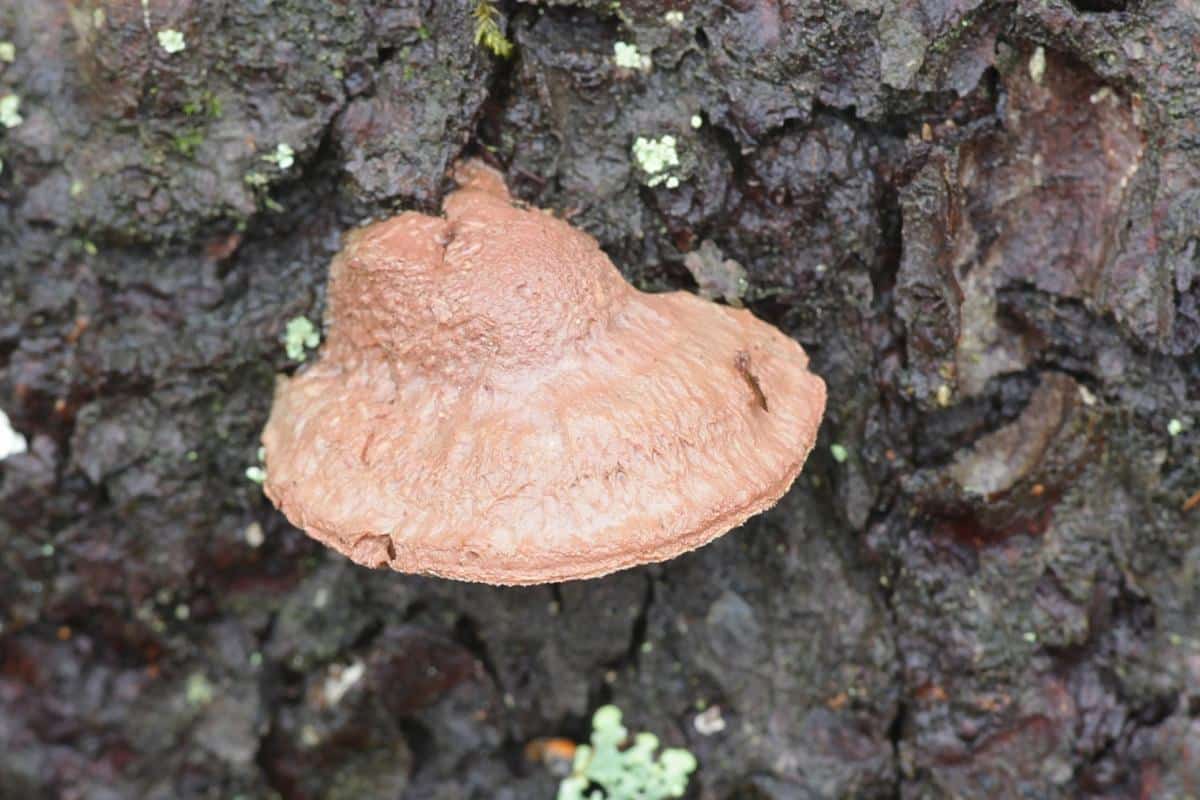
All About The Tender Nesting Polypore
The tender nesting polypore is a toxic mushroom that has been mistaken for an edible species a few times and has caused significant poisoning. It isn’t likely to kill you, as long as you get care straight away, but it is a very dangerous experience, and includes your urine turning purple!
Natural dyers love this mushroom because of the purple it creates. It is highly sought out and creates a range of stunning purples and lavenders.
The tender nesting polypore was first described to science in 1791 as Boletus suberosus. That name was already taken for a different species, so it was invalid. The name went through several more changes before becoming Hapalopilus nidulans in 1881. That name was the standard for over a century, then, due to naming complications, it was renamed Hapalopilus rutilans. This name now takes priority, but both MycoBank and Species Fungorum treat Hapalopilus nidulans as a synonym of Hapalopilus rutilans. Many older field guides and databases still list it under the name Hapalopilus nidulans.
The genus name Hapalopilus comes from the ancient Greek words for “tender” and “cap.” The species name rutilans is Latin for “orange-red.” So, the entire name translates to orange-red tender cap. The older and still widely used synonym, Hapalopilus nidulans, species name means “nesting.”
Several species of fungus beetles are known to live and breed inside the fruit bodies of this mushroom, including Sulcacis affinis, Hallomenus axillaris, Hallomenus binotatus, and Orchesia fasciata.
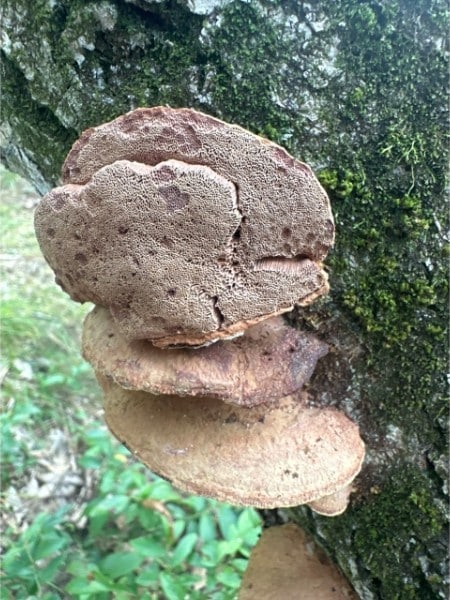
Hapalopilus rutilans by DThomas on Mushroom Observer
Tender Nesting Polypore Identification Guide
Season
The tender nesting polypore fruits from spring through fall. In warmer climates, it can fruit into winter. The fruit bodies are tough enough to persist on the wood after the growing season ends, so dried-out specimens can be found at any time of year.
Habitat
This is a saprobic fungus that causes a white rot in dead wood. It grows on decaying logs, sticks, and branches of hardwood trees. Its preferred wood hosts in North America include oak, beech, and birch. In the Southwest, it has been recorded on conifer wood as well.
The fruit bodies might grow alone or in small groups or in overlapping clusters. In North America, the species is most common east of the Rocky Mountains. It is also reported from the Southwest and the Pacific Northwest, but it is less frequent in those areas.
Outside of North America, the tender nesting polypore grows across Europe, parts of Asia, North Africa, and has been recorded in Australia and Oceania.
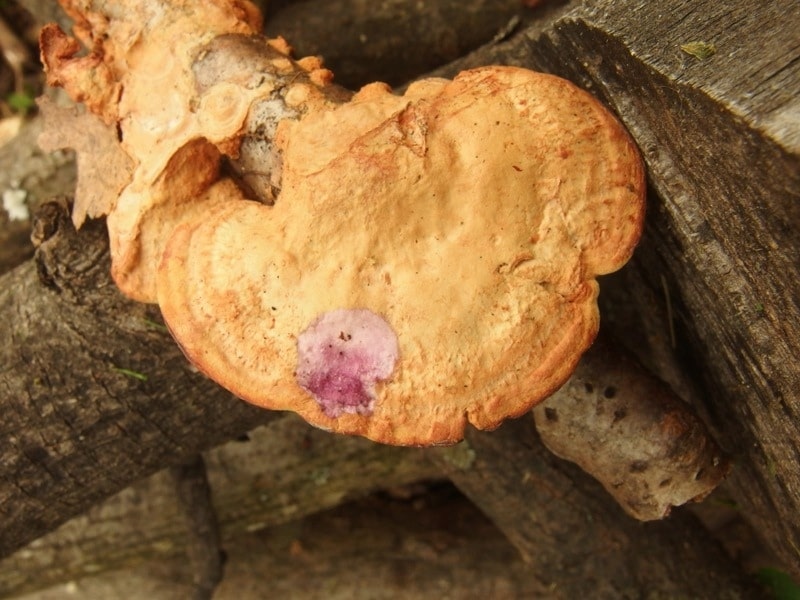
Hapalopilus rutilans by Linda Brynan Sears on Mushroom Observer
Identification
Cap
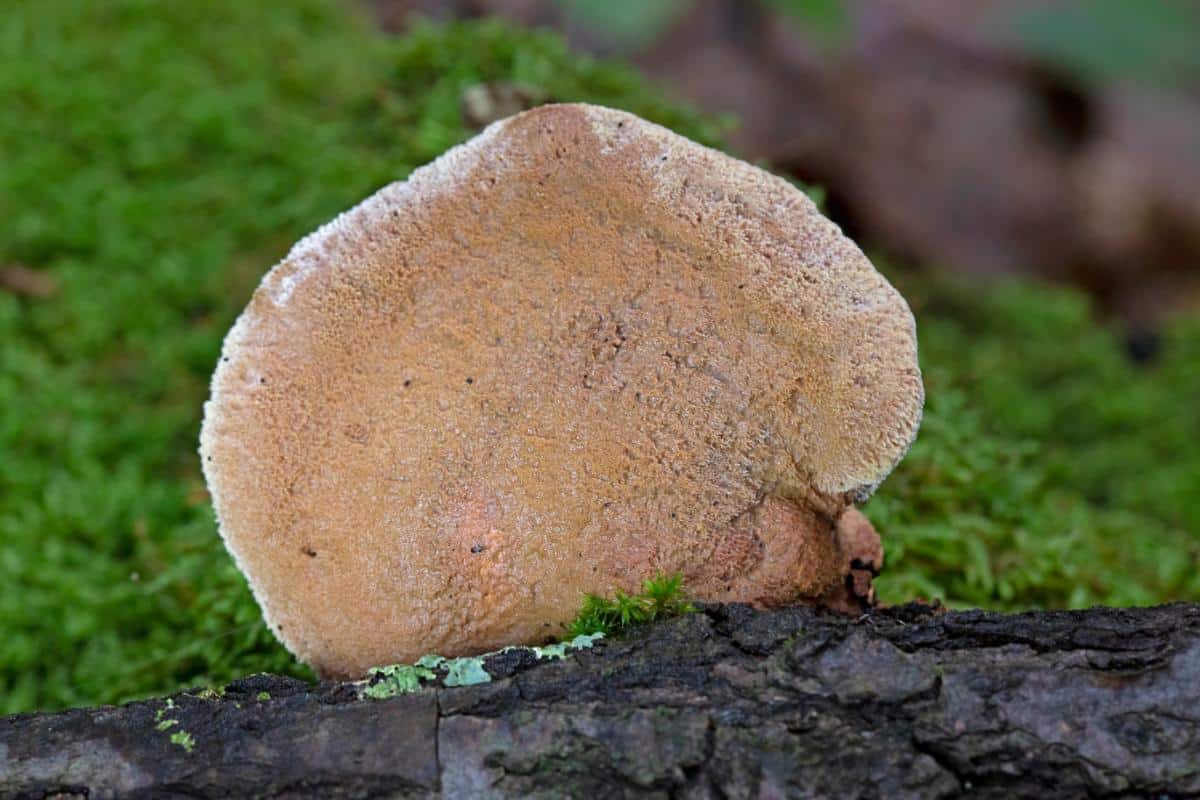
The cap is fan-shaped to semicircular, and 1 to about 4.7 inches across. The surface is covered in matted hair when it is young, but becomes smoother with age. The cap has shallow concentric furrows across it. Concentric furrows are shallow grooves or lines that curve across the cap surface in rings, one inside the other, like the rings on a target or the growth rings on a tree stump. They circle outwards from the point where the cap attaches to the wood.
Tender nesting polypore caps are a dull brownish-orange to cinnamon-brown color, and have a paler, yellowish to whitish line along the outer edge. The fruit bodies are soft and spongy when fresh, but become hard and brittle once they dry out. The flesh is up to about 1.2 inches thick at the thickest part and is a pale cinnamon color inside.
Pores
The underside of the cap has a pore surface that is yellowish to dull orangish-brown. There is a sterile band along the outer margin where there are no pores are present. In young specimens, the pore surface bruises reddish brown.
Stem
There is no stem. The cap attaches directly to the wood.
Taste and Smell
The taste and smell of the tender nesting polypore are generally not distinctive. However, some sources describe the odor and taste as ranging from sweetish to faint.
Flesh Color and Staining
The flesh is dull orangish-brown to pale cinnamon. It is watery and soft when fresh, but dries to a tough, hard texture. It does not change color when sliced. The pores will bruise reddish-brown when the mushroom is young.
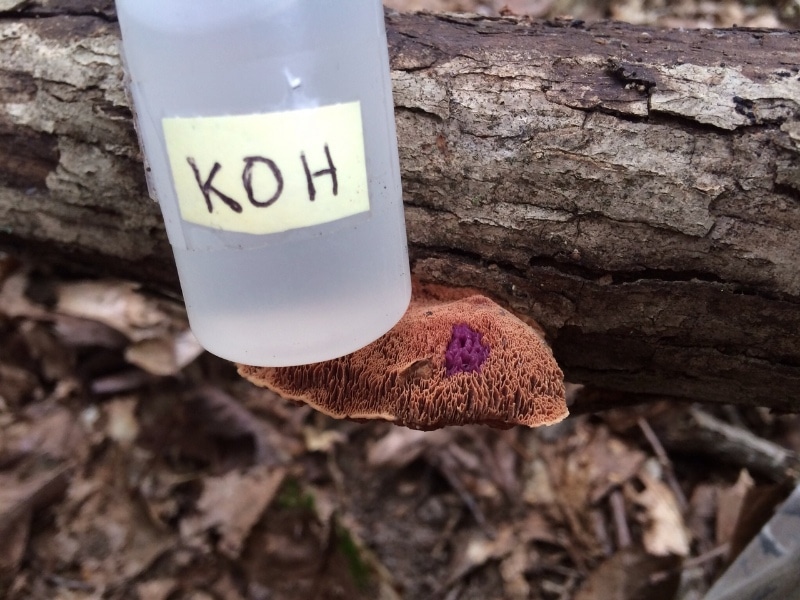
A very distinctive feature of this mushroom is the KOH reaction. A drop of potassium hydroxide (KOH) or household ammonia on any part of the fruit body turns it an instant bright purple to lilac. This reaction works on the cap, the pores, and the flesh.
Spore Print
The spore print is white.
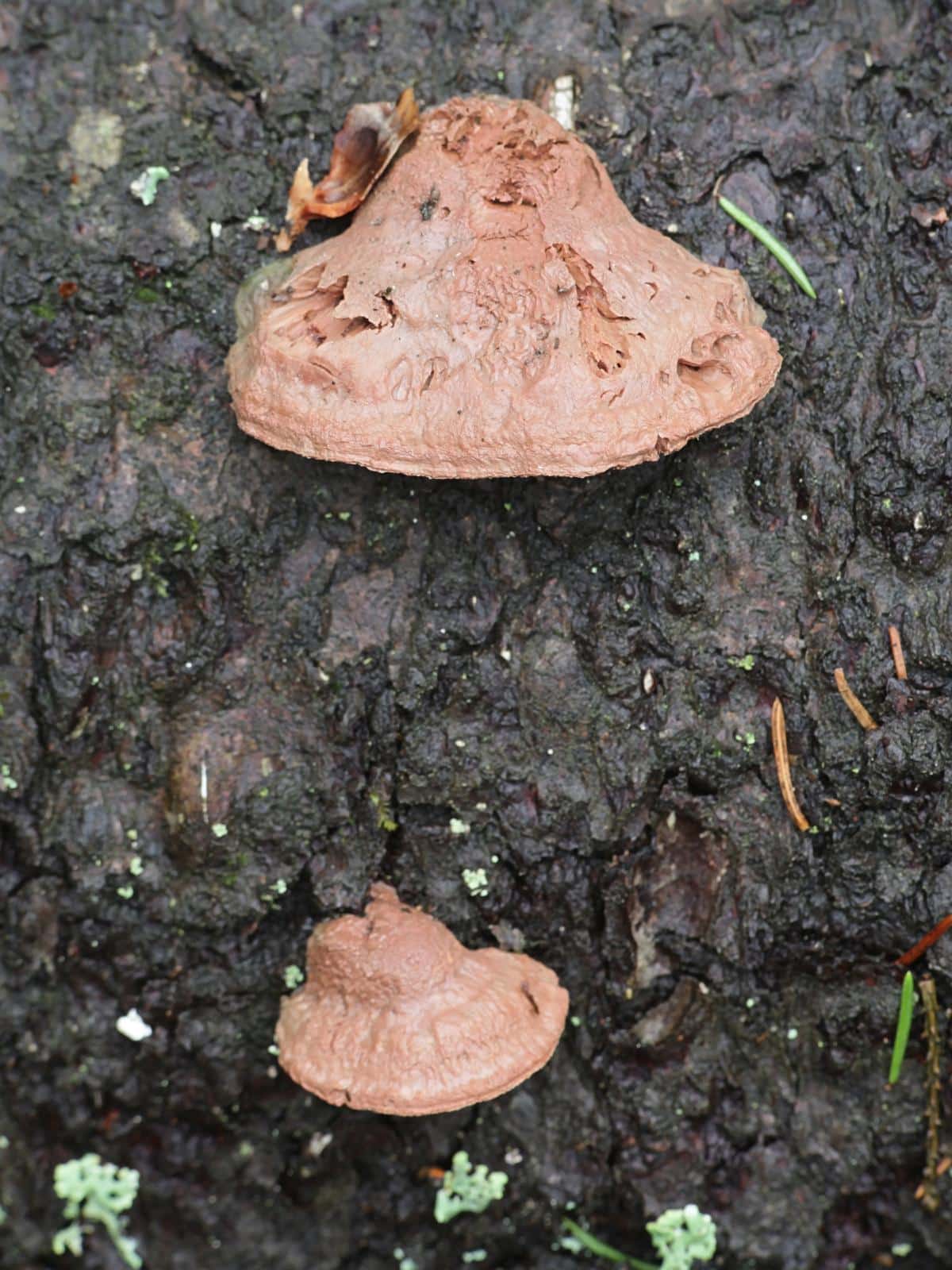
Hapalopilus nidulans by Jon Shaffer on Mushroom Observer
Tender Nesting Polypore Lookalike Species
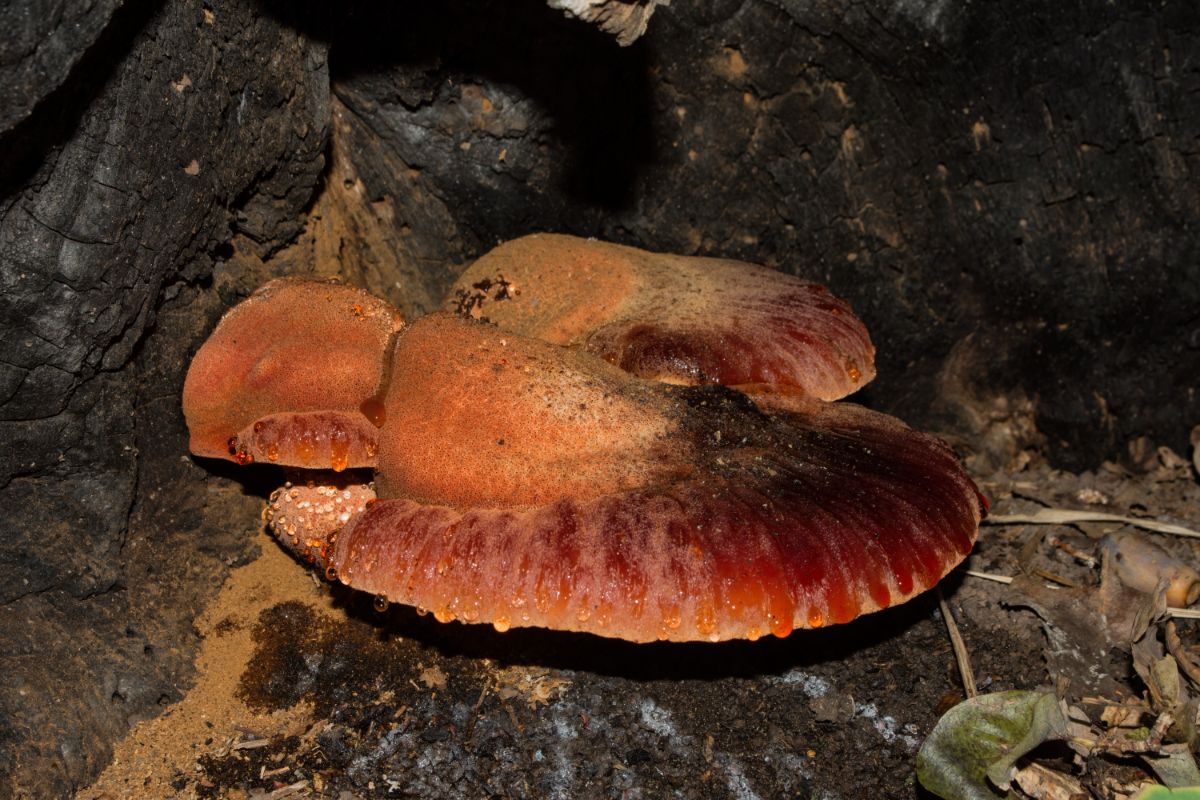
Beefsteak Fungus (Fistulina hepatica)
There is at least one documented poisoning case that happened when someone confused the beefsteak fungus with the tender nesting polypore. The beefsteak is an edible species, but the nesting polypore is toxic, so you must be very careful with these.
Both are bracket fungi that grow on hardwood and have a somewhat similar shape and soft texture. The beefsteak fungus, however, is a deep blood-red color and oozes red juice when cut. Its pore surface is made up of individual tubes that separate easily, while the tender nesting polypore has fused pores.
Cinnabar Polypore (Pycnoporus cinnabarinus)
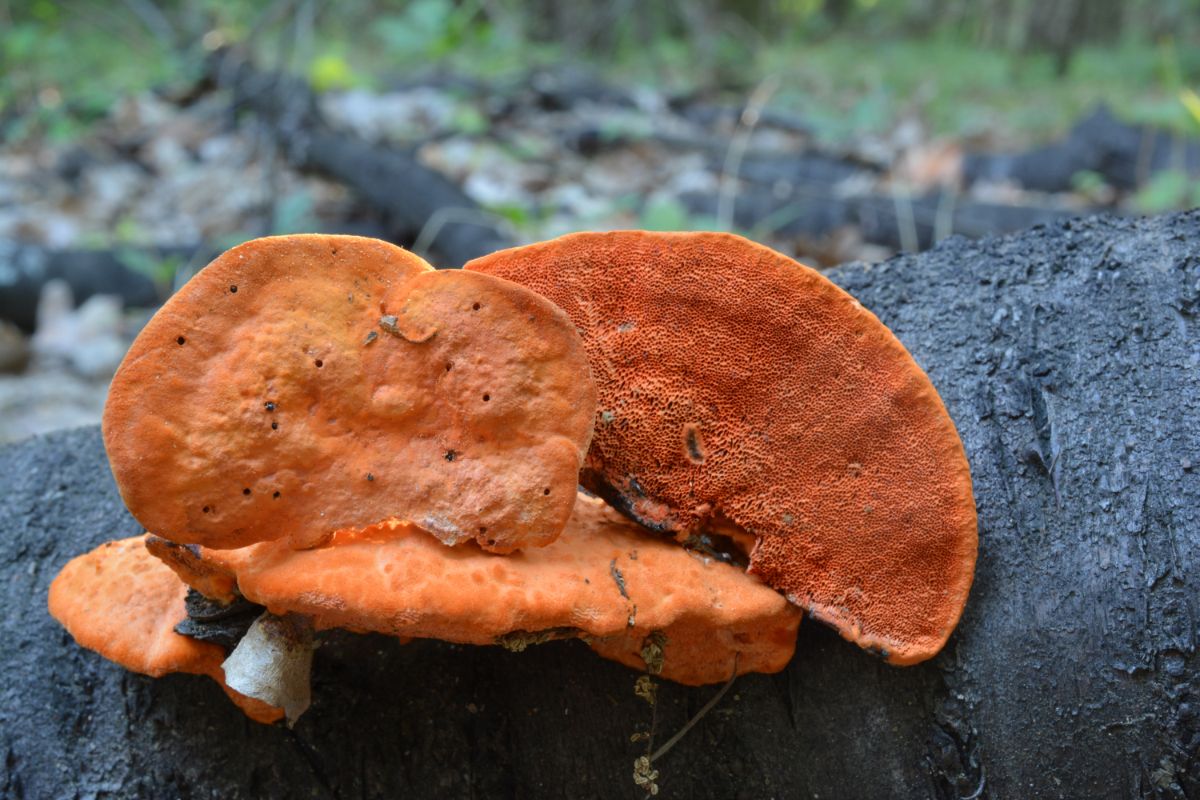
The cinnabar polypore is a brighter red-orange color and is much tougher and woodier than the tender nesting polypore. The tender nesting polypore is softer and fleshier, and its color is more of a muted cinnamon-brown rather than a bright red.
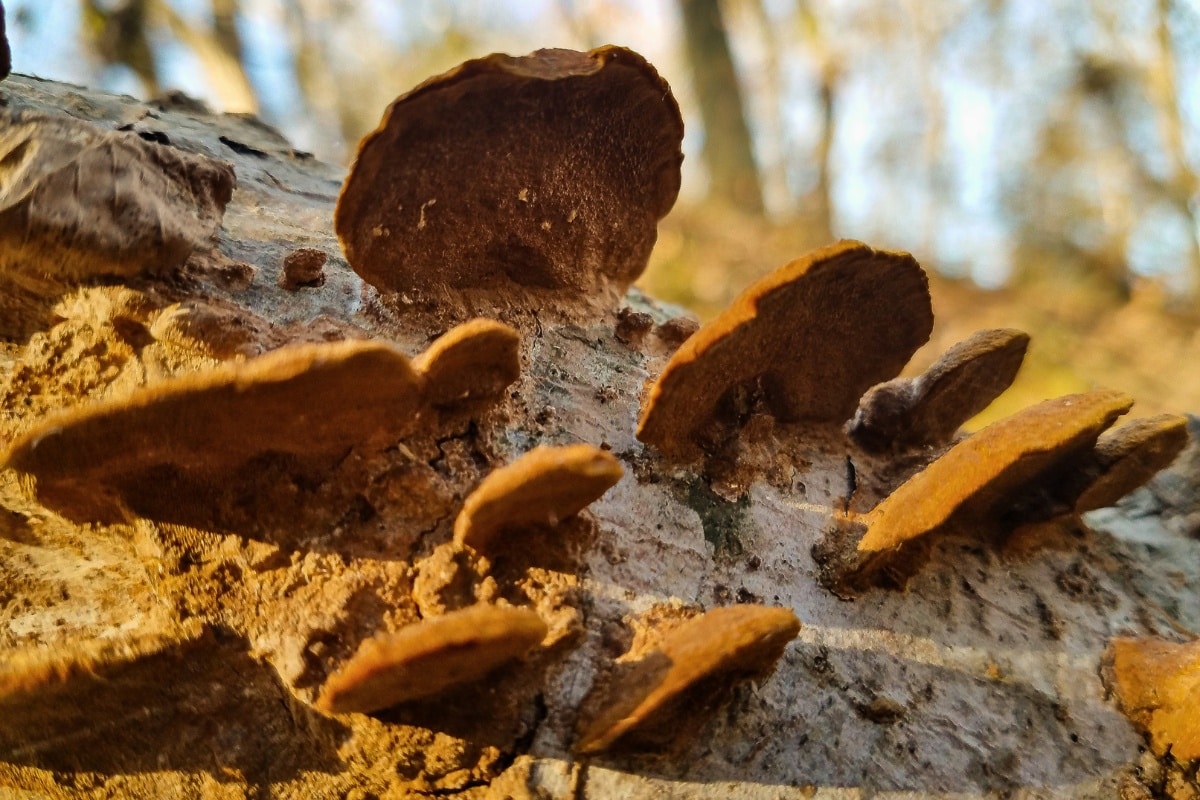
Phellinus gilvus
Phellinus gilvus is another bracket fungus with a yellowish to rusty-yellow fibrous cap. It has a grayish-brown to dark brown pore surface and yellowish-brown flesh. Its flesh is much tougher and woodier than the tender nesting polypore. If there is any doubt, check the KOH reaction. Phellinus gilvus turns black with KOH, not purple.
Hapalopilus croceus
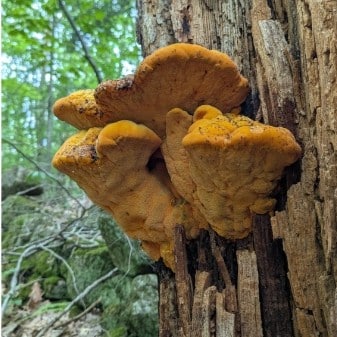
This is a related species that is much larger. Its caps reach up to about 8 inches across, and it grows in dense stacks on a tree. Its pore surface is bright reddish-orange when fresh, but much duller when older. Its size alone is usually enough to differentiate it, but a KOH reaction can be used too. Hapalopilus croceus turns red, not purple.
Tender Nesting Polypore Medicinal Uses
The tender nesting polypore has no recognized medicinal uses. The primary bioactive compound in this mushroom is polyporic acid, which is toxic to mammals.
Polyporic acid is found in some other fungi as well, but in much lower amounts. It is the active ingredient in a Chinese herbal medicine called GuiZhiFuLing, which is made from an extract of a Poria species. (according to a report by the North American Mycological Association). No clinical or medicinal applications have been used with this compound from the tender nesting polypore, though.
Poisonous Traits of the Tender Nesting Polypore
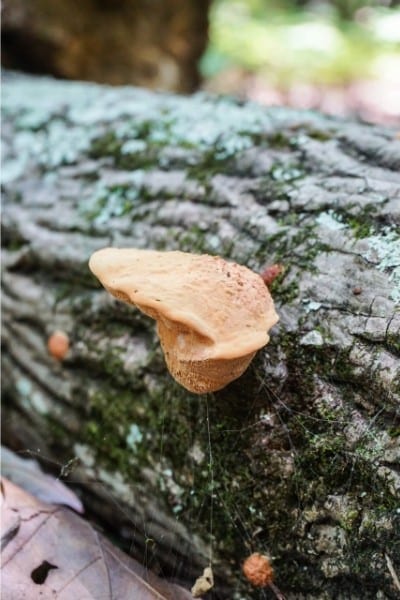
The tender nesting polypore is one of the very few polypore fungi that is genuinely poisonous. Most bracket fungi are either edible, inedible due to toughness, or simply ignored. This one causes real harm if eaten.
The toxin is polyporic acid, and it is present at extremely high concentrations in the fruit bodies. Polyporic acid stops the body’s cells from doing their jobs, and the mushroom is full of it. If the mushroom were dried out completely, somewhere between a fifth and almost half of what’s left would be polyporic acid, which is a huge amount for a single chemical in a mushroom.
In a poisoning case reported in 1992, a German family who ate the mushroom experienced nausea, difficulty with movement, blurred vision, and liver and kidney problems. The symptoms started about 12 hours after the meal. All three family members also had urine that turned violet. Thankfully, they recovered fully within a week.
A similar poisoning case was reported in 2013, where the fungus was mistaken for the edible beefsteak fungus (Fistulina hepatica). The symptoms and recovery were similar to the 1992 case. The pattern of symptoms from eating this mushroom has been called the neurotoxic delayed syndrome.
Recent studies on rats confirmed the same toxic reactions: stomach damage, kidney damage, and loss of motor control.
Dyeing With Tender Nesting Polypores
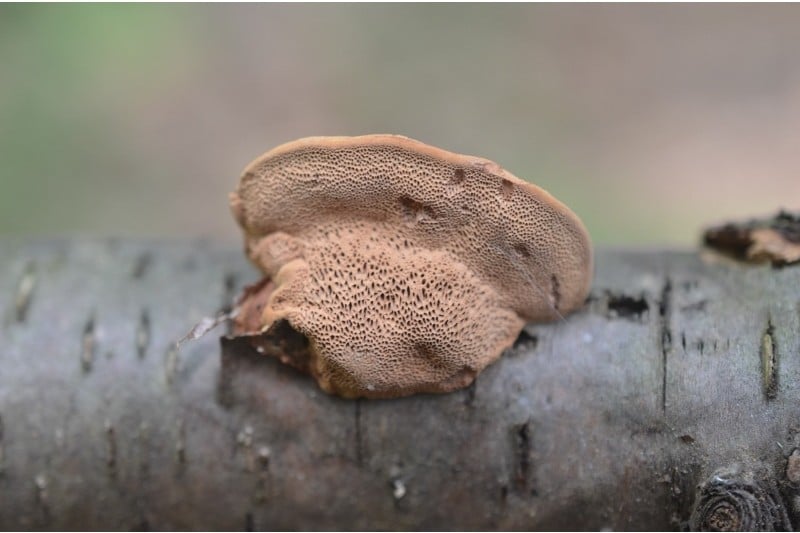
The tender nesting polypore is a prized mushroom among people who dye fabric and yarn with fungi. When the fruit bodies are broken up and placed in hot water with pre-mordanted wool, and the pH is raised with ammonia, the polyporic acid turns the water purple. The color can range from deep purple to bright lavender. Because the mushroom is not especially common, dyers are always looking for it.
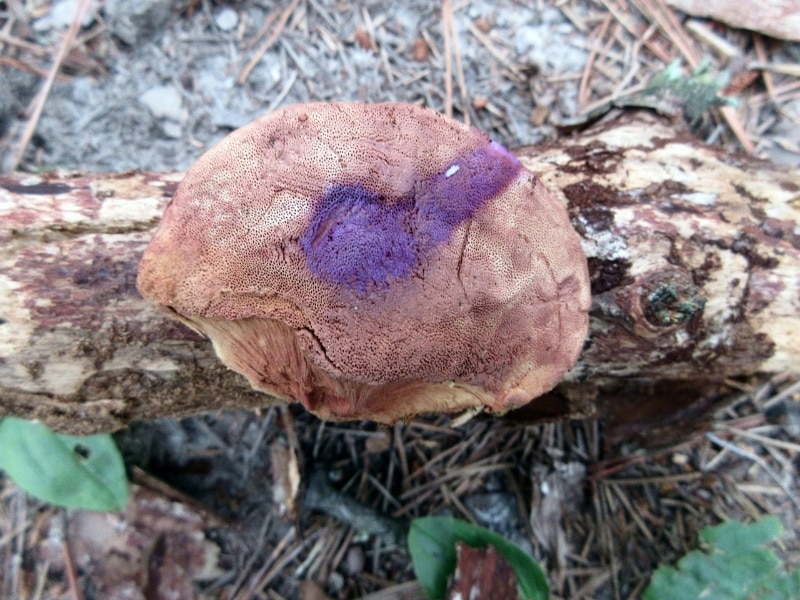
Hapalopilus nidulans by weed lady on Mushroom Observer
Common Questions About The Tender Nesting Polypore
Is the tender nesting polypore edible?
The tender nesting polypore is not edible. It is toxic and should not be eaten under any circumstances. The toxicity of this mushroom is described above.
Leave a Reply