
Do you know the science (and art!) behind the hunting of morels? Do you know where to find them, when to pick, and how to tell a false specimen from the real deal?
This photo gallery celebrates the science and hunting of these special mushrooms. Here you’ll find some pictures of the mushrooms in the wild, pictures of true vs false, and a handy identification chart.
Also included is a close up of how they reproduce and a diagram of their life cycle. Hopefully this gets you more interested in the genus Morchella!
An understanding of the science behind these mushrooms can greatly increase your chances of finding them. If you’re having trouble with your hurt, I can offer some mushroom hunting tips. Also check out my pages on the sport of morel mushroom hunting.
Of course, if you find some you’ll still need a bunch of delicious recipes, and perhaps some cooking tips as well. It’s all here!
This is the second morel photo gallery of three. You can find more pictures by clicking on one of the links below.
So without further ado….
In The Wild
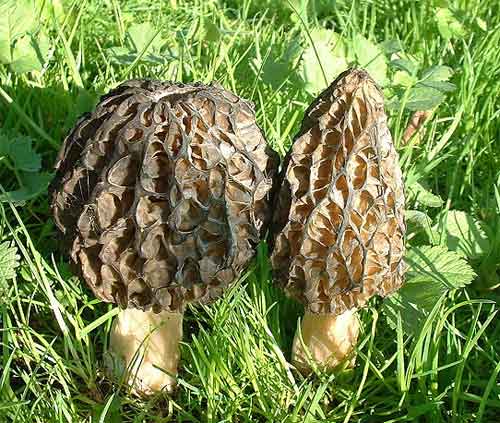
Picture taken by Sharksbaja and is published on Wikipedia under the Creative Commons Attribution Share-Alike 3.0 License.
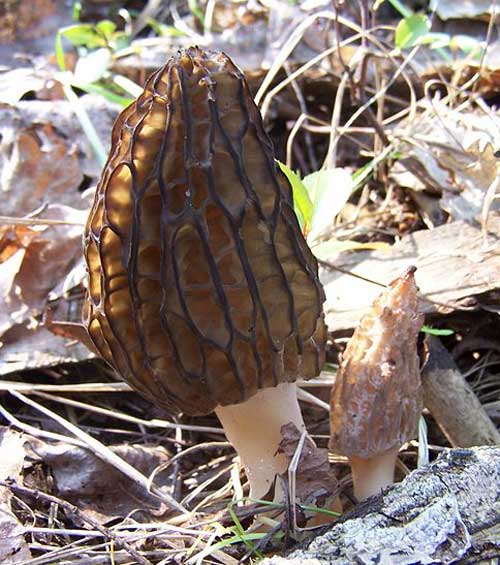
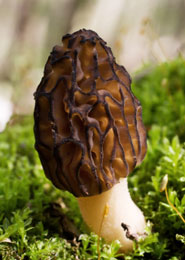
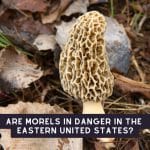
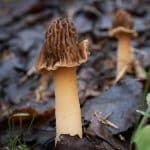
The top two pictures show some mushrooms in the wild. When hunting, it’s important to know where to look and exactly what you’re looking for.
Look for these mushrooms near ash, dying elm, old apple, or tulip trees. They also tend to pop up near areas where the ground has been disturbed, such as burn sites, logging areas, and near downed trees.
The bottom mushroom photo shows an older specimen near a younger one. They’re both black morels, but the one on the right is too immature to have the dark ridges yet. Here I would pick the left one, and leave the right for another day.
Mushroom Hunting – True Vs. False Morels
Picture by Danny Glick and is published on Wikipedia under the Creative Commons Attribution Share-Alike 3.0 License.
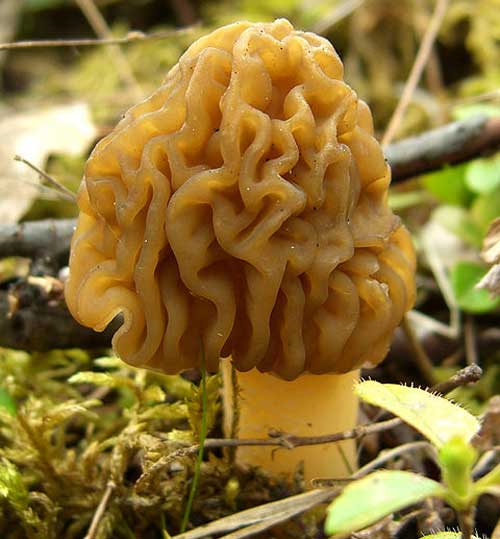
Photo by Jason Hollinger and is published on Wikipedia under the Creative Commons Share Alike 3.0 License.
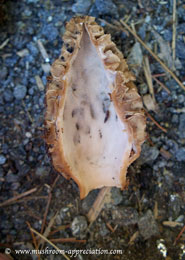
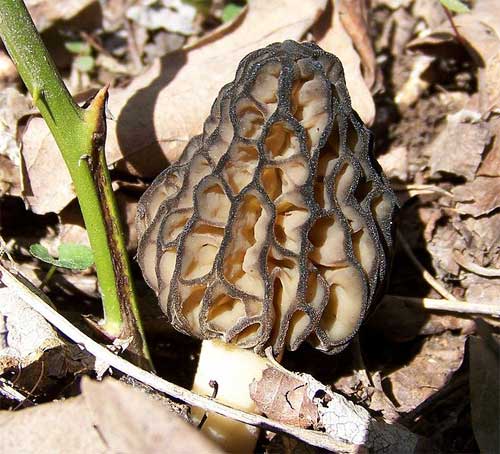
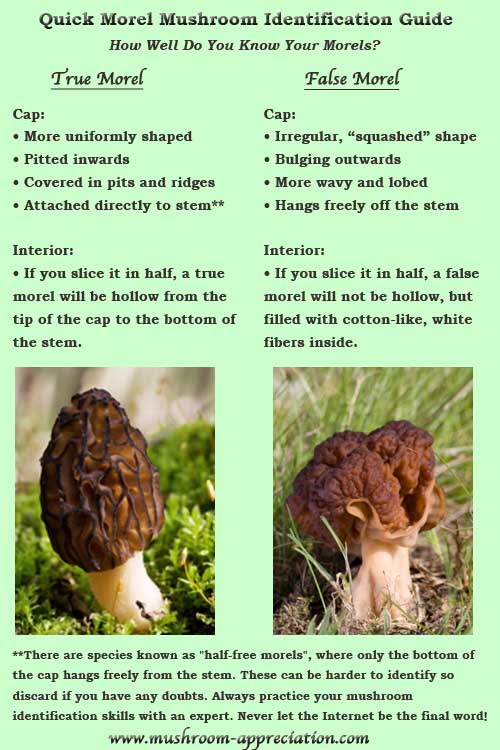
Can you guess which is the true Morchella and which is false?
I’ll give you a hint: the false species have caps that appear “squashed” and bulging outwards. So the bottom picture is the false Verpa bohemica.
Never rely on cap shape alone to identify Morchella species. I would also cut both mushrooms lengthwise to observe the inside (true species are hollow) and stem attachment (true species are attached directly to the stem).
You can learn more about identifying these mushrooms here. Also check out the helpful chart below!
The Joy of Mushroom Hunting
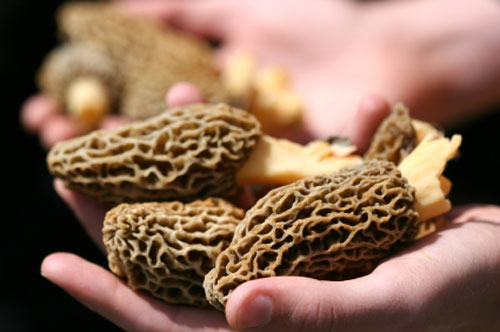
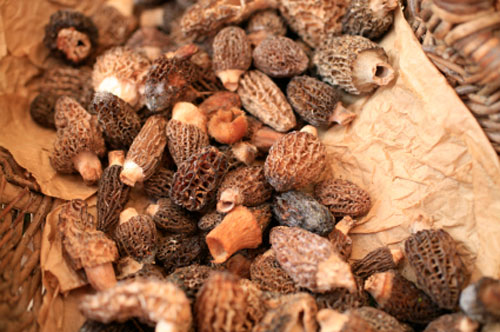
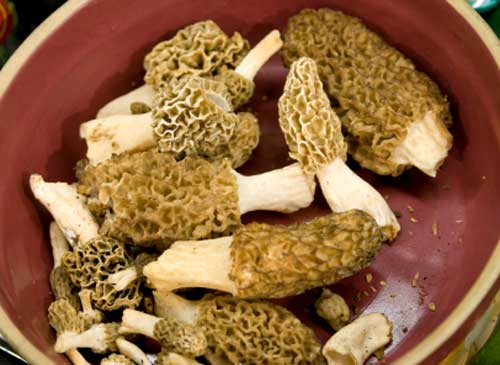
A successful mushroom hunt can be a real thrill! These pictures show some triumphant returns.
Note how in each picture the mushrooms have been sliced at the bottom of the stem, not picked. This is to minimize the amount of dirt picked. A meal of mushrooms is delicious. A meal of dirt is not!
A Little Morchella Science
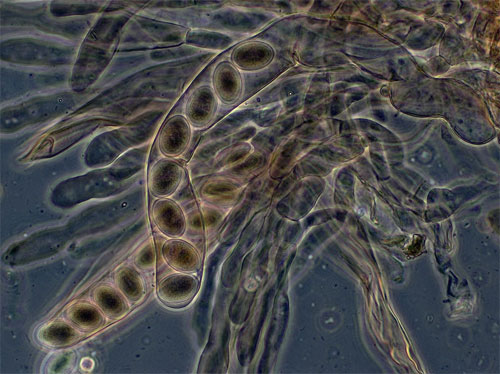
Close-up photo taken by Peter G. Werner and is published on Wikipedia under the GNU Free Documentation License.
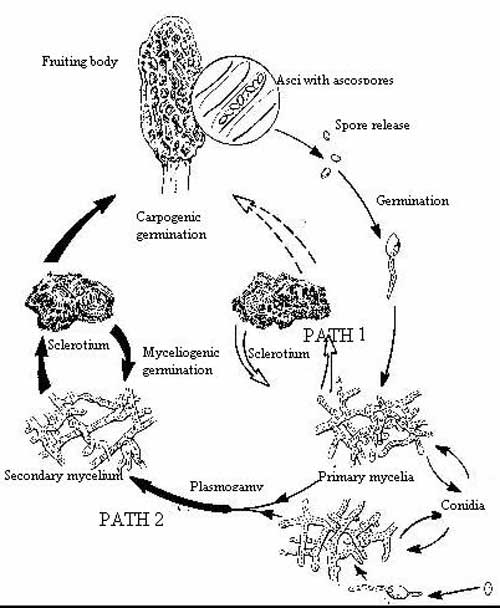
Awesome chart by Tom Volk (Volk and Leonard 1990, Volk and Leonard, 1989) and is taken from Tom Volk’s page.
Species in the Morchella genus belong to the Phylum known as Ascomycota. These mushrooms are defined by their asci, the sex cells of the fungus that bear spores. Each ascus usually houses eight ascospores.
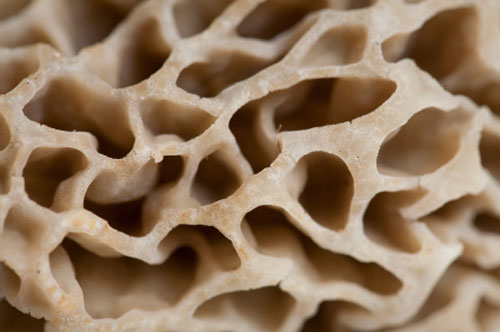
You can see these sex cells in the top photo. Note the eight spores in each ascus. This picture is so detailed, I just love it!
The bottom diagram shows the life cycle. Spores germinate and fuse into mycelia, and the mycelia create sclerotia. A sclerotium is a hardened mass of mycelium used as a reserve in times of difficult environmental conditions.
If conditions are right, these sclerotia give rise to mushrooms. Many mushrooms don’t produce sclerotia, another reason why these are so difficult to cultivate!
Patricia A Fuller says
Thank you for all the interesting information. I hope to get out and start some searching. I did buy a bag of spores as well; I think I was supposed to prepare soil and scatter them in the fall. Do you have any experience with the best technique to try propagating them? I have heard it’s tricky trying to grow them yourself.
Thank you!
Jenny says
Honestly, and I’m sorry to say it, but I hope the spores weren’t a scam. It is notoriously difficult to propagate morels and there are a ton of less-than-honest suppliers out there trying to make a quick buck. The company should say it’s experimental and provide advice on how to propagate them. The thing is, there are many morel species and what’s best for them depends which type you have. There are landscape morels (the easiest to attempt) which grow in mulch and more tree-loving species that, well, need trees. Not only are you trying to emulate the growth habitat, but if you have one of the tree-preferring species, you have to somehow recreate the mycelial bond with the tree. First, find out which type you have. Then, prepare the best space for them based on that, and then wait and don’t have many expectations… I don’t want to sound pessimistic, but I generally am about growing morels. It’s not just tricky, its almost impossible