
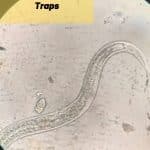
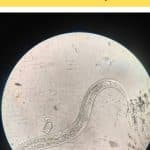
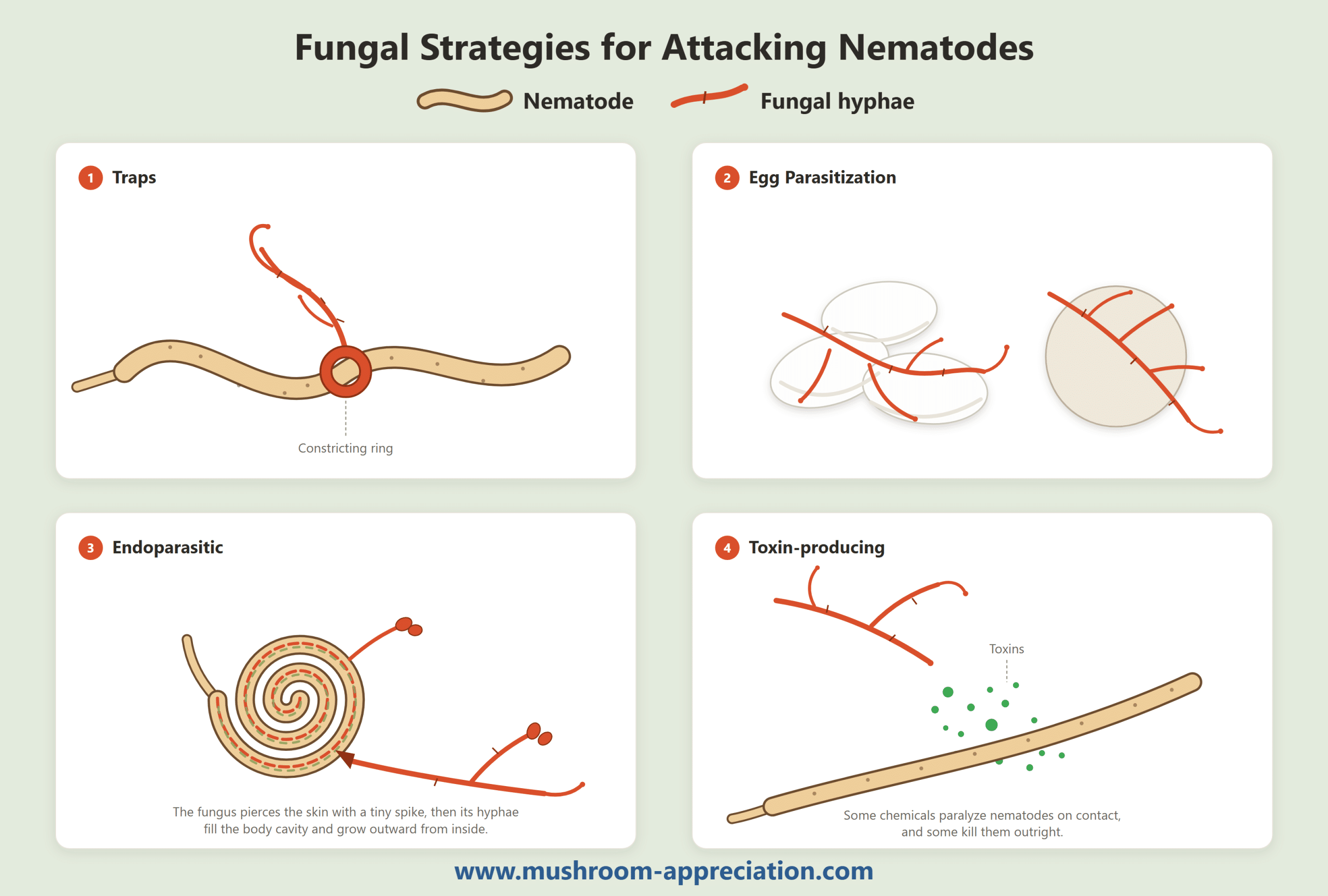
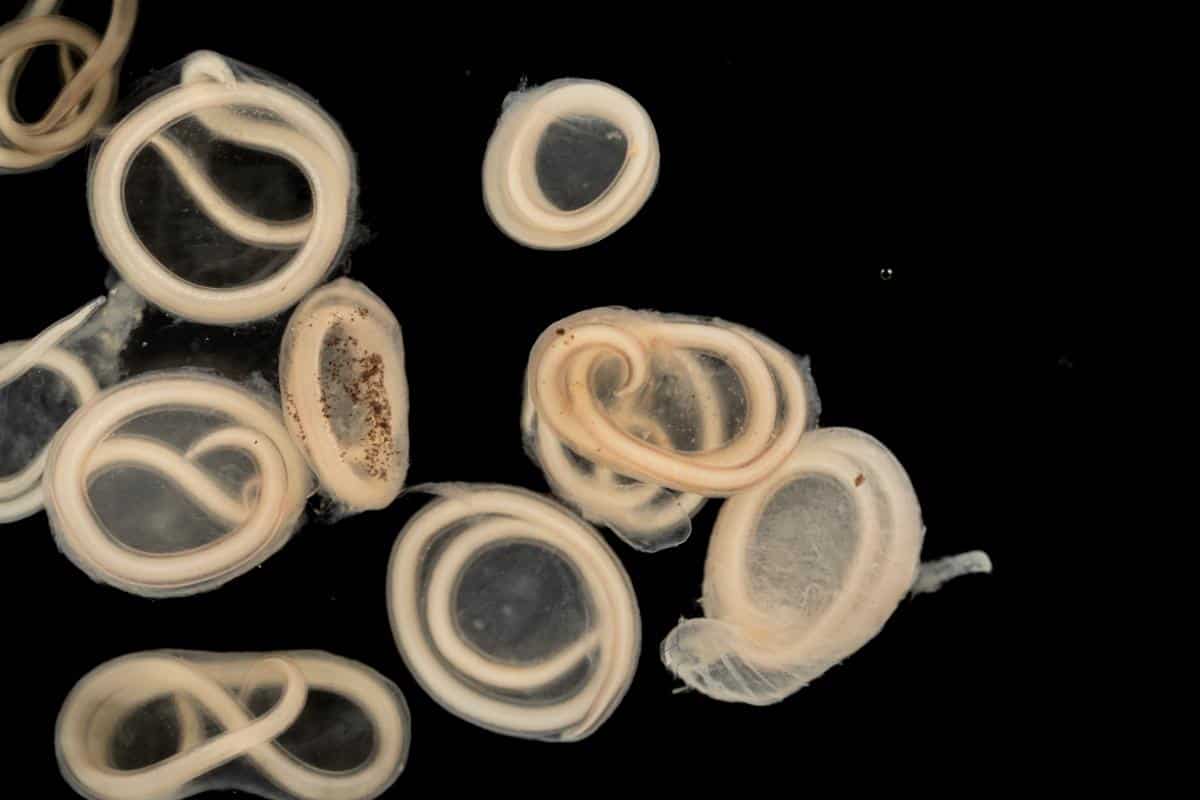
Predatory fungi are species that attack and digest small animals, most often nematodes, which are tiny roundworms that live in soil and water. There are more than 700 species of nematode-eating fungi, and they have some interesting hunting tactics! Some species build physical traps for the nematodes, while others use toxins, infectious spores, or attack the nematode’s eggs.
Most predatory fungi don’t depend entirely on hunting for their food. They are often also saprophytic and get their nutrients in other ways until those nutrients get scarce; then they’ll switch to hunting. The traps they use range from sticky nets to rings that close around a worm, and some mushrooms, including oyster mushrooms, shaggy ink caps, and wine caps, use their underground mycelium to infiltrate and kill the tiny worms.
Jump to:
What Are Predatory Fungi?
Predatory fungi are fungi that kill and absorb small animals. Most hunt nematodes, tiny roundworms, and more than 700 species of nematode-eating fungi are known, although they do not all hunt in the same way.
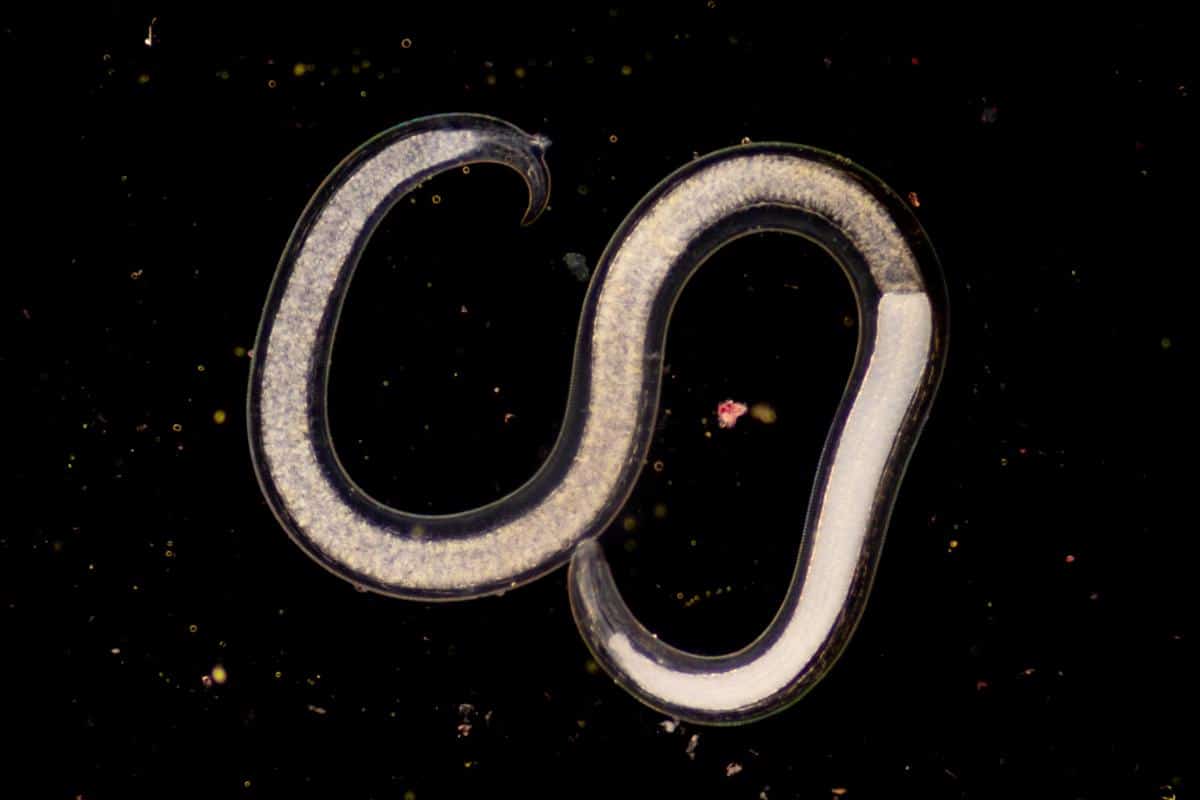
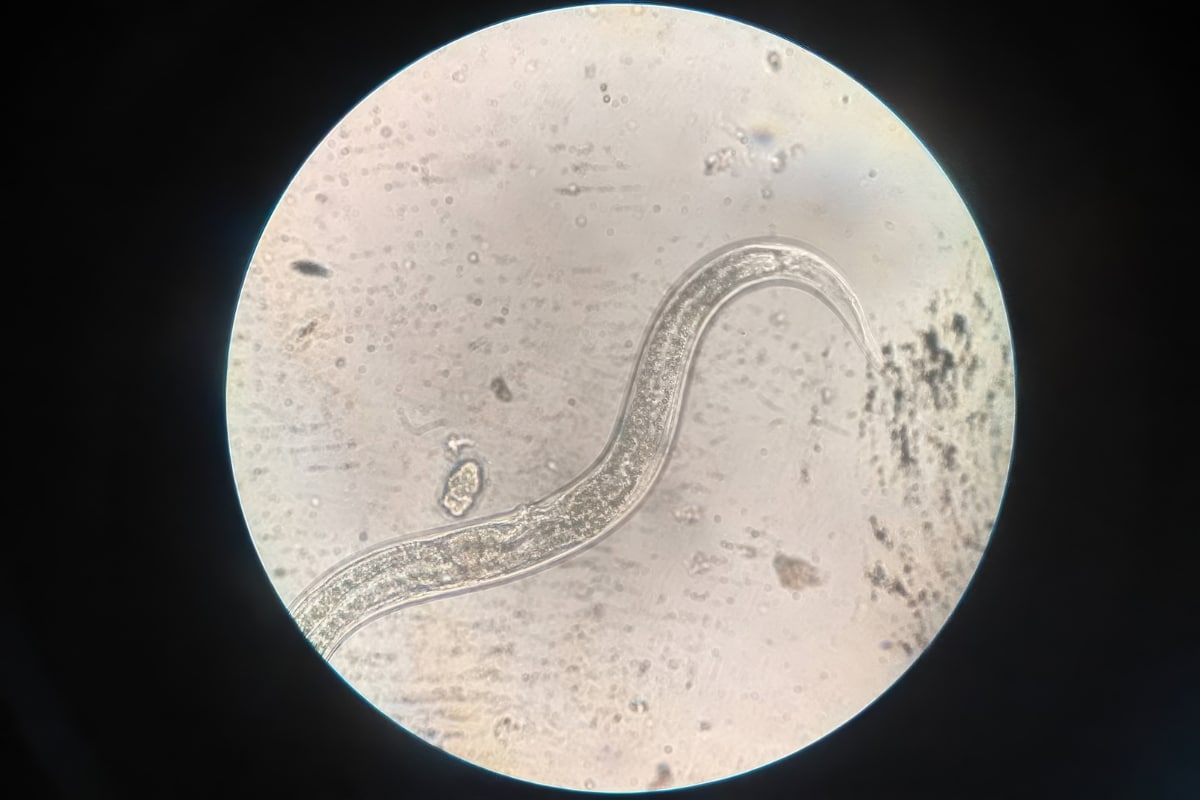
The main body of a fungus is underground or in the wood and is made up of fine threads called hyphae, which, en masse, are called mycelium. In predatory species, the mycelium can trap a nematode or enter its body. The fungus then breaks down the animal’s tissues and absorbs the released nutrients. Most of this hunting activity is not visible to the naked eye and can only be seen under a microscope.
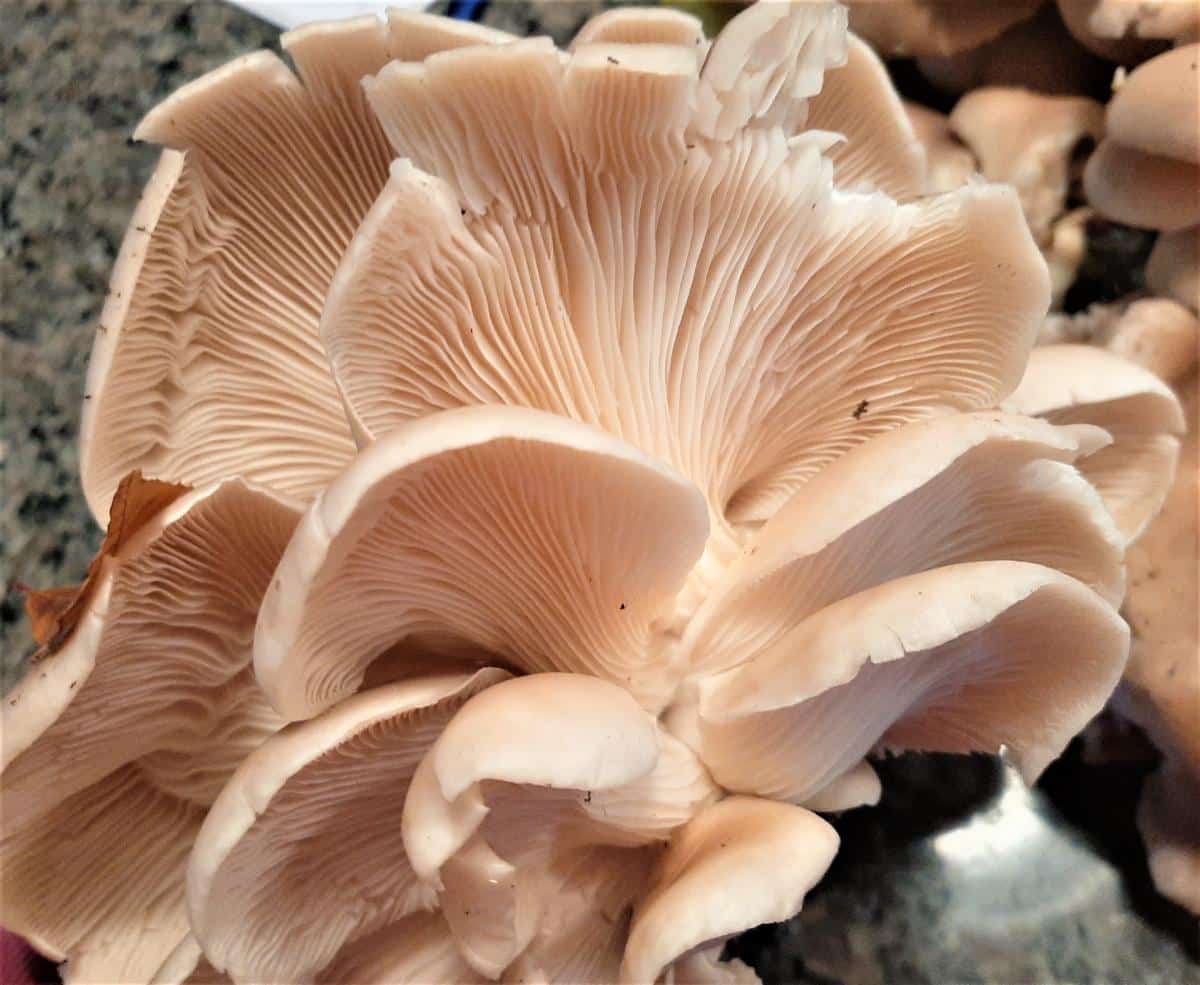
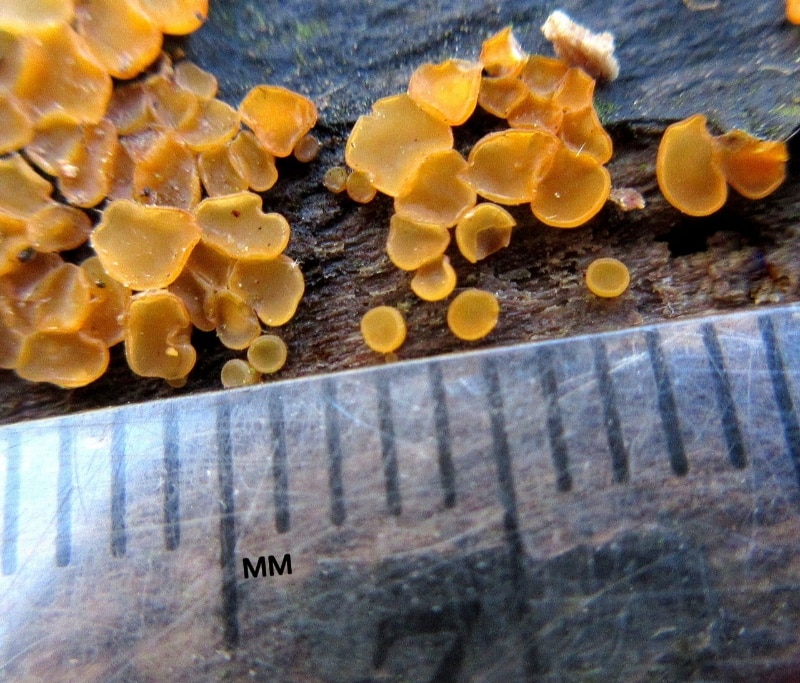
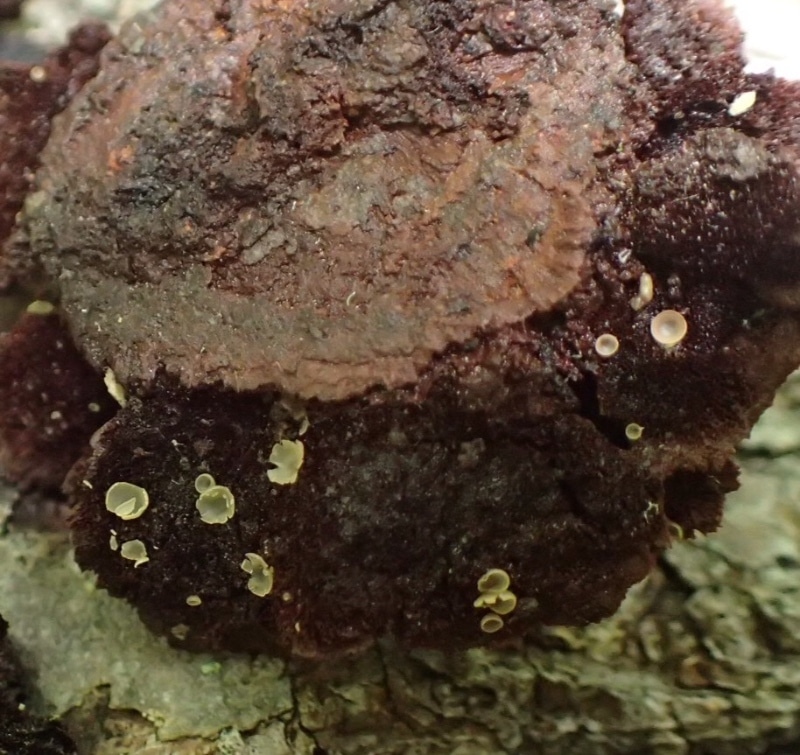
Some predatory fungi make visible mushrooms, but the mushroom is only their reproductive structure. Oyster mushrooms, shaggy ink caps, wine caps, and Laccaria bicolor all produce fruiting bodies we can see, but their hunting happens underground or deep in the infiltrated wood. Other species make small, translucent, waxy discs called Orbilia on rotting wood. Many trap-building fungi have no noticeable fruiting body, so it’s hard to see them without examining their traps under a microscope.
About 380 species build specialized physical traps. Others release toxins, grow inside nematodes after their spores are swallowed, or pierce nematode eggs. Most of these species will also feed on dead organic material, in addition to hunting.
The ability to hunt evolved independently in three major fungal lineages; they do not share a common ancestor. The best-studied trap builders belong to the family Orbiliaceae. This family includes species that form three-dimensional adhesive networks, make stalked sticky knobs or passive rings, and use constricting rings.
How Sticky Traps Work
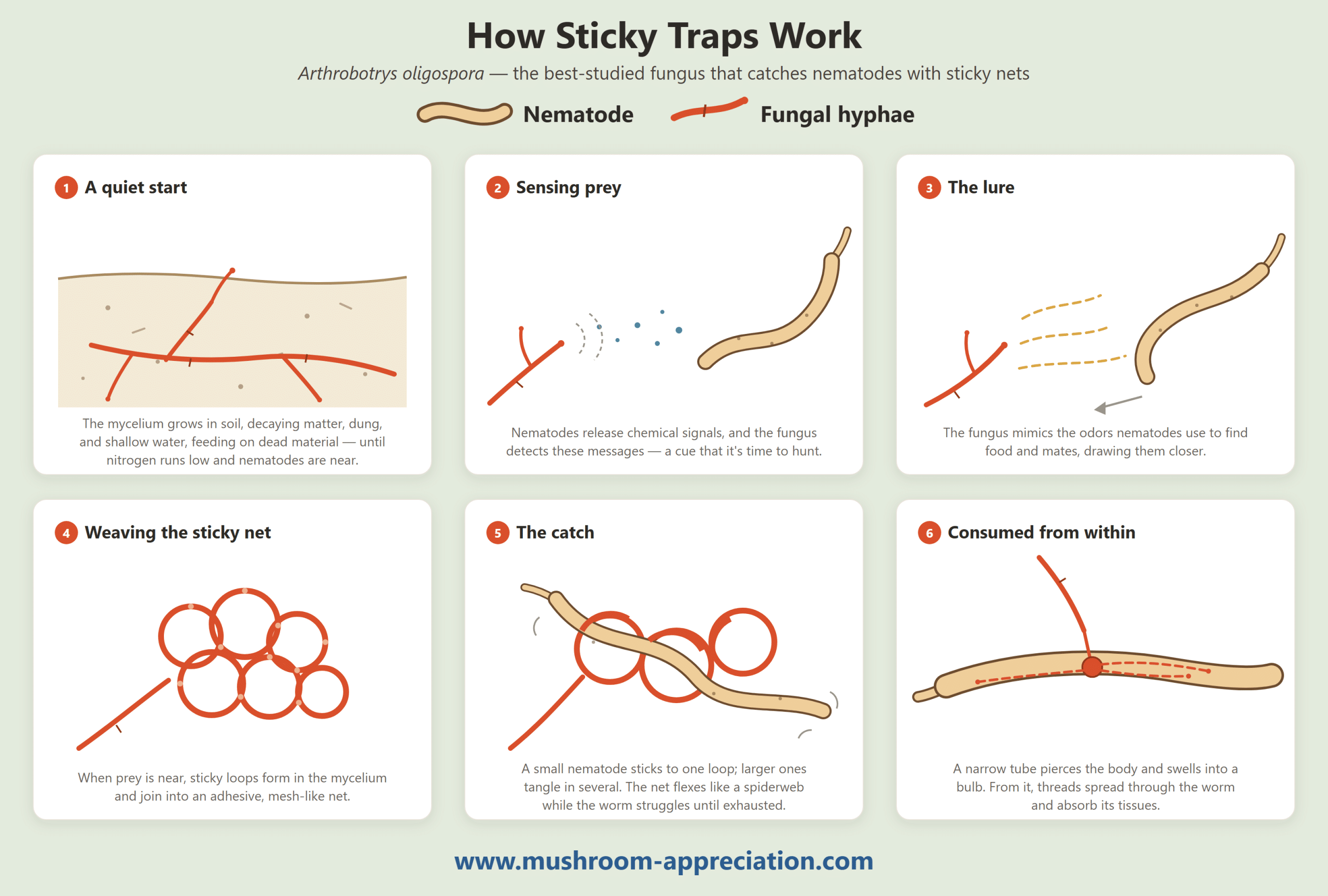
Arthrobotrys oligospora is the best-studied fungus that catches nematodes with sticky nets. Its mycelium grows in soil, decaying material, animal dung, and shallow water across much of the world. For much of its life, the fungus absorbs nutrients from dead material rather than hunting. But when nitrogen becomes scarce and nematodes are nearby, its mycelium begins creating traps.
Nematodes release chemical signals that regulate their development and behavior. Many species of predatory fungi can detect these chemical messages, and when they do, they know it’s a good time to start hunting.
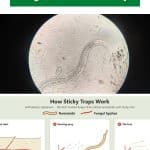
The fungus doesn’t just wait for a nematode to wander into its trap, though. It gives off odors that resemble the signals nematodes use to find food or mates, which can lure them closer. When prey is nearby, the fungi form sticky loops in their mycelium that join together into a net. By repeating this, they create a mesh-like surface. The mesh is also adhesive.
A small nematode can get stuck to a single loop, while a larger one may only get stuck if it gets tangled in several loops. The net flexes as the animal struggles in it, just like with a fly in a spiderweb, and while it struggles, the worm drags the attached threads until it becomes exhausted.
Then the fungus sends a narrow tube through the nematode’s body, and once the tube reaches the inside, it swells into a bulb. After that, the fungus sends mycelial threads outward from that bulb until they extend through the animal and absorb its tissues. Researchers have found no competing fungi or bacteria in nematodes killed and eaten this way, which has led to the suggestion that A. oligospora may release an antibiotic inside its prey.
Constricting Rings
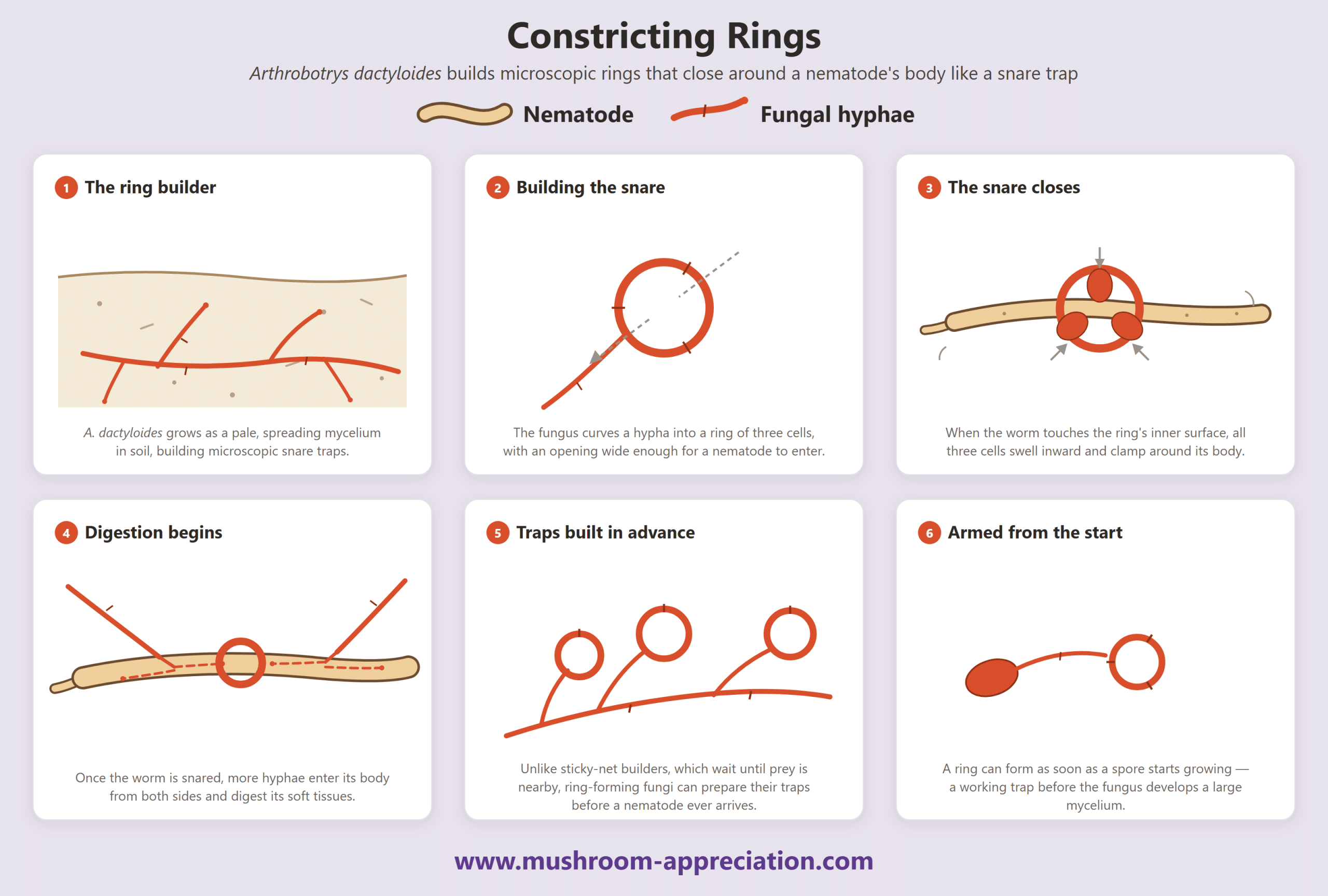
Some fungi create rings that close around the worm’s body, like a snare trap. One of them is Arthrobotrys dactyloides, a microscopic trap builder with a pale, spreading mycelium that grows in soil.
To build its trap, the fungus curves one of its hyphae into a ring made of three cells. The opening of the ring is wide enough for a nematode to enter, but when the worm touches the inner surface, all three cells swell inward and clamp around its body. Once the nematode is captured in the snare trap, more hyphae enter its body on both sides and digest its soft tissues.
Ring-forming fungi can prepare their traps before their prey arrives, which is different from sticky trap builders who wait until nematodes are nearby before building. A. dactyloides can even form a ring as soon as one of its spores begins to grow, which means the young fungus can create a working trap before it develops a large mycelium.
Spines and Other Physical Weapons
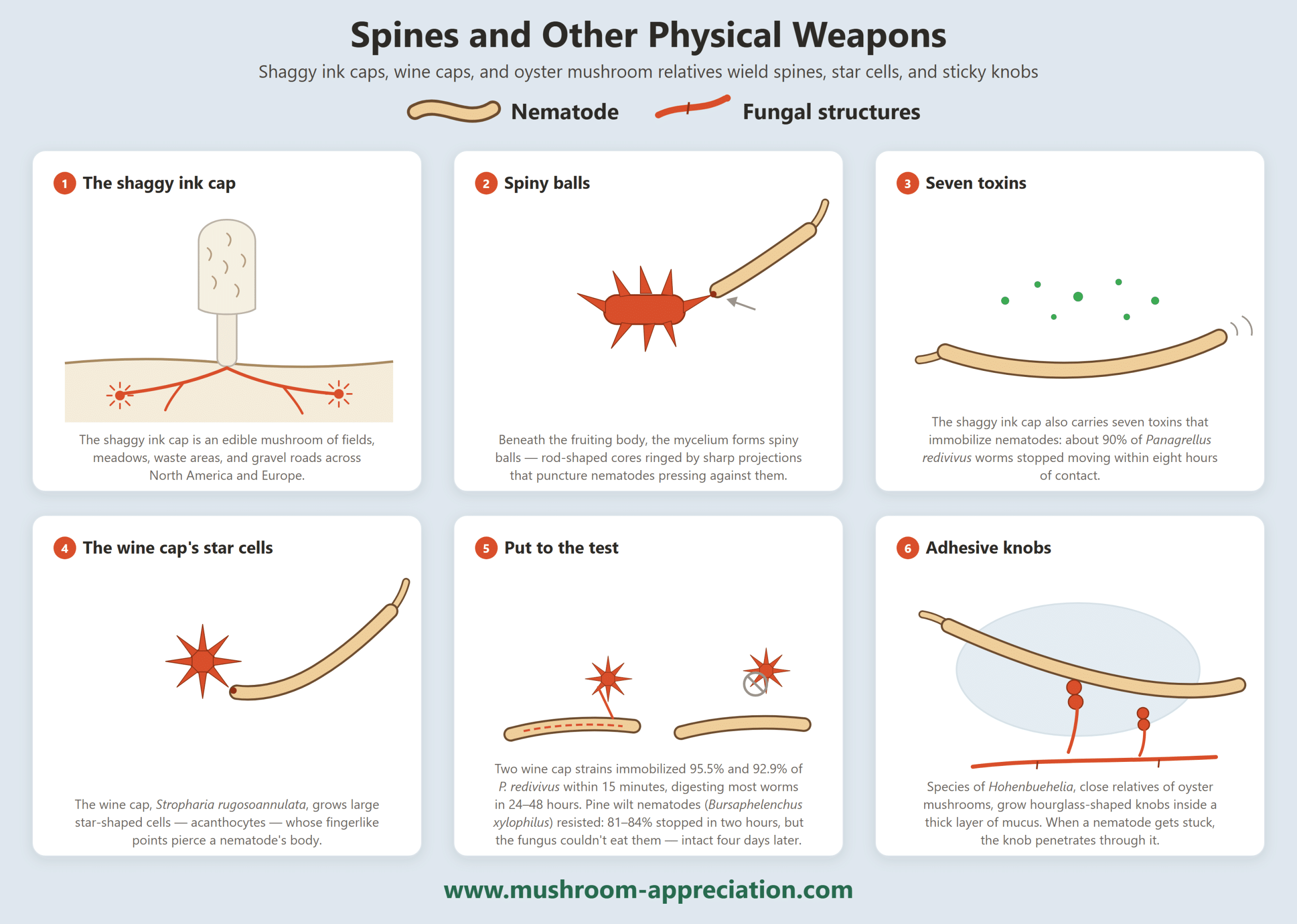
The shaggy ink cap, an edible species, grows in fields, meadows, waste areas, and along gravel roads in North America and Europe. Underneath its fruiting body, its mycelium forms structures called spiny balls. These are made up of a rod-shaped core surrounded by pointed projections. When a nematode presses against the spiny balls, the projections puncture its body.
The shaggy ink cap also has seven toxins that immobilize nematodes. In one experiment, about 90 percent of Panagrellus redivivus micro worms stopped moving within eight hours of contact with shaggy inkcap cells.
The wine cap, Stropharia rugosoannulata, uses a related structure called an acanthocyte. Each acanthocyte is a large, star-shaped cell with fingerlike points that can pierce a nematode’s body.
In studies, two wine cap strains immobilized 95.5 and 92.9 percent of P. redivivus within 15 minutes, and most of the worms were digested within 24 to 48 hours. The pine wilt nematode, Bursaphelenchus xylophilus, resisted longer, and 81 to 84 percent of them were immobilized after two hours. However, even though the fungus killed that species, it could not eat it, and the dead worms were still intact after four days.
Other gilled fungi use adhesive knob structures instead of spines to hunt nematodes. Species of Hohenbuehelia, close relatives of oyster mushrooms, form hourglass-shaped knobs inside a thick layer of mucus. When a nematode gets stuck in the mucus, the knob penetrates through it.
How Oyster Mushrooms Kill Nematodes
The oyster mushroom, Pleurotus ostreatus, is both a widely cultivated edible mushroom and a nematode predator. It breaks down dead or dying deciduous wood, especially beech, where carbon is available but nitrogen may be limited. Its mycelium gains additional nitrogen by paralyzing and consuming nematodes.
The mycelium of oyster mushrooms has fragile, lollipop-shaped structures called toxocysts. When a nematode touches and breaks one of these toxocysts, it releases its toxic contents. The toxin paralyzes the worms and eventually kills them. After the nematode becomes immobile, the oyster mushroom’s mycelium enters its body and consumes it from the inside.
Fungi That Attack from Inside
Endoparasitic fungi are fungi that live and feed inside another organism. Instead of trapping a nematode in an external trap, these fungi infect it with spores. When a nematode encounters the fungus’s spores, it may swallow them, or the spores may attach to its skin. The spores then germinate, and their mycelium spreads through the worm and absorbs its tissues. Later, the fungus grows tubes through the nematode’s skin and releases new spores into the surrounding environment.
Harposporium anguillulae has curved, sickle-shaped spores that it uses for this. When a nematode swallows the spores, they lodge in its esophagus or gut before germinating.
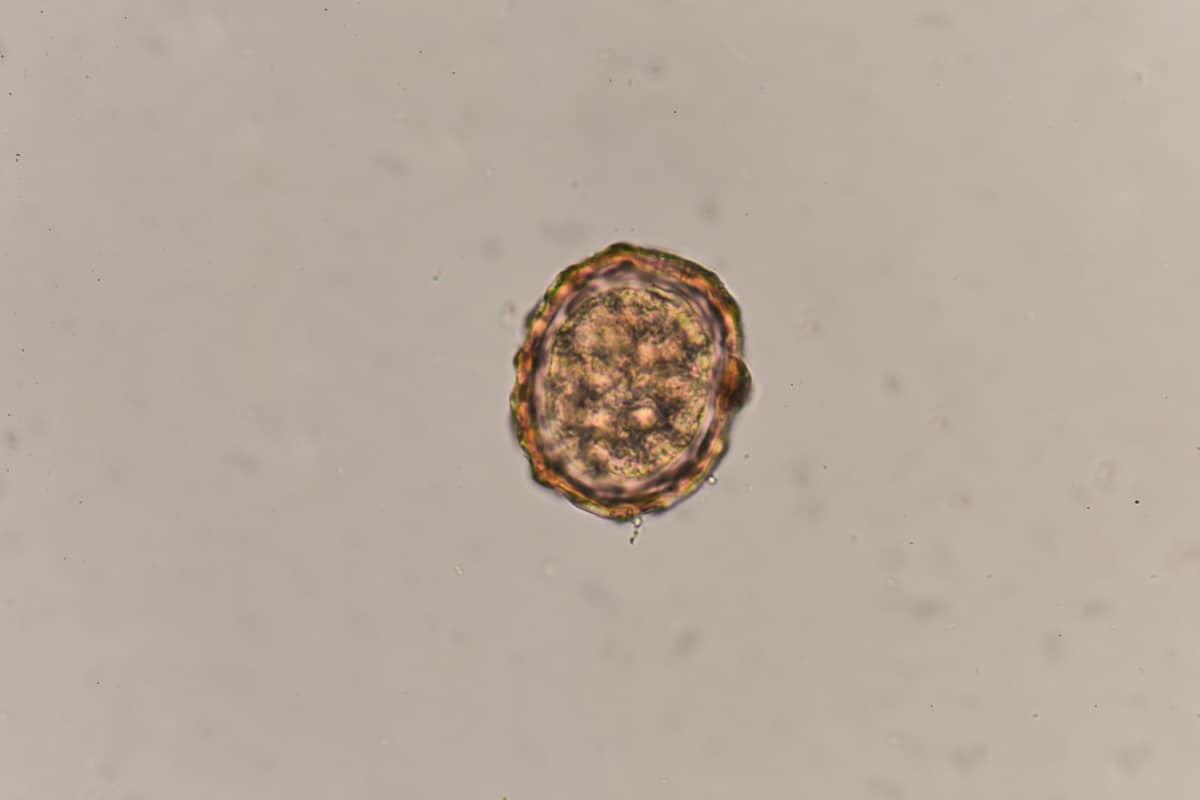
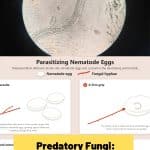
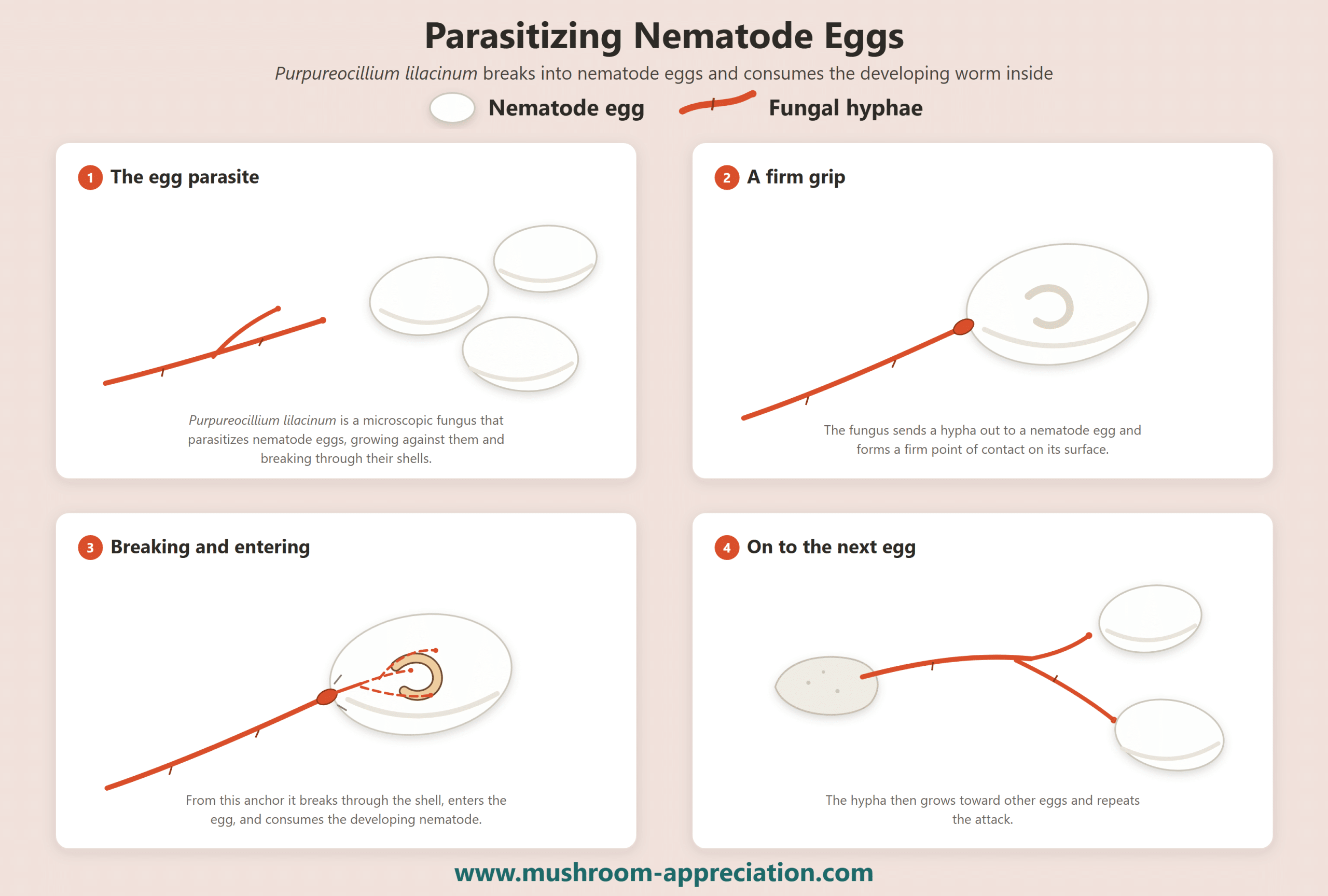
Some fungi parasitize nematode eggs by growing against a nematode egg and breaking through its shell. One of these fungi is Purpureocillium lilacinum, a microscopic species that sends its hypha out to a nematode egg and forms a firm point of contact.
The fungus uses this spot to break through the shell and enter the egg. When the fungus pierces the egg covering and enters, it consumes the developing nematode. The hypha can then grow toward other eggs and repeat the attack.
P. lilacinum can attack the eggs of the root-knot nematode Meloidogyne incognita. It is highly adaptable and can feed on dead material, other fungi, insects, or nematodes, depending on available nutrients. It grows in forests, fields, deserts, cultivated soils, sewage sludge, estuarine sediments, and insects. Its flexibility has made it a candidate for crop protection, but it is also an infrequent cause of fungal infection in people with weakened immune systems.
Fungi That Hunt Other Small Animals
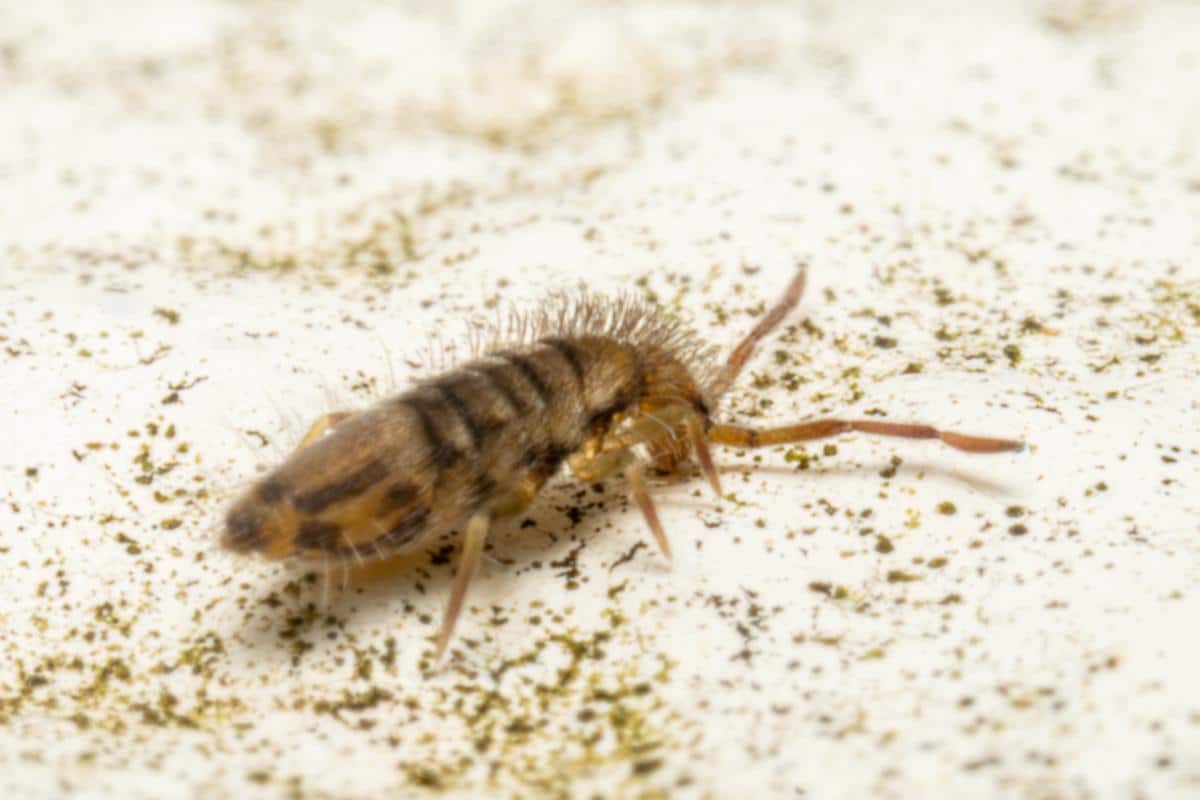
Laccaria bicolor, a small mushroom with lilac colored gills, attacks springtails. The fungus paralyzes these tiny arthropods and absorbs their nitrogen through its mycelium.
In a 2001 experiment, Laccaria bicolor in an eastern white pine stand killed springtails and absorbed nitrogen from their bodies. The fungus passed some of this nitrogen to the roots of the trees, which supplied it with carbon in return. Up to 25 percent of the trees’ nitrogen came from the springtails, via the fungi.
Where Predatory Fungi Live
Nematode-trapping fungi live across the world, from the tropics to Antarctica. On land, they grow in soil, and the widest range of species is found usually between 4 and 12 inches below the surface. They also live in freshwater, brackish, and saltwater. The freshwater species that have been studied were concentrated in shallower areas. In one pond, they were found only where the water was less than about 13 feet deep (this single pond does not establish a depth limit for aquatic species everywhere, though).
Soil conditions influence where predatory fungi live. Moisture, acidity, nutrient levels, metals, and the number of nematodes all affect the local fungal community. Fungi with constricting rings occur more frequently in richer soils with larger nematode populations, while knob-forming predators are more common in low-nutrient soils. Net-forming species can be found in both nutrient-rich and nutrient-poor soils. One survey also found more trapping fungus species where lead concentrations were higher, although that relationship does not establish that lead caused the difference.
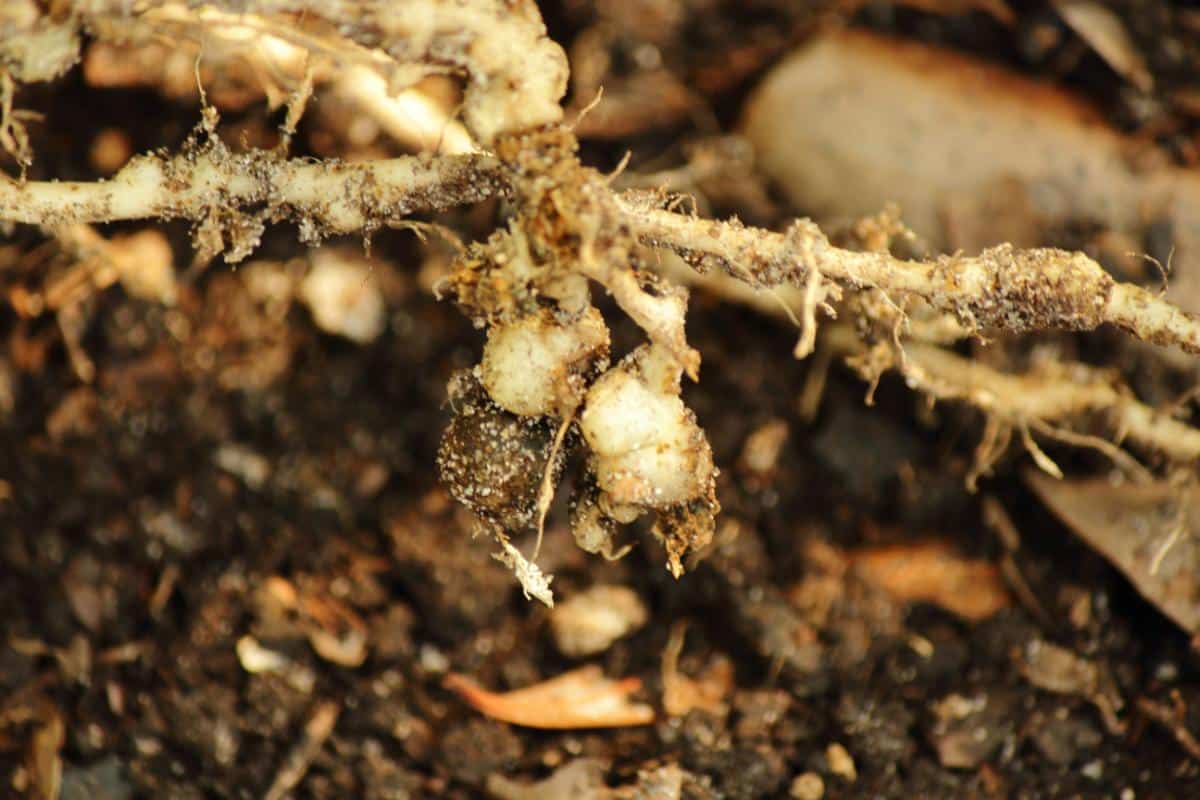
Plant roots are another place that predatory fungi hunt. The fungus A. oligospora grows around tomato and barley roots because there are a lot of nematodes around. As fungi developed ways to detect, trap, and poison nematodes, nematodes developed defenses against them, including including avoidance, mimicry, and remaining motionless.
History of Predatory Fungi
Scientists knew about some of these fungi species before discovering they hunted for food. Arthrobotrys oligospora was described in 1850, but its hunting behavior wasn’t known until 1888, when Wilhelm Zopf watched it catch nematodes. In the 1930s, Charles Drechsler studied these fungi more closely and described the different traps they make.
The full picture of how these predatory fungi operate took much longer to understand because one fungus can have two very different forms. It may hunt in soil as microscopic hyphae, then form a visible spore-producing body on rotting wood. It wasn’t until 1994 that researchers confirmed that an Arthrobotrys hunter and an Orbilia disc were two stages in the life of the same fungus.
Research also found that predation was not limited to these small soil fungi. In 1984, scientists confirmed that members of the oyster mushroom family could kill nematodes. DNA studies in the 1990s then helped researchers sort the trap builders into related groups and link each group to the type of trap it makes.
Scientists estimate that fungi developed this predatory way of life about 419 million years ago. Nematodes were already present by then, having emerged roughly 550 to 600 million years ago. The types of traps changed over time, and fungi with constricting rings may have separated from those with sticky traps about 246 million years ago. Several kinds of sticky traps may then have developed between 198 and 208 million years ago.
Researchers disagree about which sticky trap developed first. Some studies say nets developed before sticky knobs, while others place knobs before nets. A genetic study has proposed that simple knobs and constricting rings developed along separate branches from an early fungus with an adhesive trap. This model explains how the different traps may be related, but it has not settled the disagreement about their order.
The oldest direct evidence of predatory fungi comes from a fungus preserved in amber about 100 million years ago in what is now southwestern France. Its hyphae had sticky rings, and several small nematodes lay nearby as possible prey. Each ring was made from a single cell, unlike the three-celled rings used by the current constricting ring fungi. Because the fossil does not match any modern group, it may belong to an ancient line of hunters that later disappeared. Its trapping method also supports the idea that different fungi developed their own ways of catching animals.
Can Predatory Fungi Control Crop Pests?
Nematodes that parasitize plants cause an estimated 5 to 12 percent of global crop losses each year (costing around $100 billion). Chemical products used to kill these crop-damaging nematodes are called nematicides. The worldwide market for these chemicals is worth billions, but concerns about their effects on human health and the environment have led researchers to look for another option: using predatory fungi to control the worms.
Some fungal treatments are already sold commercially. Once added to the soil, these fungi are meant to attack the nematodes that damage plant roots.
Researchers are also studying other predatory fungi species to see whether they work to combat nematodes. The constricting ring fungus A. dactyloides grows slowly and dries out easily, so researchers have experimented with placing it in protective granules that can be mixed into soil. The egg parasite Purpureocillium lilacinum has been registered for use in numerous countries, but some strains work better than others, and success varies.
There are fungi that work well in a laboratory but might not work once in an actual field. Some grow too slowly to become established, which is problematic because there are bacteria and other fungi already living in the soil that compete with them for space and food. Mites and nematodes that eat fungi also might eat the mycelium of predatory species before they have time to create enough traps. Another issue is that predatory fungi may also catch helpful nematodes along with crop pests, since they do not necessarily distinguish between them.
References:
- Mykoweb — “Fungal Snares and Other Sticky Ends” (Vellinga, Mycena News, Feb. 2008): https://www.mykoweb.com/articles/FungalSnares.html
- Jiang, Xiang & Liu (2017). “Nematode-Trapping Fungi.” Microbiology Spectrum 5(1). PMC11687430: https://pmc.ncbi.nlm.nih.gov/articles/PMC11687430/
- Lee et al. (2023). “A carnivorous mushroom paralyzes and kills nematodes via a volatile ketone.” Science Advances 9(3):eade4809. PMC9848476: https://pmc.ncbi.nlm.nih.gov/articles/PMC9848476/
- Luo et al. (2007). “Coprinus comatus damages nematode cuticles mechanically with spiny balls and produces potent toxins to immobilize nematodes.” Appl. Environ. Microbiol. 73(12):3916–3923. PMC1932715: https://pmc.ncbi.nlm.nih.gov/articles/PMC1932715/
- Luo et al. (2006). “Acanthocytes of Stropharia rugosoannulata function as a nematode-attacking device.” Appl. Environ. Microbiol. 72(4):2982–2987. PMC1449000: https://pmc.ncbi.nlm.nih.gov/articles/PMC1449000/
- Schmidt, Dörfelt & Perrichot (2007). “Carnivorous Fungi from Cretaceous Amber.” Science 318:1743. PDF fetched: http://www.bio-nica.info/biblioteca/Schmidt2007CarnivorousFungi.pdf
- National Geographic — “Meet the fungus that can transform into a carnivorous predator” (Gurudev, Dec. 12, 2023): https://www.nationalgeographic.com/environment/article/worm-eating-fungus-predator-nematodes

Leave a Reply