

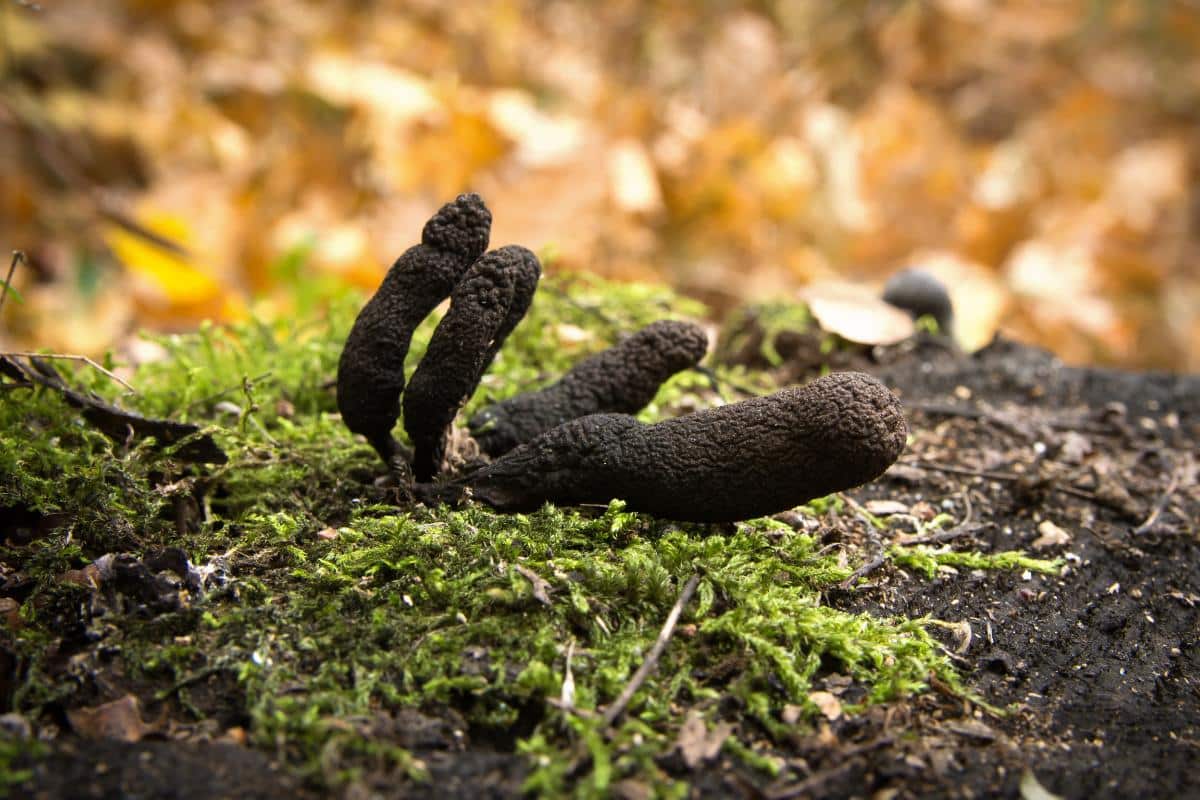
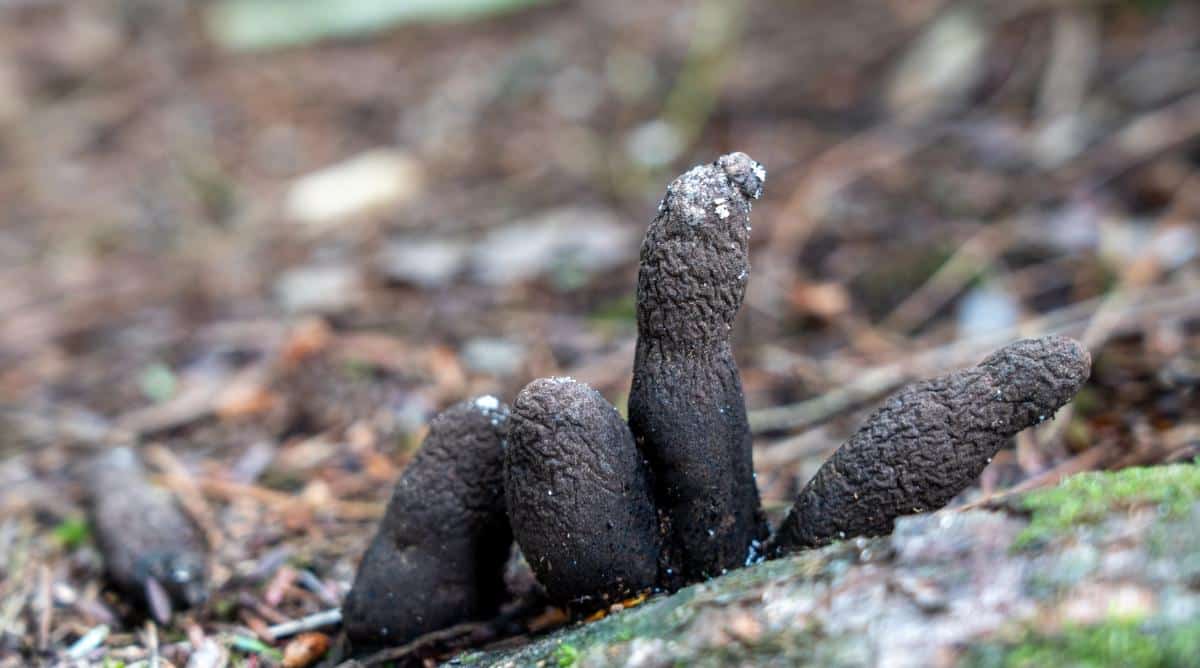
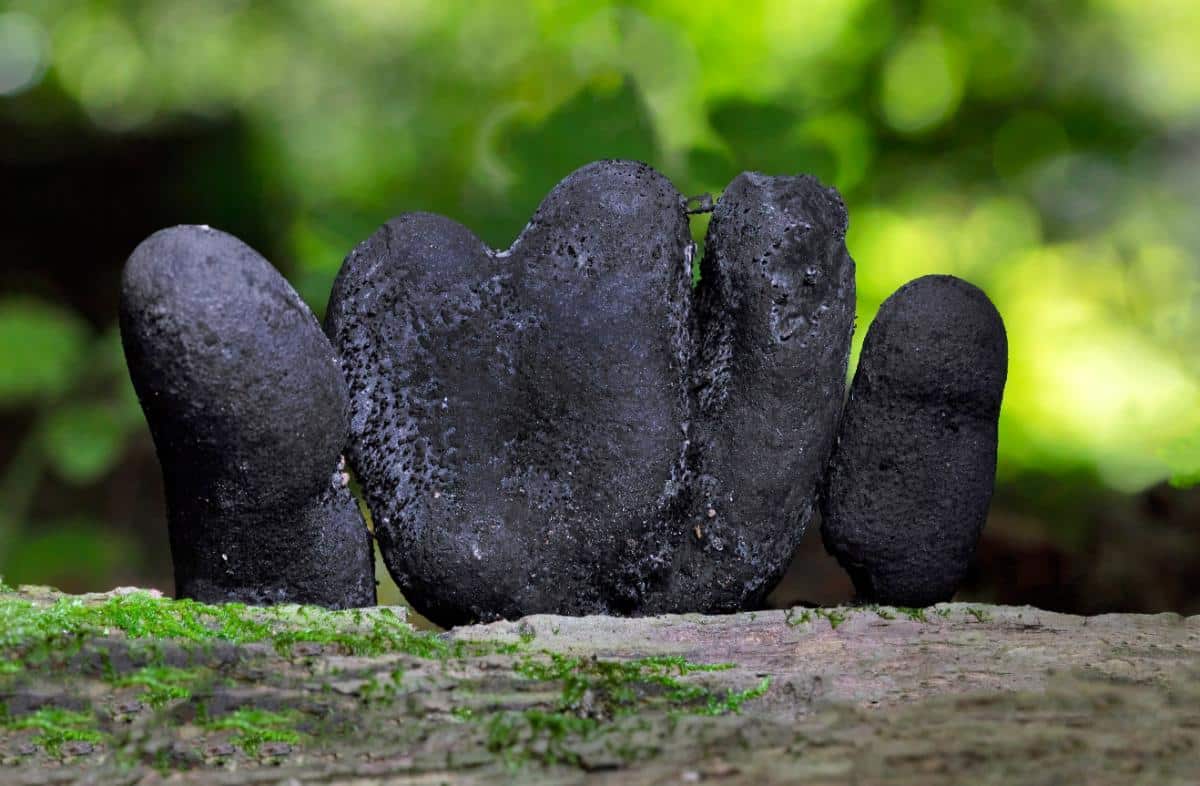
Finding the black, finger-like growths of dead man’s fingers (Xylaria polymorpha) can be a little unnerving. They emerge from rotting stumps and at the bases of dead trees, and the fruiting bodies look like swollen, charred fingers reaching out of the wood. The mushroom grows in tight clusters of three to six fingers, and the fingers sometimes bend at the top, like arthritic black knuckles.
This species is one of the most widespread fungi in the world and is common in forests across most of North America east of the Rocky Mountains. The species is also fairly common in Britain, Ireland, and mainland Europe. It isn’t edible- not that you’d be inclined to eat it, but it is a fun find.
- Scientific Name: Xylaria polymorpha
- Common Name: Dead man’s fingers
- Habitat: Dead hardwood
- Edibility: Inedible, non toxic
Jump to:
All About Dead Man’s Fingers
The common name, dead man’s fingers, comes from the resemblance of the fruiting bodies to a corpse’s hand rising from the ground.
This species was first described to science in 1797. Over the years, dead man’s fingers have been listed under many scientific names, including Sphaeria polymorpha, Hypoxylon polymorphum, Xylaria corrugata, Xylaria obovata, and Xylaria rugosa.
The genus name Xylaria is from the Greek xýlon, meaning “wood.” This is the same root as the word xylem, which is the tissue that moves water and nutrients up a tree’s trunk. The species name polymorpha means “many shapes” or “many forms.” This is a reference to the variable shape of the fruiting bodies; the fingers can be narrow and elongated, club-shaped, paddle-shaped, or fused together into thick irregular masses.
The fungus is a weak pathogen as well as a saprobe. The mycelium can colonize stressed or injured living trees and slowly kill them. Dead man’s fingers growing at the base of a tree can be a sign of an advanced state of root rot.
Dead man’s fingers is one of the fungi that creates spalted wood in sugar maple and other hardwoods. The fungus grows inside the dead wood and slowly breaks it down, leaving behind dark line patterns called spalting. These patterns are popular with woodworkers for furniture and bowls because they create a neat natural effect.
Dead Man’s Fingers Identification
Season
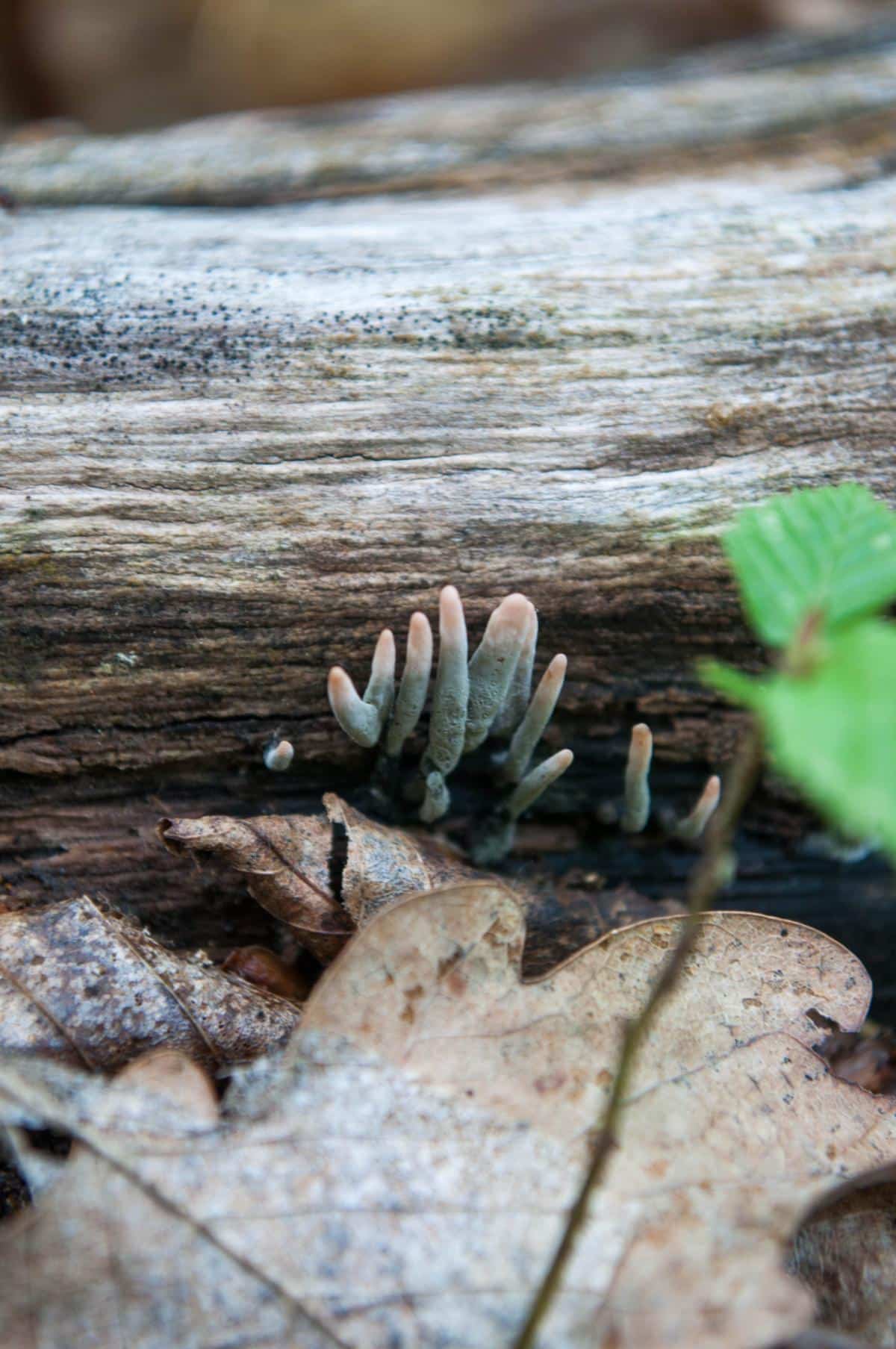
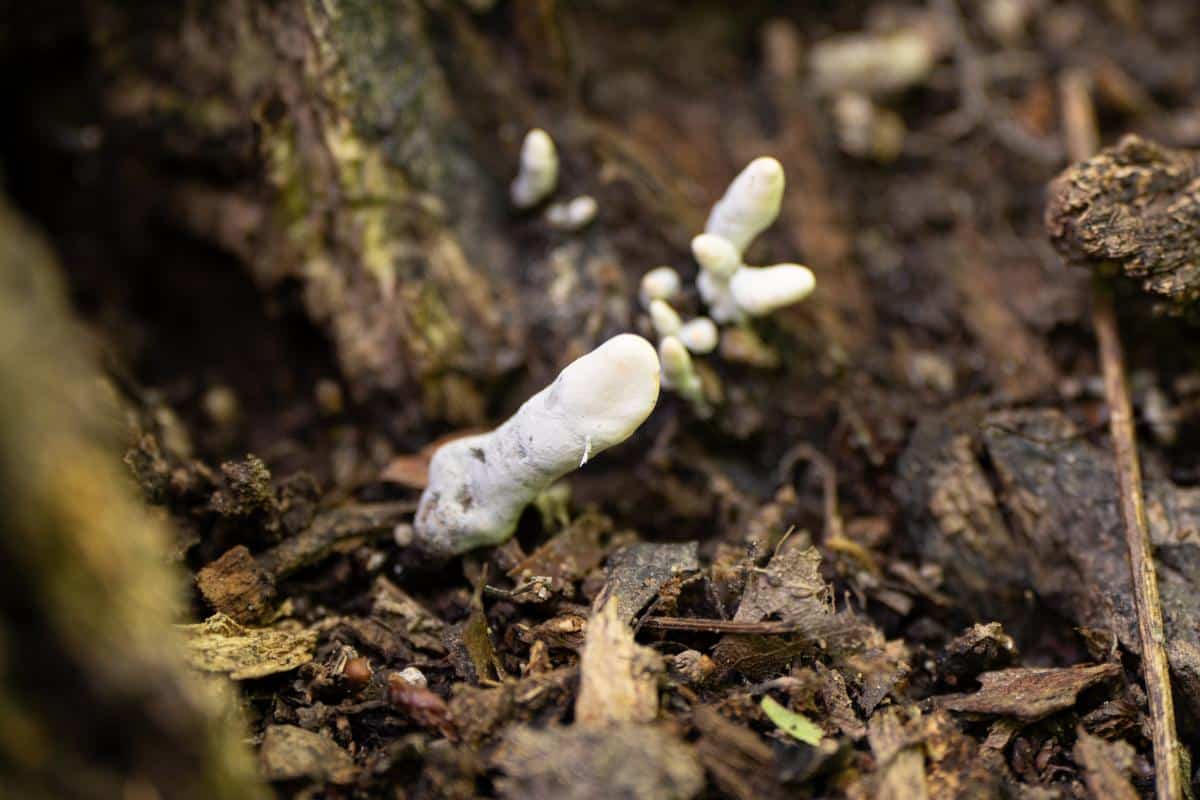
Dead man’s fingers fruit year-round in milder climates, but the bodies are most common from late summer through fall. They first emerge in spring or early summer as pale, knobby, finger-shaped growths. Then, the bodies darken through the summer as they mature and reach full maturity by late summer or fall. The fruiting bodies will persist on wood for many months, even after they’ve released their spores.
Habitat
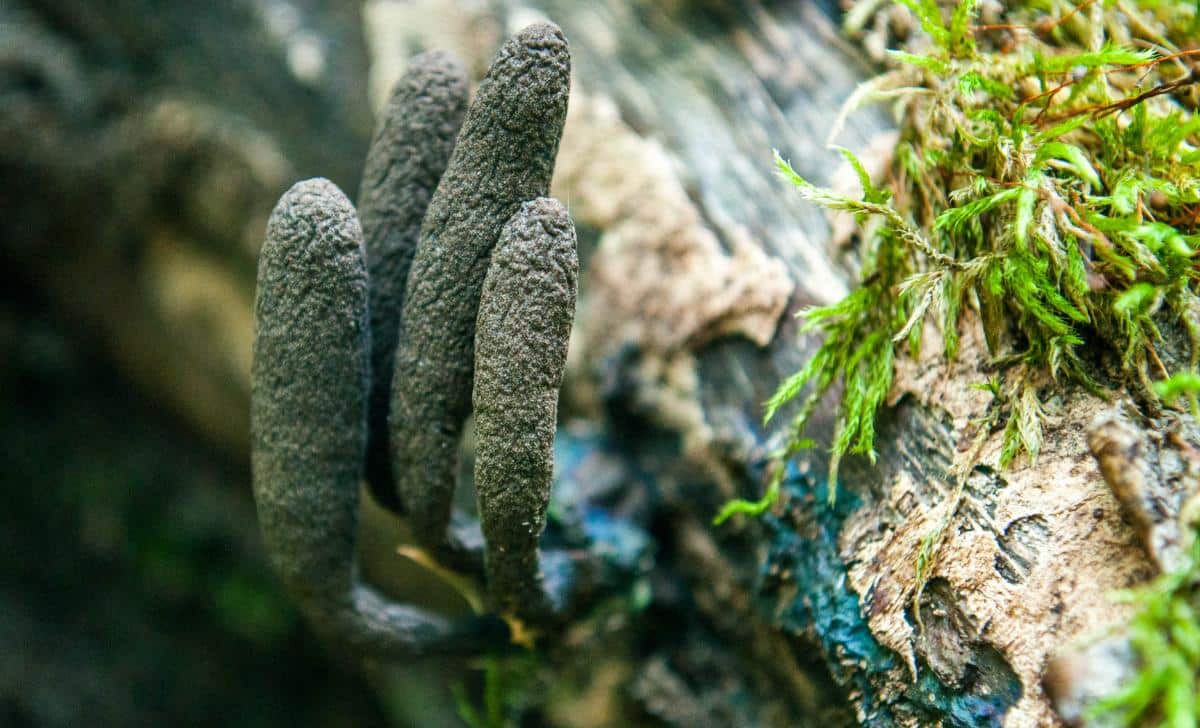
Dead man’s fingers grows on a wide range of hardwoods, and beech, maple, and oak are some of the most common hosts. This is one of the few ascomycete fungi that can decompose the wood of sugar maple and box elder. They are mainly found at the base of stumps, but also grow on fallen logs, dead attached branches, and buried roots.
Although they are primarily found on wood, they’ve also been recorded growing in a wide array of unexpected places, like woody legume pods, leaf stalks, and soft plant stems. It’s also been documented on the dead wood of red maple, coffee plants, London plane, and Shorea trees. The fruiting bodies usually grow in clusters of three to six, but they sometimes grow as individual fingers. They always attach to wood, even when they look like they’re rising straight from the soil.
Identification
Body
This mushroom has no cap, no gills, no pores, and no real stem. The whole visible structure is a single mass called a stroma, and the upright, finger-shaped, or club-shaped projections are called stromata. They sometimes branch near the top into shorter knobs or fuse together at the base into wider masses.
The fingers grow between 1 and 3 inches tall, and the diameter of each finger is between about 0.4 and 1.2 inches. The shape varies widely. The fingers can be narrow and elongated, squat, club-shaped, or paddle-shaped. They sometimes bend at the top, giving them a knuckle-like look.
The surface of dead man’s fingers changes dramatically with age. The young fruit bodies in spring are pale grey, white, or pale blue, and have a fine powdery coating and a whitish tip. This pale coating is the mushroom’s spores, called conidia, and they cover the developing fingers.
As the fungus matures, the surface darkens to brown and then to black. The surface of the mature dead man’s fingers is finely wrinkled, roughened, or warty and looks like blackened charcoal. There are sometimes bluish, purplish, or greenish tinges.
Stem
This mushroom doesn’t have a true stem. The base of the fruiting body attaches directly to the dead wood, but sometimes there is a very short, pinched-in section at the base that can look stem-like. Even when the fingers look like they’re growing straight from the soil, the base always connects to wood below the surface.
Taste and Smell
The taste and smell of dead man’s fingers are not distinctive.
Flesh Color and Staining
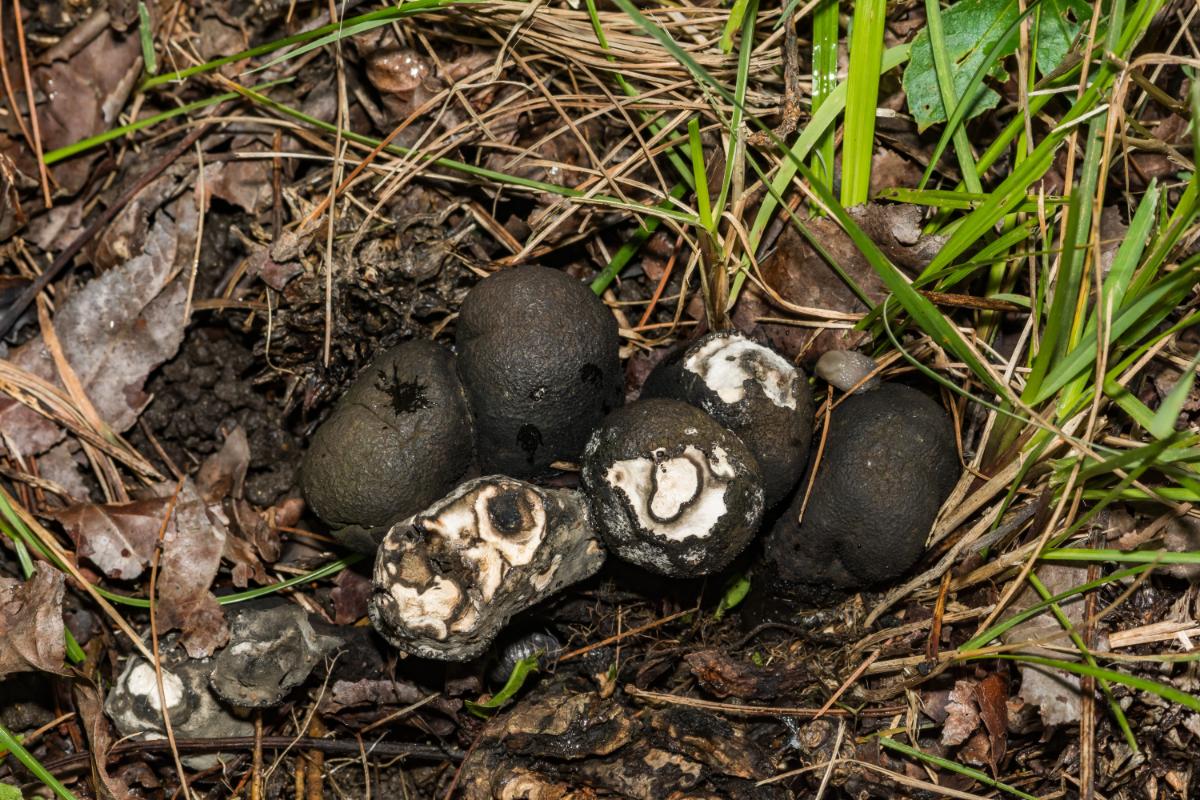
The interior flesh of dead man’s fingers is white, tough, firm, and slightly woody in texture. The fingers have a thin black outer crust surrounding a white inner core that is visible when you cut one in half. The black coating looks like tiny dark dots against the white flesh. The flesh does not stain or change color when cut or handled.
Spore Print
The spore print is black.
Lookalike Species
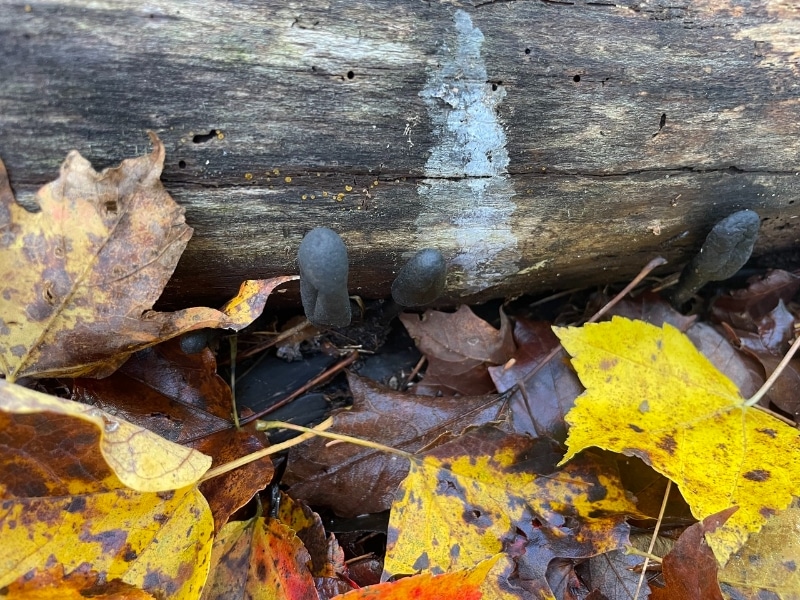
Dead Moll’s Fingers (Xylaria longipes)
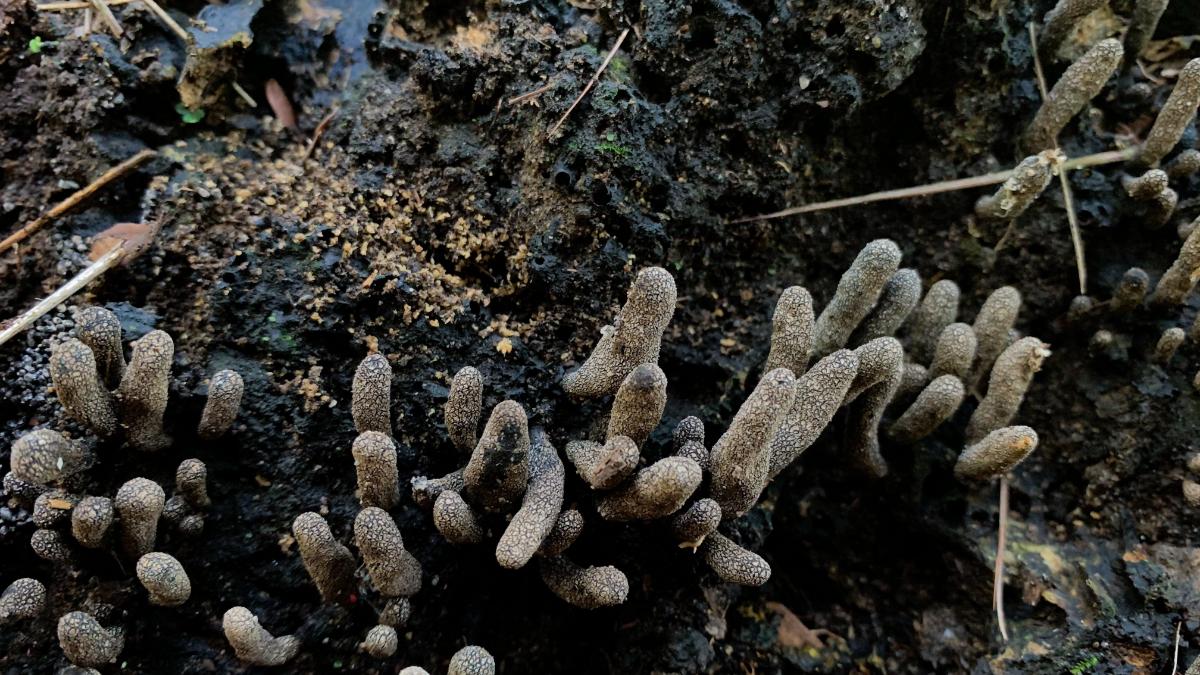
The closest lookalike is dead moll’s fingers (Xylaria longipes), which is a smaller, slimmer relative. The two species have the same dark, finger-like form and grow on wood, but vary a bit in size, shape, and host tree. Dead moll’s fingers are 1 to 2.6 inches tall and are noticeably smaller and slimmer than dead man’s fingers. They also have a more obviously stalked club-shape and a narrow stem at the base. Dead moll’s fingers also grow mainly on dead sycamore and beech wood.
Candlesnuff Fungus (Xylaria hypoxylon)
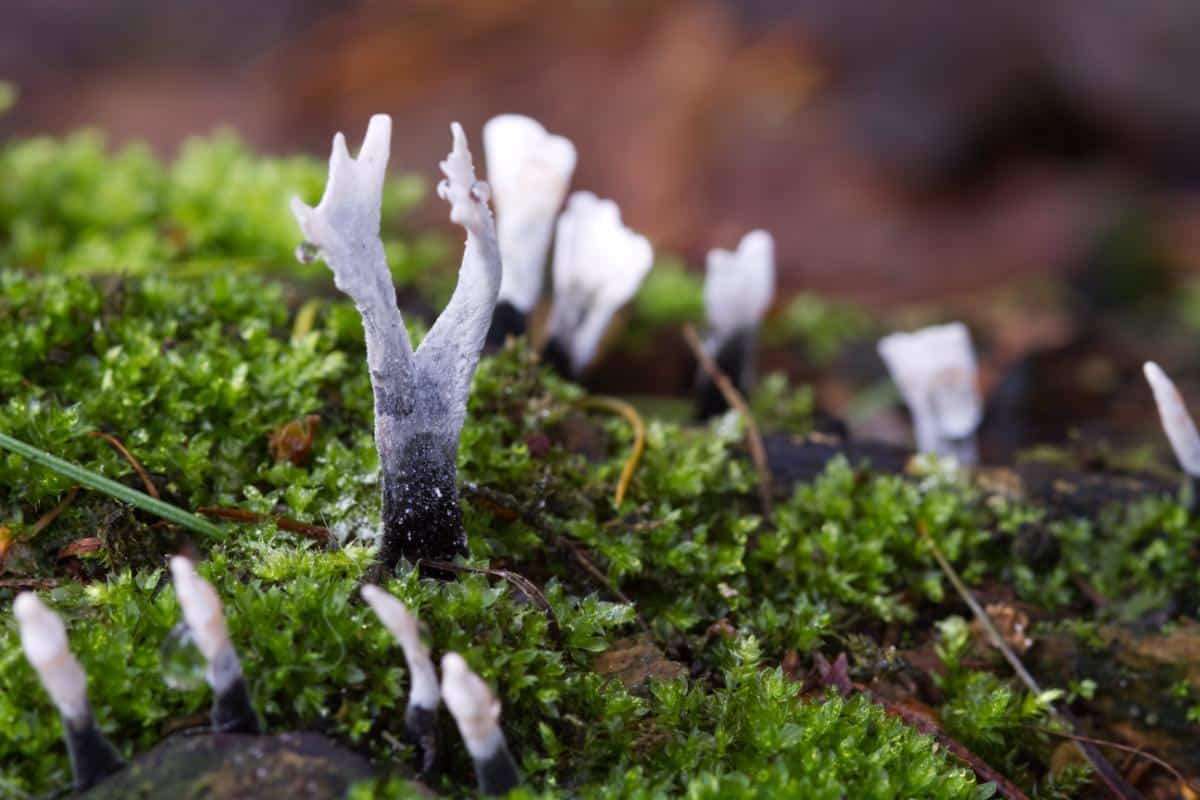
Candlesnuff fungus (Xylaria hypoxylon) is a close relative that grows on the same kinds of dead wood. The main difference is the shape. Candlesnuff fungus has antler-like, branched fruiting bodies and grows up to 3 inches tall. The antlers are black at the base and whitened at the branched tips. Dead man’s fingers are never branched, so if you see branching, you will know. Their coloring is also different, as their bodies are dark from top to bottom. The two are easy to tell apart at a glance because of the branching habit and the white-tipped antlers of candlesnuff.
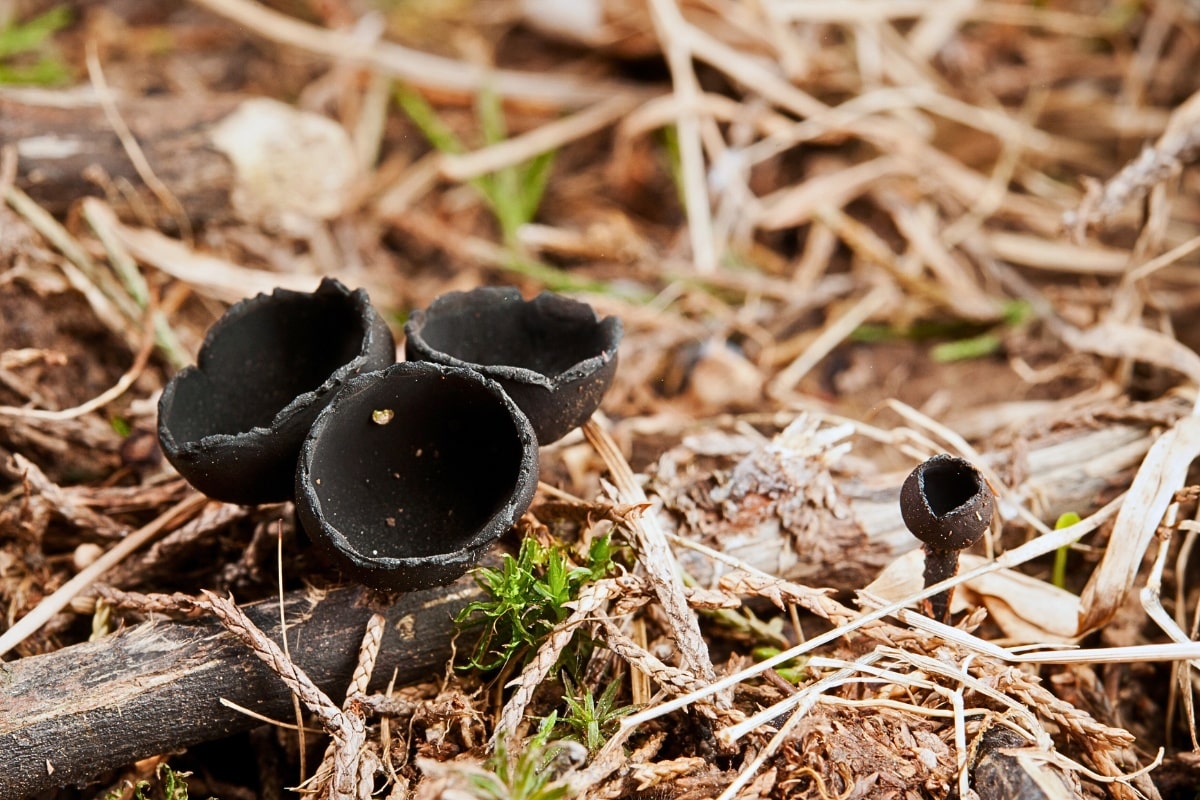
Devil’s Urn (Urnula craterium)
Young dead man’s fingers can be mistaken for the developing fruit bodies of devil’s urn (Urnula craterium). Both are small, dark, and rounded before they take on their adult shape. Once the devil’s urn matures, though, the resemblance is gone. The urn opens into a deep, blackish-brown cup with a distinct stem, and looks nothing like the gnarled finger shape of dead man’s fingers.
Dead Man’s Fingers Medicinal Uses
In traditional Ayurveda practices, dead man’s fingers reportedly was used to help new mothers with milk production. There is no other known medicinal use for the mushroom.
Edibility of Dead Man’s Fingers
Dead man’s fingers is not a poisonous mushroom. The species is inedible but not toxic. The texture is tough and woody, the taste is bland, and there is no culinary appeal. There is no documented history of the species being used as food.
Common Questions About Dead Man’s Fingers
Why are they called dead man’s fingers?
The fruit bodies look like swollen, dark, lifeless fingers pushing up out of the ground. They are gray to black in color, and when they’re young, they have pale tips, like fingernails. They grow in small clusters that look a bit like a stiff hand reaching out of the soil.
Are dead man’s fingers poisonous?
No, they are not toxic. They are not edible, either, because the flesh is too tough, woody, and bland to eat.
What kind of tree do dead man’s fingers grow on?
They grow on rotting hardwood. The most common host is beech, but they also grow on oak, maple, elm, and other broadleaf trees. They almost never grow on conifers.
Leave a Reply