

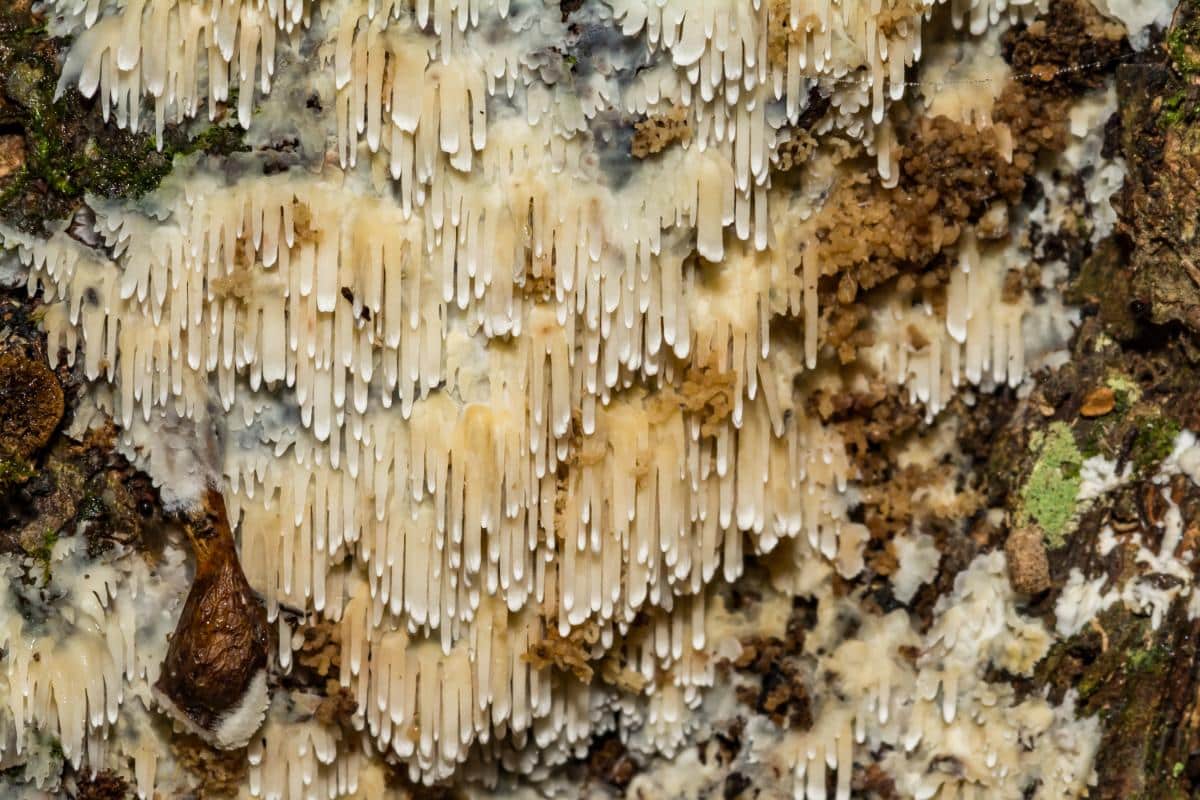
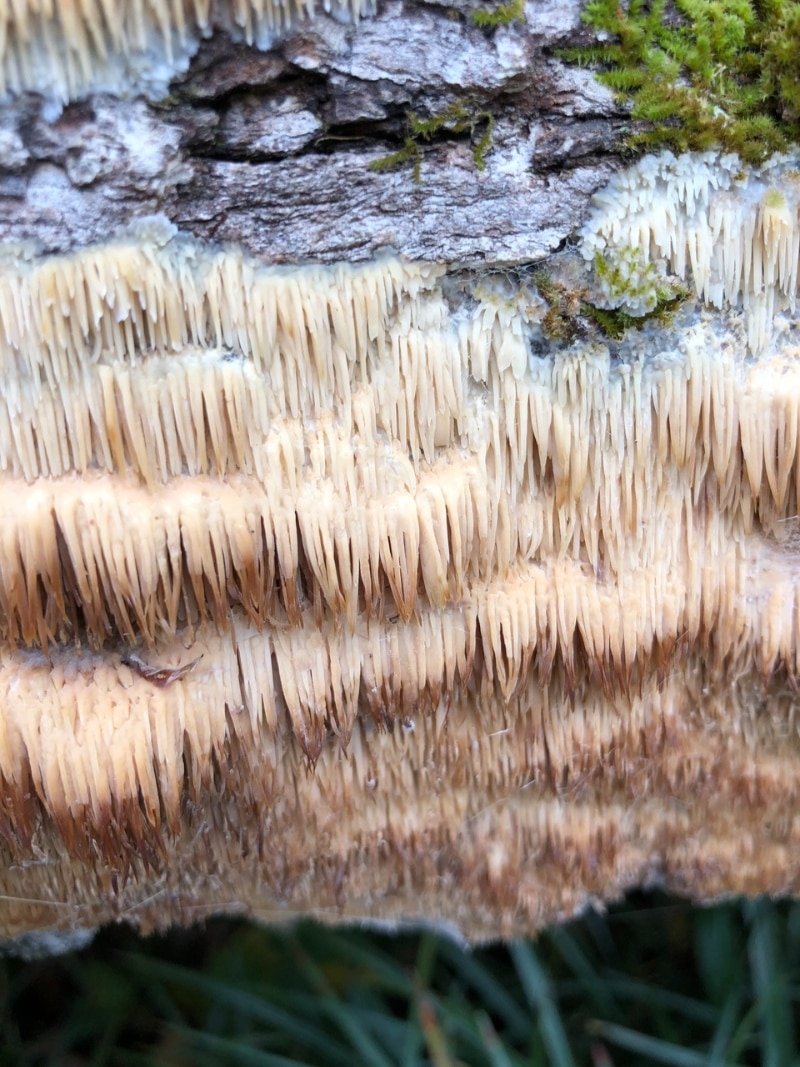
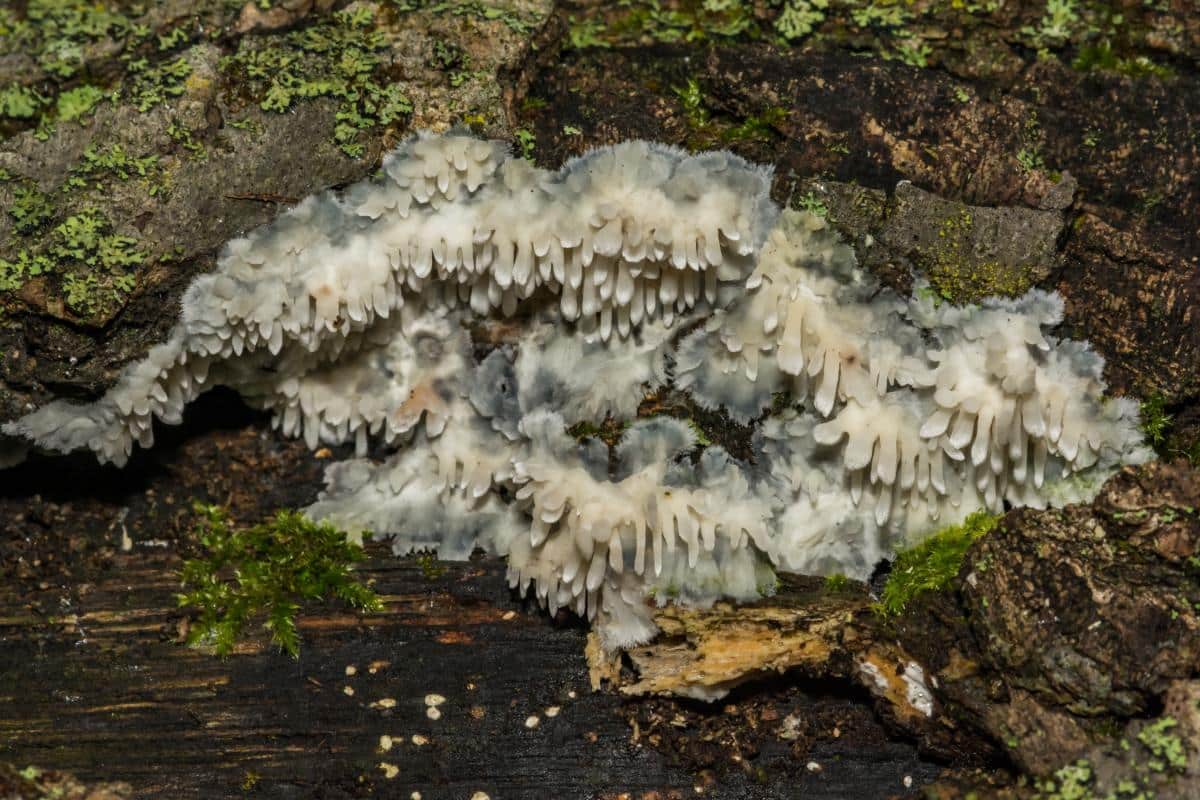
The Asian beauty fungus (Radulomyces copelandii) looks like a white shag carpet growing out of the cracks of tree bark. This crust fungus is often confused with Hericium species (Lion’s Mane, Bear’s Head, and Coral Tooth) because it has hundreds of slender white spines on its surface. From a few feet away, the patch looks like a young lion’s mane mushroom just emerging. There are some key differences, though, that are easy to recognize once you know what to look for.
Asian beauty fungus is not native to North America; it is an introduced species from Asia. It was first recorded in North America in November 2009, on a red maple log at Bradley Palmer State Park in Ipswich, Massachusetts. It has since been recorded across New England and south through the Mid-Atlantic states. How it got into North America is still unknown, and how far it will spread is to be seen.
- Scientific Name: Radulomyces copelandii
- Common Names: Asian beauty
- Habitat: Decaying hardwood
- Edibility: Not documented
All About the Asian Beauty
This species was first described in 1914 and named Hydnum copelandii. The type collection came from the Philippines. It went through several name changes over the years until 1990, when it was transferred to Radulomyces. Then, in 1993, it was moved again to Radulodon. Both of those names stayed in circulation for decades, and databases and field guides still list this fungus under both of these newer names.
Radulomyces is the accepted genus today. The difference between the two names is significant. Radulomyces belongs to the family Radulomycetaceae in the order Agaricales, which includes most familiar gilled mushrooms. Radulodon belongs to the family Meruliaceae in the order Polyporales, the group that includes many wood-rotting crusts and shelf fungi. The switch from one name to the other moves this fungus onto a different branch of the fungal family tree.
A study done in 2021 folded another species into the final Radulomyces copelandii analysis. In 2018, mycologists had named a new fungus from a rotted hardwood log on Long Island, New York, and called it Radulomyces paumanokensis. Its fruit bodies were small, rounded cushions with branching spines, and they looked nothing like the wide flat sheets of the Asian beauty. The DNA from that original Long Island material came back a 99 percent match to the Asian beauty, and the cushions turned out to be young fruit bodies that hadn’t spread out yet.
The 2021 study also split out a fungus from this species, Radulomyces licentii. This mushroom grows in eastern Asia and had been thought to be the same as Radulomyces copelandii, but it is actually a unique species.
The 2009 Discovery
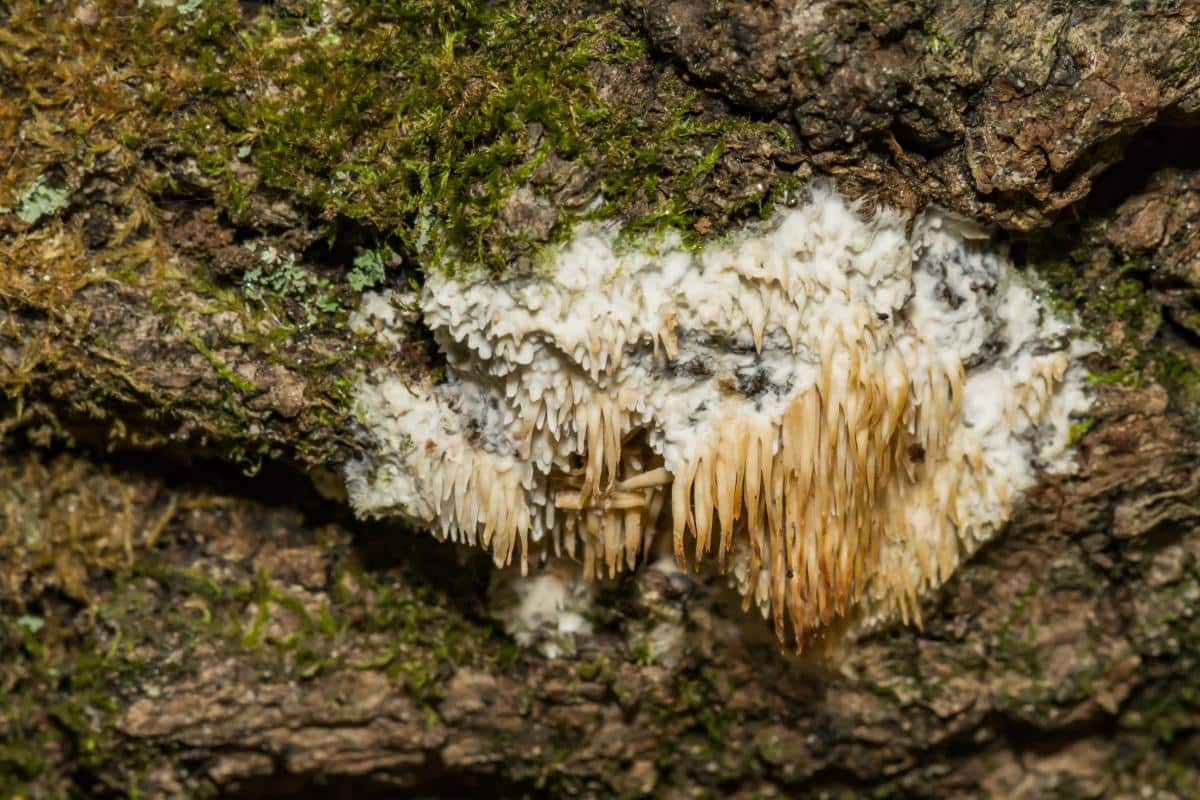
In mid-November of 2009, Lawrence Millman, a mycologist and author, found a spiny fungus he didn’t recognize on a red maple log at Bradley Palmer State Park in Ipswich, Massachusetts. He couldn’t identify it by eye or under the microscope, so he mailed a sample to a mycologist in British Columbia, Ginns. The identification came back as Radulomyces copelandii, a species known at that point only from Asia. Karen Nakasone confirmed it and determined that this was the first collection of the species in the Western Hemisphere.
From January to March of 2010, Millman found it again at four more sites in eastern Massachusetts. The host trees were northern red oak, white oak, and beech. He first thought the fungus had gone unnoticed because it fruits in winter, when few people look for mushrooms. That idea fell apart in the fall of 2010, when he was finding it on nearly every collecting trip he made. At that time, it was only identified within a 35-mile radius of Boston, but since then, it has been found in other states.
Millman and Ginns published the record in 2011, calling this new fungus Asian Beauty, and it’s the name that stuck.
It is unknown how this decomposer fungus has or will affect the forests. It might crowd out native polypores and crust fungi, but more research is needed to determine its effect. How common the Asian beauty is across Asia isn’t known. Its range there is from Sri Lanka and the Philippines north to eastern Russia, but no survey has measured how often it occurs.
Asian Beauty Identification Guide
Season
This fungus fruits year-round.
Habitat
In North America, this fungus grows on the dead wood of hardwood trees in the northeastern and Mid-Atlantic United States. In New England, collections have come from Massachusetts, New Hampshire, Connecticut, and Rhode Island. To the south, it’s been recorded in New York, New Jersey, Pennsylvania, Maryland, and Virginia. There are also reports from Michigan, Wisconsin, and Ohio, and other parts of the Midwest, but no official survey has caught up with where it is now.
Outside of North America, it grows across tropical and temperate Asia, from the Philippines and Sri Lanka north to eastern Russia. It has also been collected in China, northern India, Nepal, and Georgia (the country).
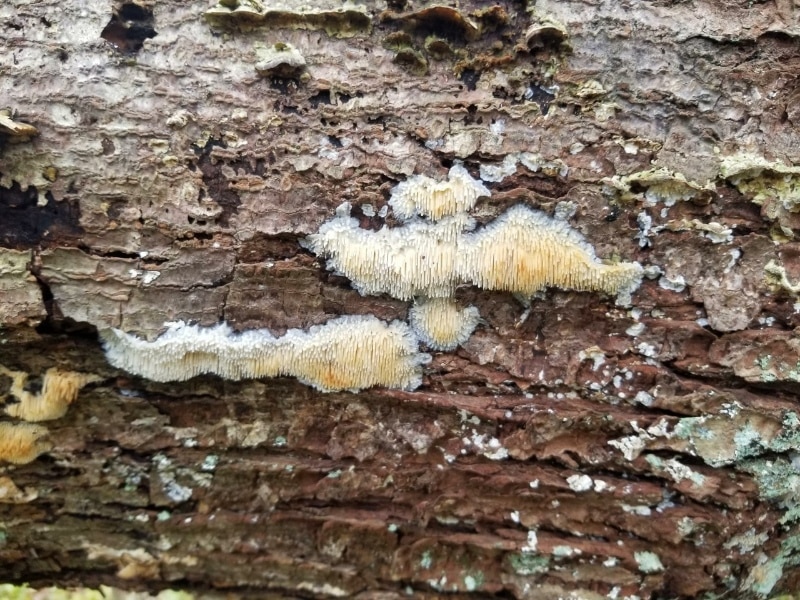
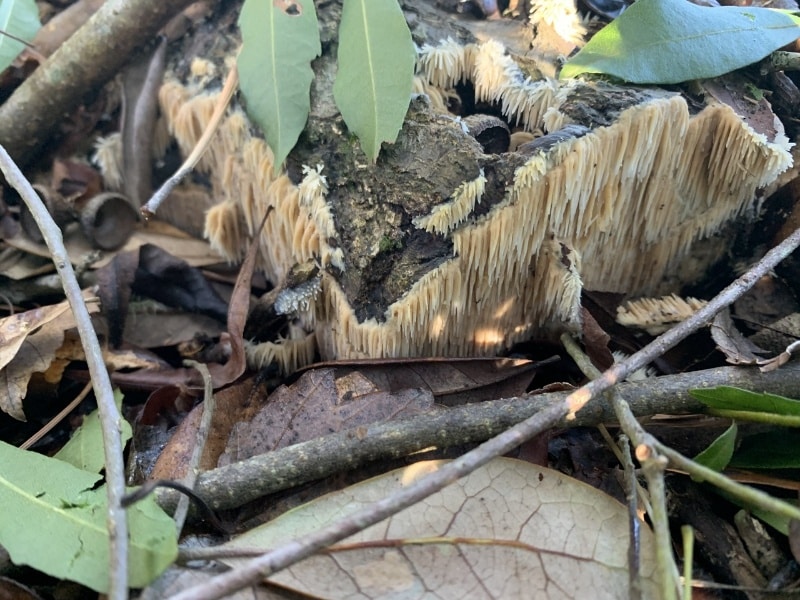
It grows mostly on oak and maple and occurs on both standing dead trees and fallen logs. The fruit bodies develop down in the cracks, crevices, and furrows of bark that’s still attached to the wood. This decomposer causes white rot, and it grows only on wood that’s already dead.
Identification
Fruit Body
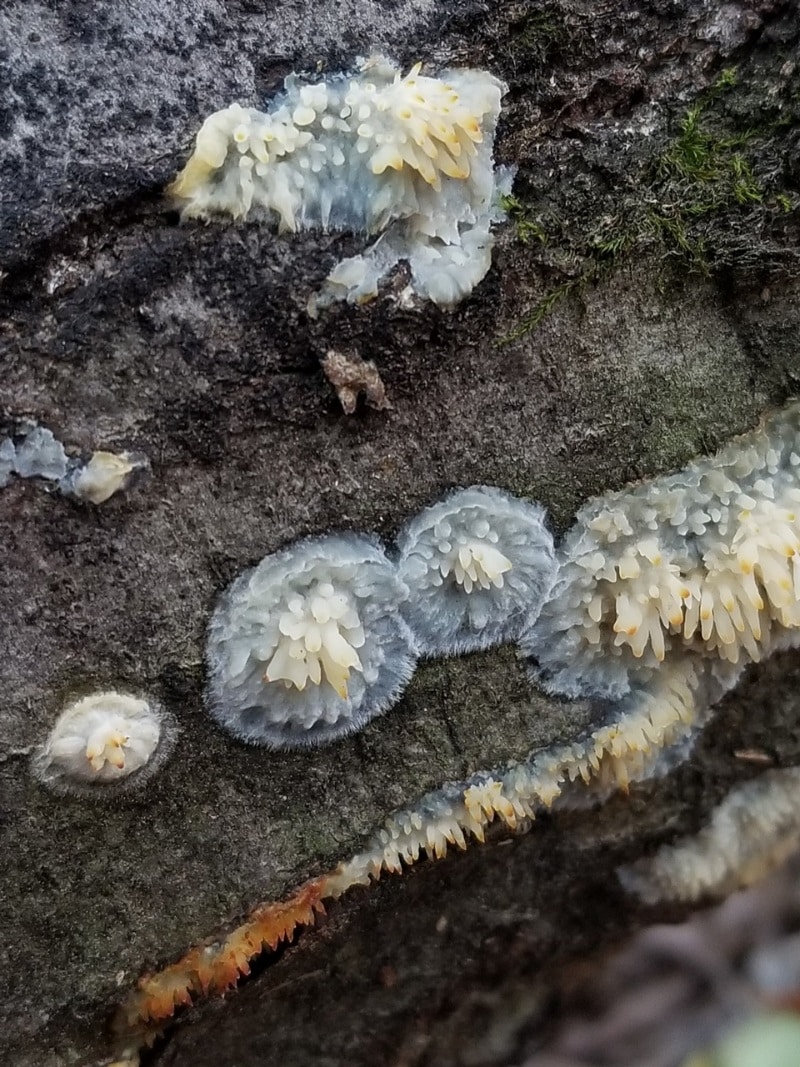
This fungus has no cap and no stem. The fruit body is a thin mat of tissue that spreads flat across the wood, and grows spines that hang down off that flat tissue mat. A single fruit body starts as a compact cushion and spreads outward across the wood, reaching about 12 inches or more. The mat or cushion itself is thin, only growing to well under a sixteenth of an inch to about an eighth of an inch thick.
Spines
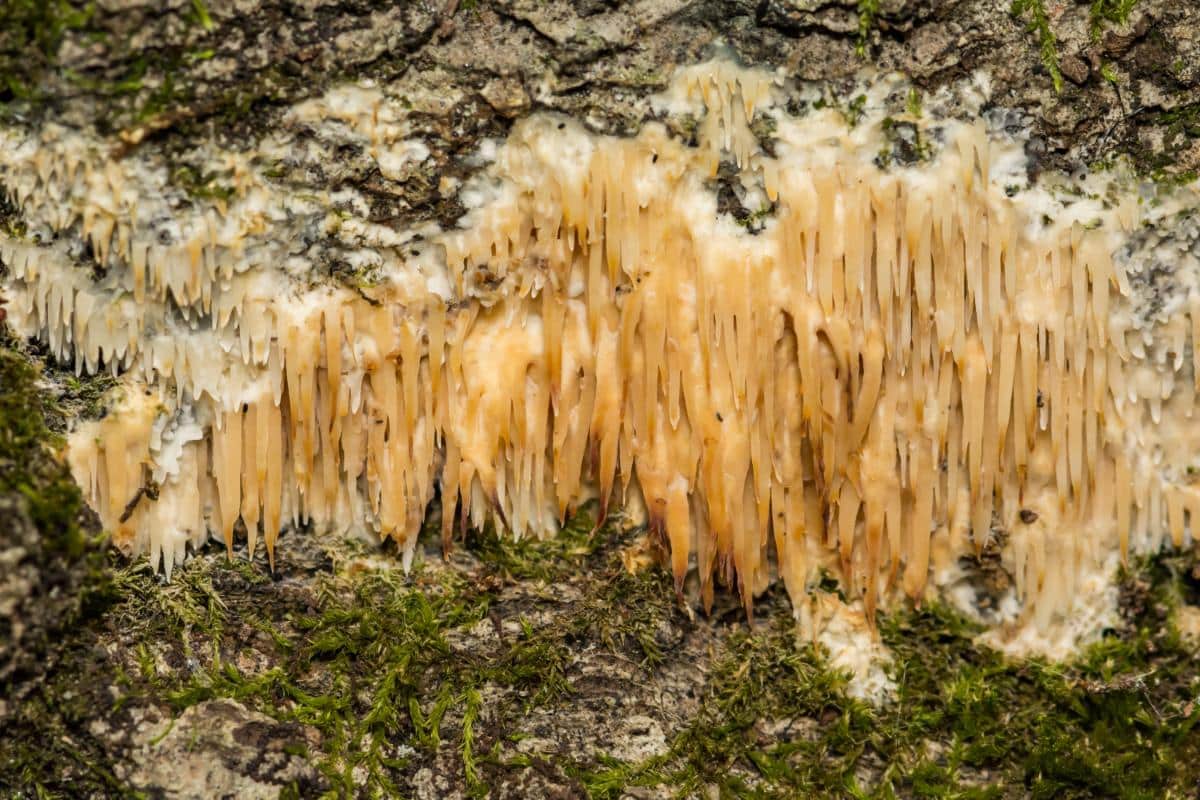
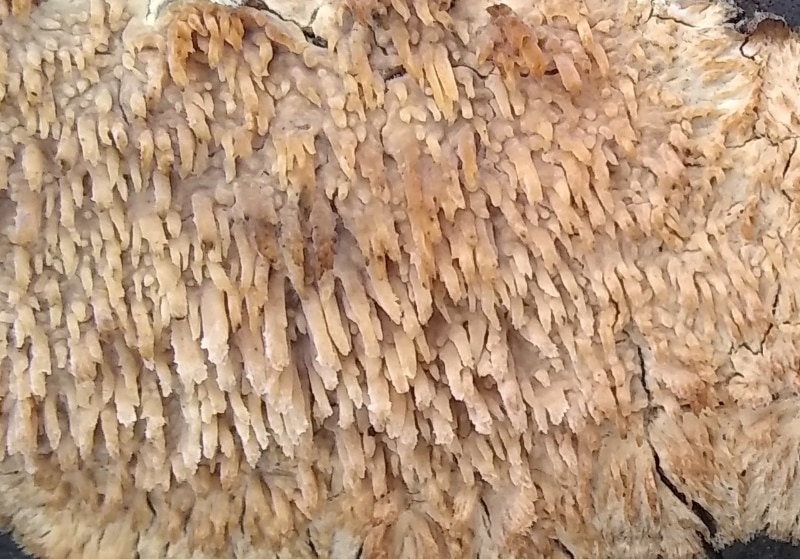
The spines are white to pale yellow when young and fresh. They turn buff, then orange-yellow, and finally brown with age. Most of them are about 0.15 to 0.4 inch long, though some reach half an inch or a little more. They’re slender, round in cross-section, and they taper to a fine point.
The spines are densely crowded, and some of them are flattened or forked. Young fruiting bodies start as compact, cushion-shaped clusters of branching spines before spreading into a flat sheet, with spines hanging down like tiny icicles.
Stem
There is no stem. The mat attaches directly to the bark or the wood.
Taste and Smell
The Asian beauty has no distinct smell.
Flesh Color and Staining
The flesh is white and fibrous, and the whole fruiting body is thin but dense. When it dries, it gets hard, and the spines become brittle enough to snap. The spines darken to yellowish brown when bruised or over-mature.
Asian Beauty Lookalike Species
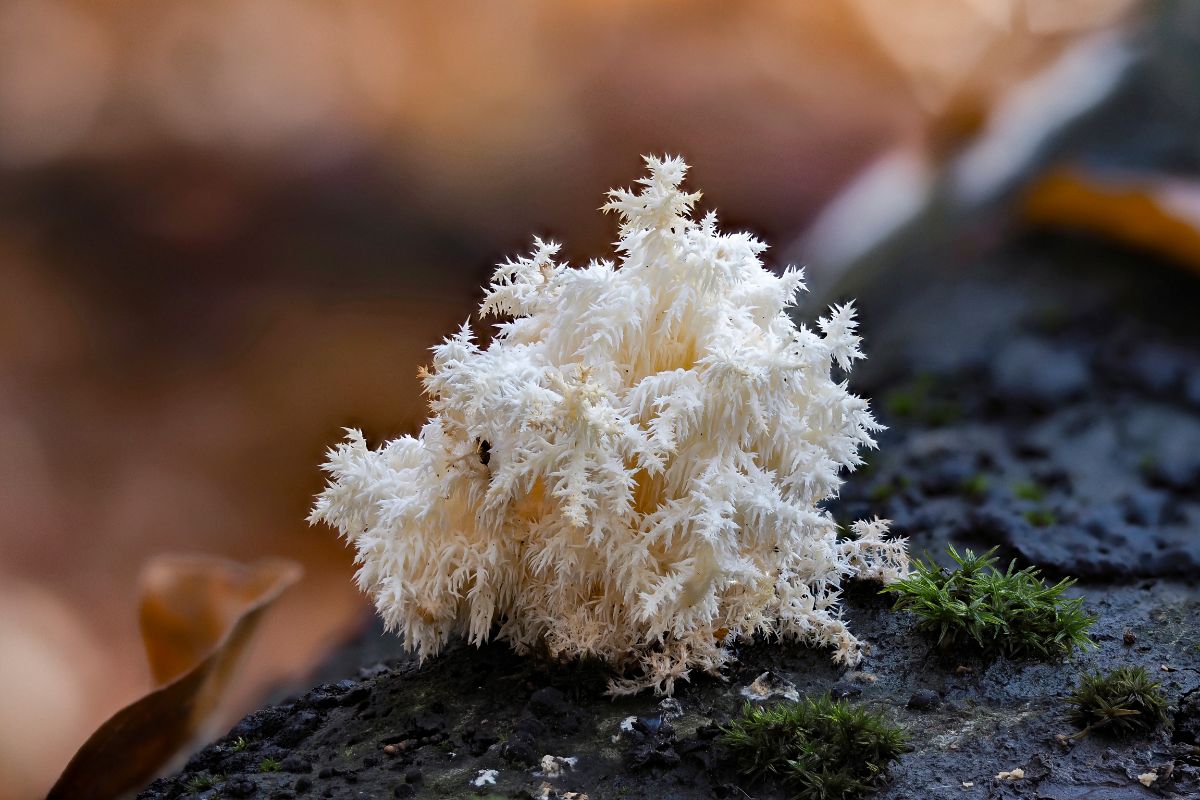
Lion’s Mane, Bear’s Head, and Comb Tooth (Hericium species)
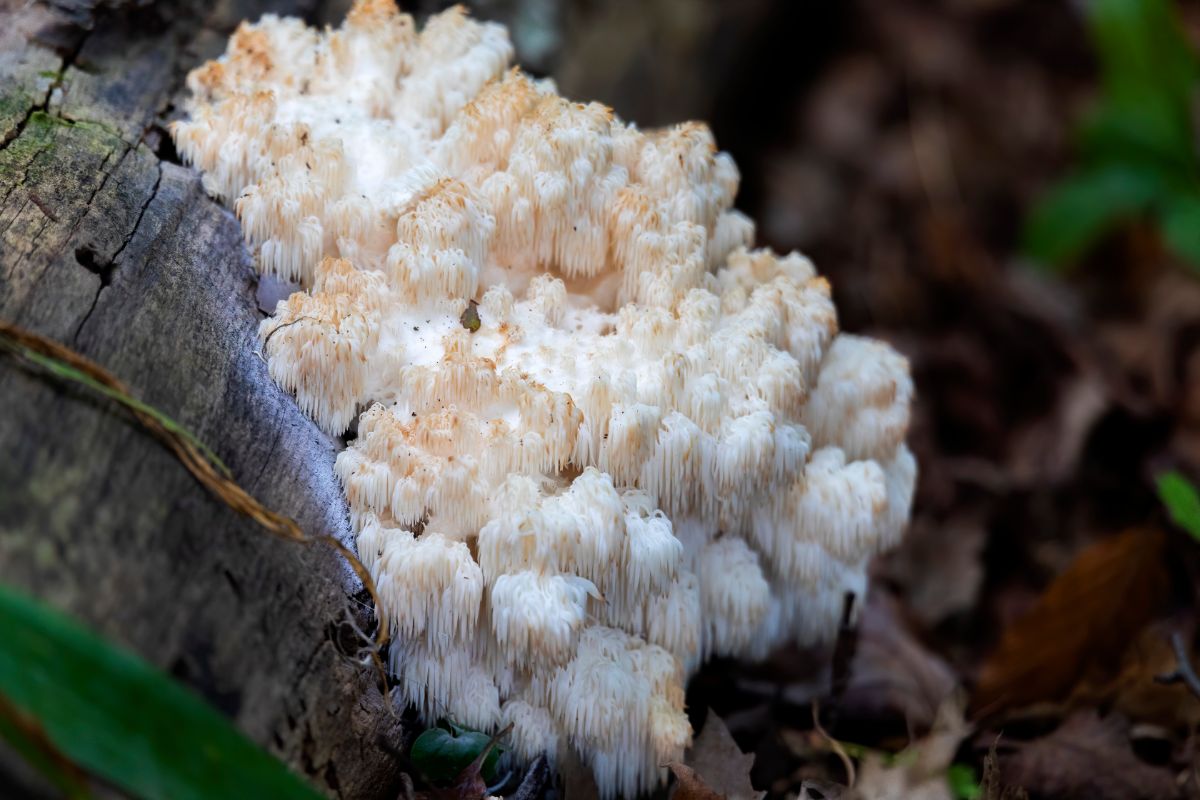
Because Asian beauty is a non-native species, and one that is rather recent, many people don’t know it even occurs in the US. And because lion’s mane and its relatives are so well known and choice edibles, seeing white hanging spines leads people to think of Hericium species instantly. It is always disappointing to realize this small white spiny growth is not the start of lion’s mane.
The two are easy to separate up close. All the Hericium species are much larger and form dense bodies; they do not spread like a thin crust across the wood. Their spines also (usually) are longer than the Asian beauty’s.
All the Hericium species have a type of stem or stalk, or discernible base when you take them off the tree. The Asian beauty has no stalk and no clump. It’s a flat mat pressed against the wood with spines coming off it, and it spreads out sideways instead of hanging in a ball.
Mucronella Species
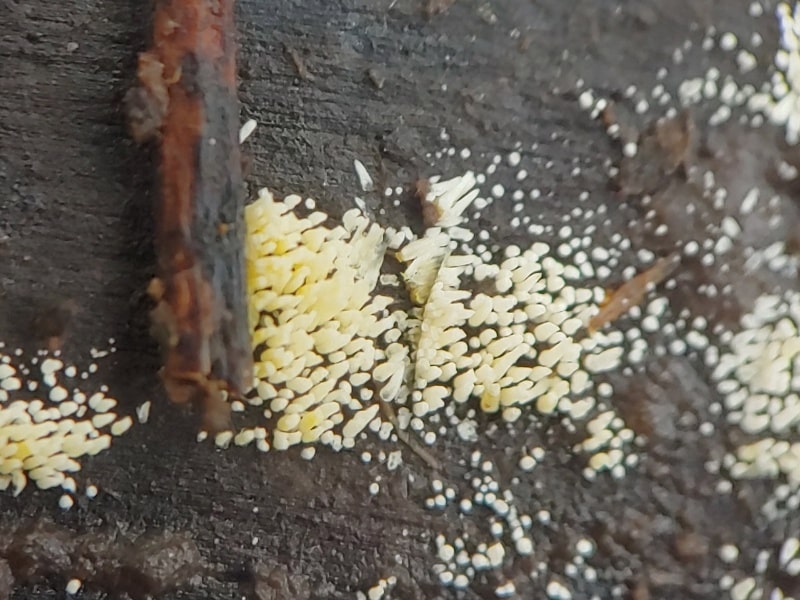
Several Mucronella species look almost identical to a small patch of Asian beauty. They’re white to yellow or orange hanging spines that grow on dead wood. They grow singly, scattered, or in groups.
The difference between the two is at the base of the spines. The Mucronella spines come straight out of the wood with no mat of tissue underneath them, while Asian beauty spines grow from a thin mat, though that mat may be hard to see when the fungus is young.
Sarcodontia amplissima
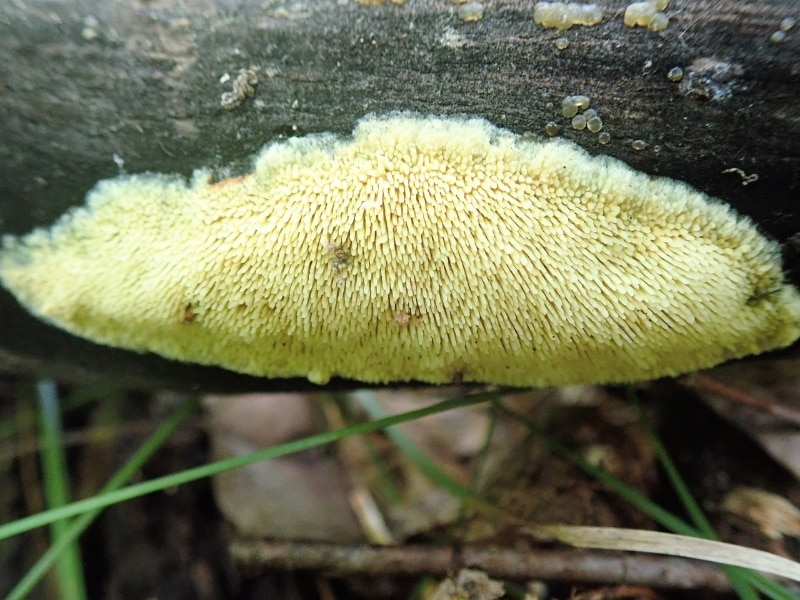
Sarcodontia amplissima is a spiny crust fungus found in eastern and central North America, and some Asian beauty collections have been mistakenly filed under Sarcodontia names more than once because they look so similar. The spines of Sarcodontia amplissima are cream to golden yellow when fresh, not white. Its fruit body also has a pungent smell, and the Asian beauty has no smell at all.
Toothed Crust (Basidioradulum radula)
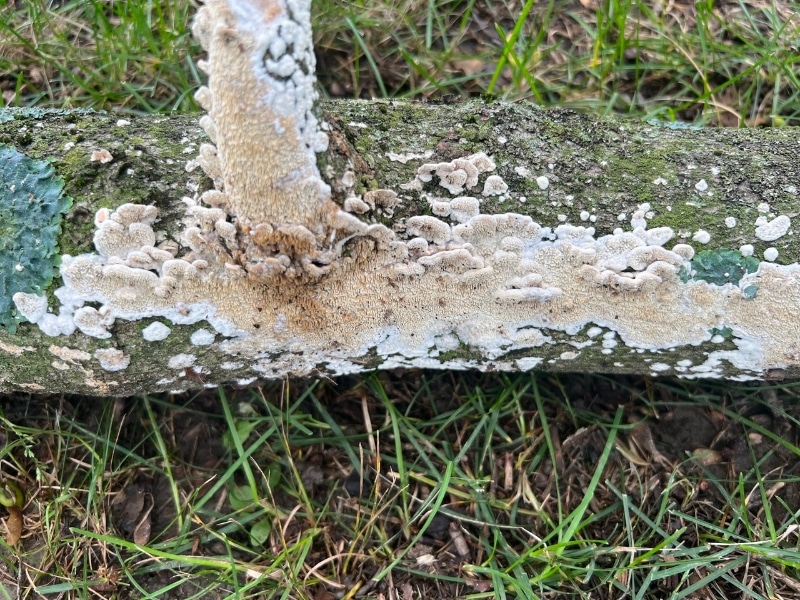
The toothed crust grows as a flat crust on dead hardwood and has teeth on its surface, which makes it look a lot like Asian beauty at a glance. The teeth are different, though. The toothed crust’s teeth are blunt and short, while the Asian beauty’s spines are slender, taper to a fine point, and get twice as long.
They’re different colors, too. The toothed crust starts white and turns cream to bright yellow or ocher-yellow, and its patches start as small circles that merge into one sheet.
Asian Beauty Culinary Uses
The edibility of the Asian beauty isn’t documented. The fruit body is a thin, fibrous mat, and there isn’t enough in a patch to make it worthwhile, even if it is edible.
Toxicity of the Asian Beauty Fungus
No toxins have been reported from this fungus, and no poisonings have been tied to it. Its toxicity hasn’t been studied either way.
Common Questions About Asian Beauty Fungus
Does Asian beauty fungus have any medicinal uses?
The Asian beauty has no recognized medicinal properties.
Is the Asian beauty edible?
The edibility of the Asian beauty isn’t documented. No toxins have been reported from it, but its toxicity hasn’t been studied either way. The fruit body is a thin, fibrous mat that hardens as it dries, so there isn’t much to it. It shouldn’t be eaten.
Is the Asian beauty the same thing as lion’s mane?
No, they’re two different fungi. Lion’s mane forms a single rounded clump 4 to 8 inches across and has a short stalk that attaches to the tree at one point. Its white spines reach about 2 inches. The Asian beauty has no stalk and no clump; it’s a flat mat pressed against the wood.
Is the Asian beauty invasive?
That hasn’t been settled. As a decomposer it might crowd out native polypores and crust fungi, and if it interferes with those relationships it could be called invasive. No study has measured the effect since it was discovered in North America.
Does the Asian beauty kill trees?
No, it’s a decomposer that grows on wood that’s already dead. It grows on fallen logs and on standing dead trees, down in the cracks and furrows of bark that’s still attached to the wood. It causes a white rot in that dead wood.
Where in the United States does the Asian beauty grow?
It is recorded from New England south through the Mid-Atlantic states. Collections have come from Massachusetts, New Hampshire, Connecticut, and Rhode Island. Records to the south include New York, New Jersey, Pennsylvania, Maryland, and Virginia.

Leave a Reply