
The rooting polypore (Polyporus radicatus) is a stalked polypore that looks like it’s growing straight out of bare ground or leaf litter, but it actually fruits from dead hardwood buried underground. It is not edible or toxic; it’s too tough to think about eating. It has a very distinctive stem or stalk that makes it stand out. It’s also a reminder to always dig up the base of a mushroom when you’re trying to identify it, because there can be some really neat finds and identification clues.
- Scientific Name: Polyporus radicatus
- Common Name: Rooting polypore
- Habitat: Buried hardwood roots and stumps in grassy areas, open ground, and mature deciduous woods
- Edibility: Not edible
Jump to:
All About The Rooting Polypore
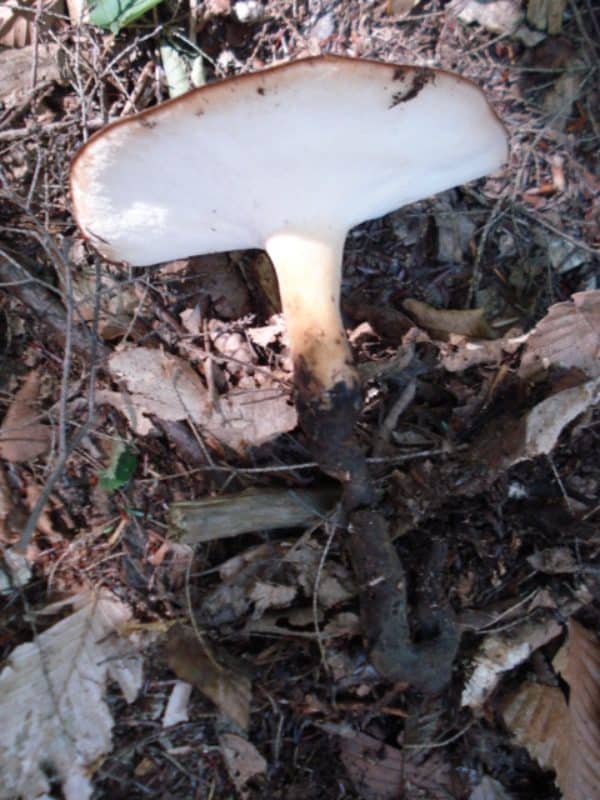
The underground extension of the rooting polypore’s stem is called a pseudorrhiza, which means false root. It isn’t actually a root, though, but a compacted strand of the mushroom’s own tissue that runs down through the soil to the buried wood the fungus is feeding on.
The larvae of the pleasing fungus beetle (Tritoma mimetica) eat the rooting polypore. It’s not the only polypore they eat, but it is one of their preferred foods. The adult pleasing fungus beetles eat a different mushroom (Hymenopellis radicata). The adults of two other beetles, Tritoma humeralis and Rotitma sanguinipennis, have also been recorded on rooting polypores.
Rooting Polypore Identification
Season
The rooting polypore begins fruiting in summer. It continues through fall and is most likely seen then.
Habitat
This is a saprobic mushroom, which means it feeds on dead wood. It grows on the roots of dead and living hardwoods, and it causes a white rot in the wood it colonizes. The tree it is most likely to grow with is oak.
The rooting polypore grows alone or in scattered groups. Most stalked polypores grow directly from visible wood, but the rooting polypore grows from buried roots or stumps.
Identification
Cap
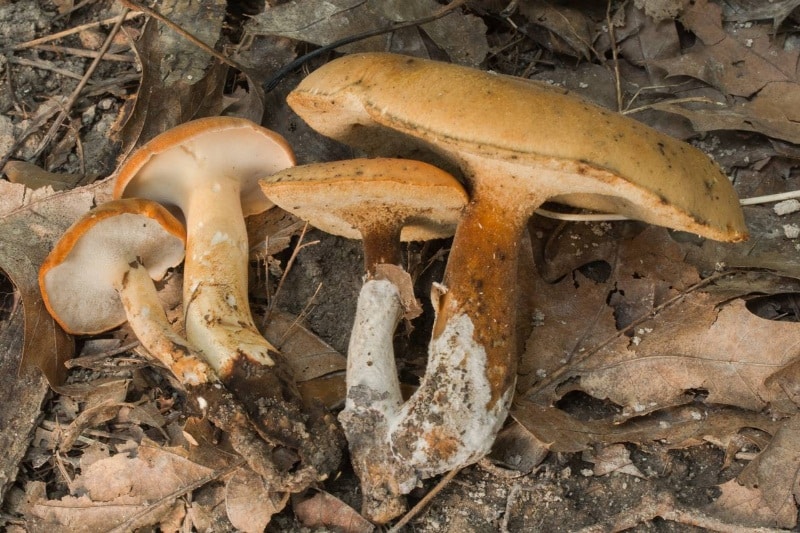
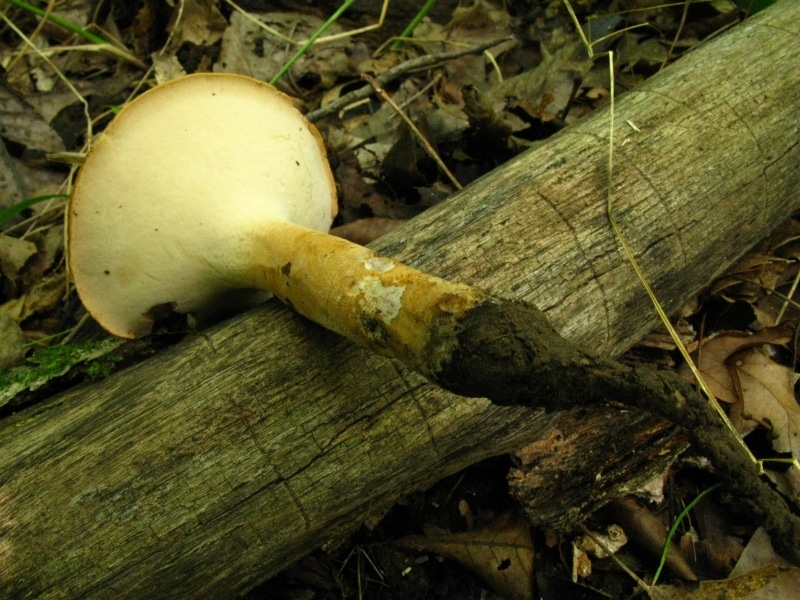
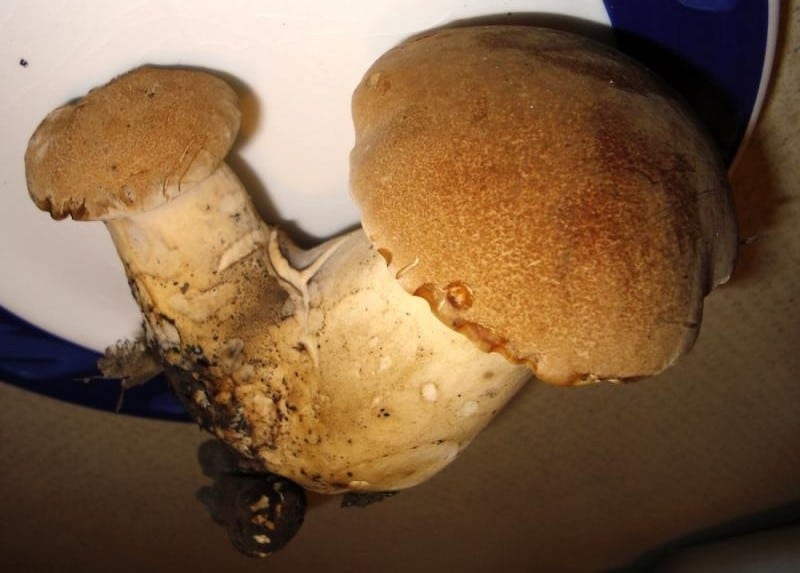
The cap is about 1¼ to 4 inches across, though it can reach up to 10-12 inches. It’s flat to slightly domed when young and then sinks into a shallow depression as it ages. It is round, and sometimes lobed.
The cap color is dark yellowish brown to reddish brown. The surface is dry, and either velvety or covered with flattened fibers and small scales. Young caps have a thin fringe of hanging fibers along the very edge.
Pores
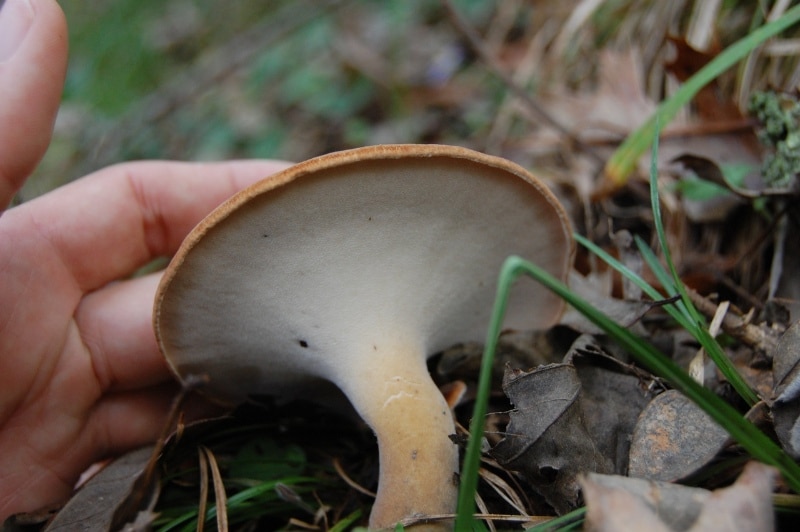
The pores are shallow and whitish, and run a short way down the stem. With age, they turn a dingy orange. They don’t bruise or change color when handled.
Stem
The stem is 1¼ to 6 inches tall above ground and roughly ¼ to 1 inch thick. It’s more or less the same width from top to bottom, though it is sometimes a little thicker at the base. Its surface is dirty orangish to slightly brownish, scruffy or scaly, and the upper part is finely fuzzy.
The stem continues below quite a bit underground. It tapers into a black root about 1½ to 4 inches long, and sometimes longer; this is how it connects to the buried wood. This part can break off when the mushroom is pulled up, so the soil around the base needs to be carefully removed to see it.
Taste, Smell, Flesh
The rooting polypore doesn’t have a distinctive smell, and it tastes slightly bitter. The flesh is white and soft but very tough. It doesn’t change color when sliced, and it doesn’t stain.
Spore Print
The spore print is white.
Rooting Polypore Lookalike Species
The lookalikes for the rooting polypore are all stalked polypores with brownish caps and whitish pore surfaces. Boletes can also cause confusion because they’re fleshy, stalked, and have pores as well. Most boletes, though, have rounded caps with smooth, round edges, and a more spongy pore surface.
Picipes melanopus
This is the closest lookalike, and it has a rootlike underground stem too. The difference is where the black is on the stem. On Picipes melanopus, the stem is covered in soft black felt above ground, while the rooting polypore is black only below the soil line.
This mushroom is also somewhat smaller. Its brown, velvety cap grows up to about 4 inches across, and it is depressed in the center. Picipes melanopus grows on dead hardwood or conifer wood, around stumps, or from buried wood, and it’s inedible.
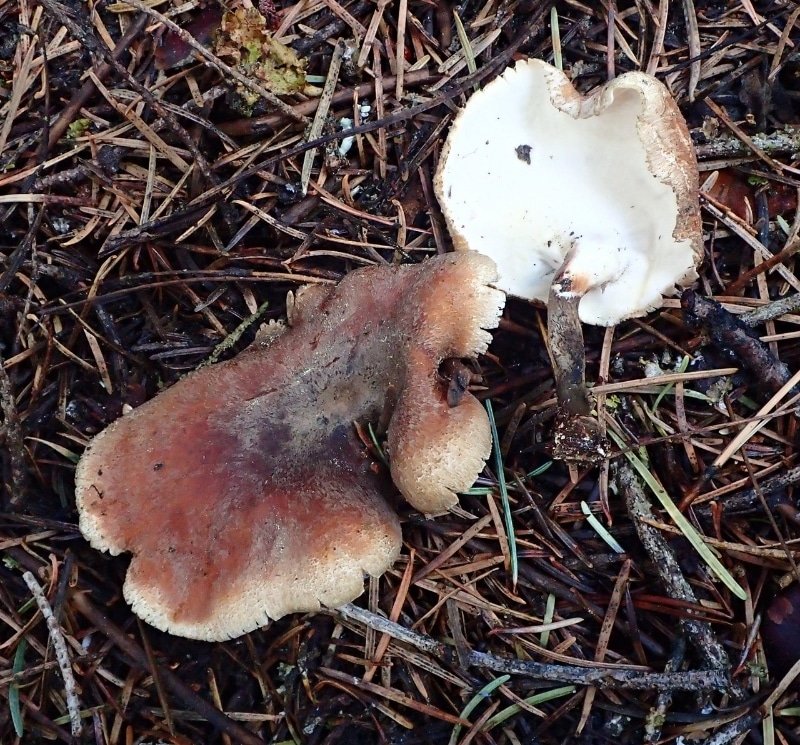
Black-Footed Polypore (Picipes badius)
The black-footed polypore looks similar from above, but it has some key differences. It grows directly on decaying hardwood logs and branches, not out of the ground, and its stalk has no rootlike ending. The cap of the bay polypore is also thin, glossy, and funnel-shaped. It’s roughly 1½ to 10 inches across and reddish-brown to chestnut colored, with a darker center that blackens with age.
The stem of the bay polypore is also black, but it is short and velvety, and often black all the way up. In North America, it’s widespread from Mexico to Alaska, and it’s inedible because of its tough texture.
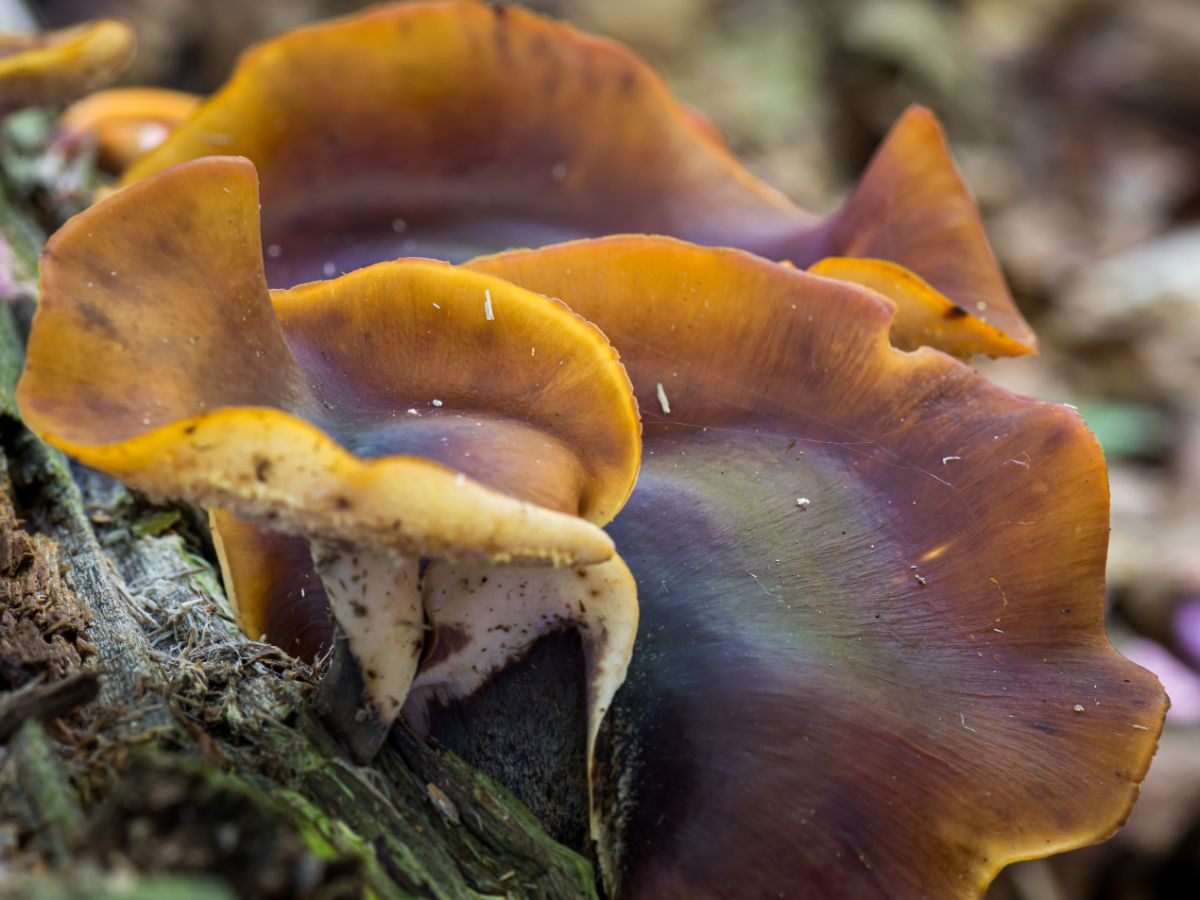
Tuberous Polypore (Polyporus tuberaster)
The tuberous polypore grows from a sclerotium, a hard underground mass of fungal tissue that can look like buried wood or a potato. This is significantly different than the rootlike stem extension of the rooting polypore. The sclerotium looks like a hard, round black mass at the base of the stem.
Its cap scales are raised, and they have sharp edges, not flattened, and the cap is a paler ochre to yellow-brown, about 1½ to 6 inches wide. The whitish stalk can be over 4 inches tall and has white hairs over the blackish lower portion.
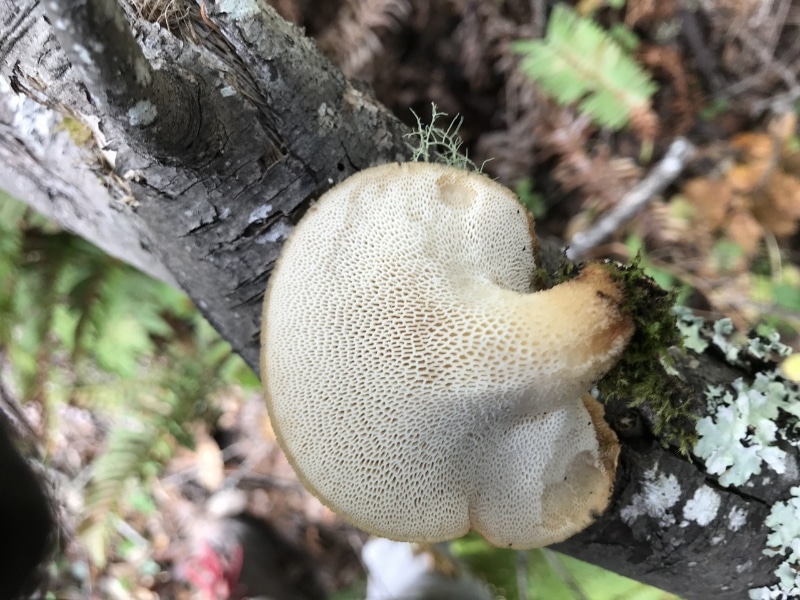
Rooting Polypore Edibility and Toxicity
The rooting polypore isn’t edible, though it’s also not toxic. The flesh is white and very tough, and the taste is slightly bitter.
Common Questions About the Rooting Polypore
Why does the rooting polypore look like it’s growing in the ground?
It looks like it is growing from the ground because it is attached to dead and buried hardwood. It usually fruits from roots or a stump.
Is the rooting polypore poisonous?
The rooting polypore is not poisonous, but it’s not edible either. Its tough flesh and slightly bitter taste make it unpleasant.
How can you collect a rooting polypore without damaging it?
The black root can break off if the mushroom is yanked from the ground. The whole mushroom needs to be uncovered by carefully removing the soil around its base. This exposes the root-like base, and then you can dig around it to get the entire thing up.
Leave a Reply