
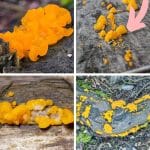
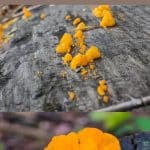
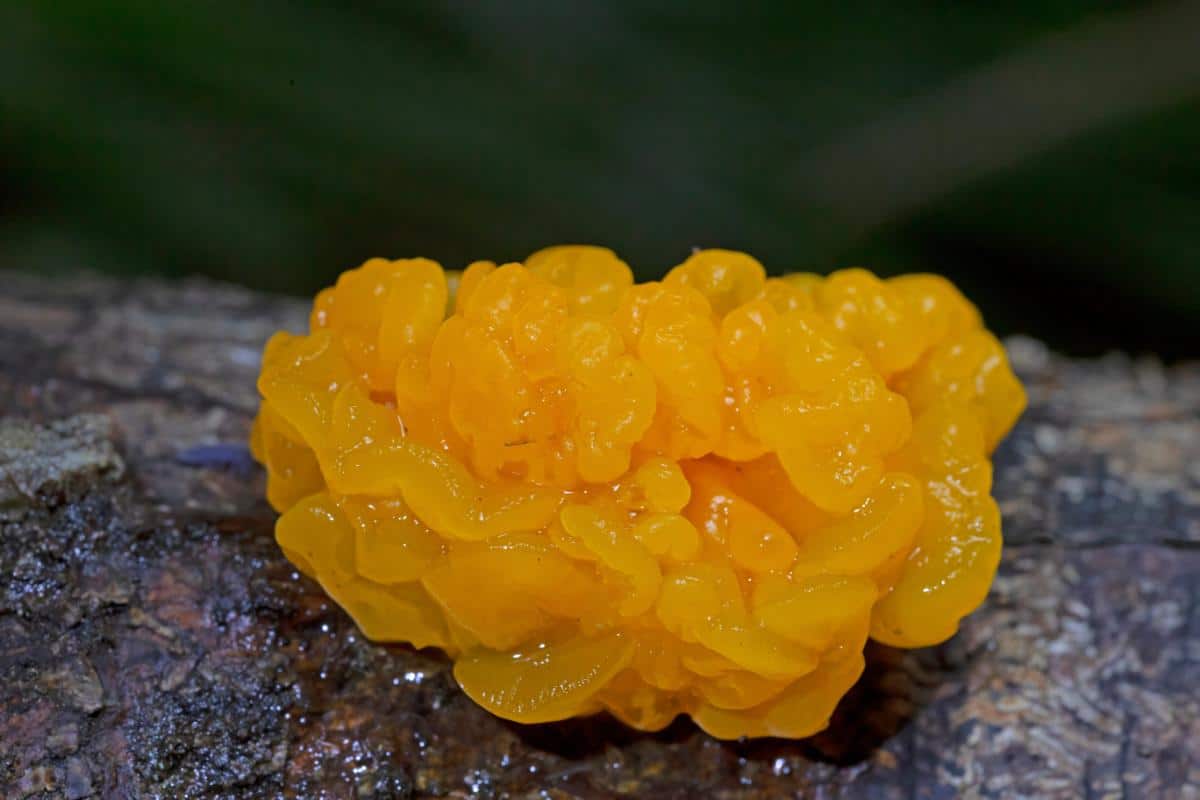
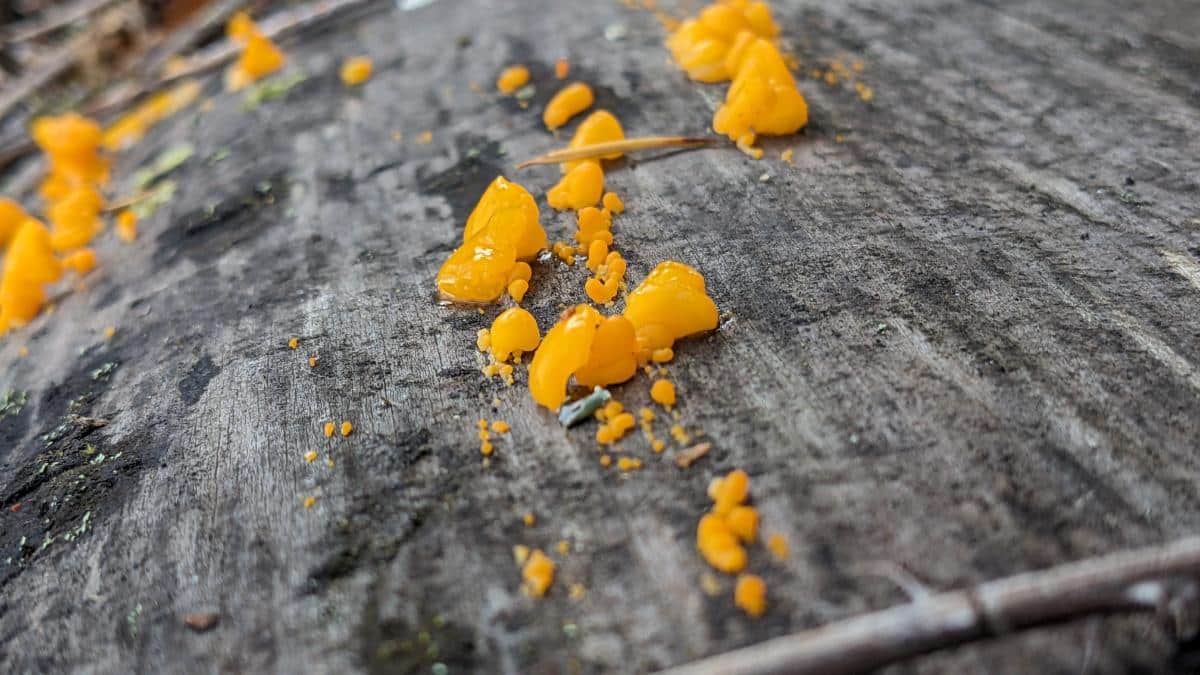
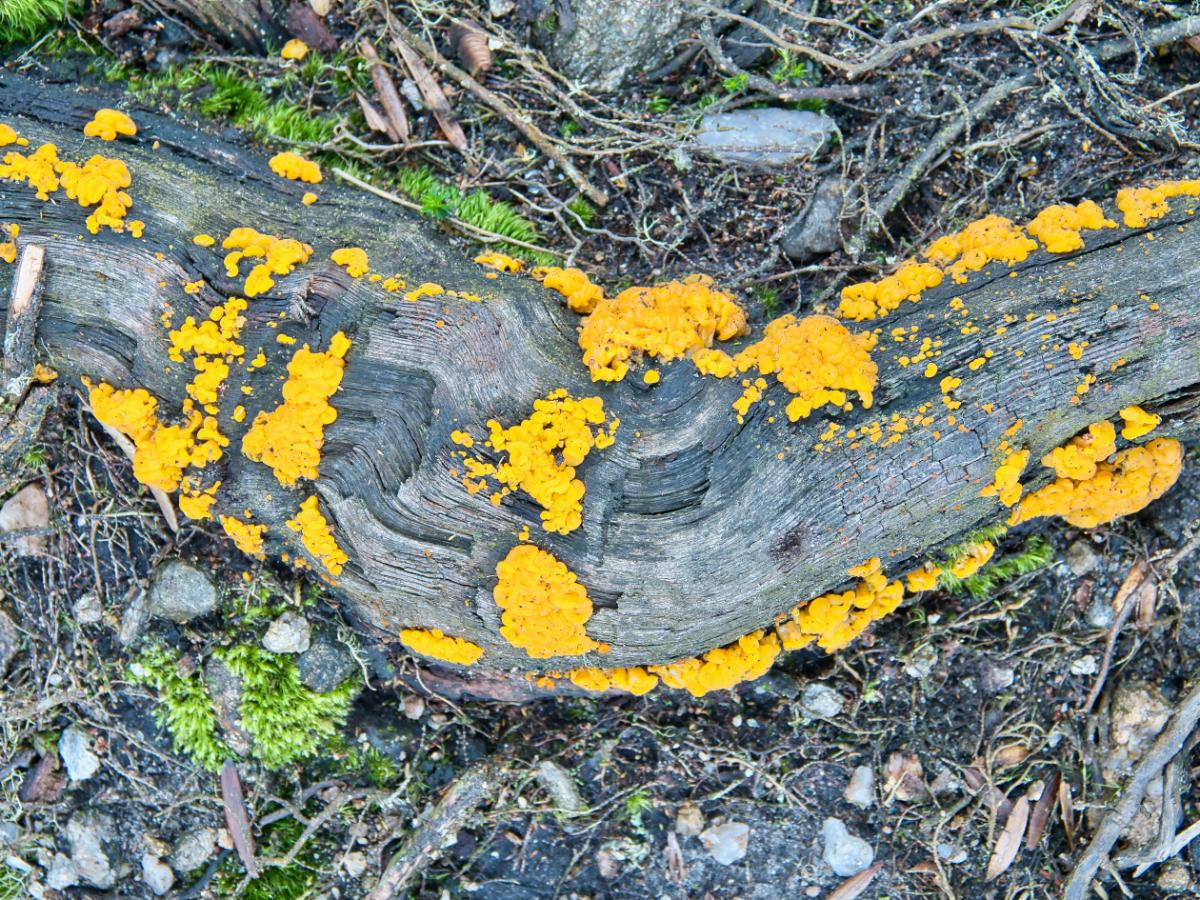
Orange jelly spot (Dacrymyces chrysospermus) is a bright orange jelly fungus that forms wrinkled masses resembling a brain or a cluster of petals. It is widespread across North America and grows mainly on dead conifer logs, stumps, branches, and old wooden structures. This species is edible, but it doesn’t have much flavor and is pretty slimy.
- Scientific Name: Dacrymyces chrysospermus
- Common Names: orange jelly spot, orange jelly, orange witch’s butter, witch’s butter
- Habitat: dead, decaying conifer wood, with rare reports from hardwood
- Edibility: edible
Jump to:
All About Orange Jelly Spot
The orange jelly spot is also commonly called witch’s butter or orange witch’s butter, which is confusing because there are other species also called witch’s butter. Tremella mesenterica and Naematelia aurantia are yellow witch’s butter species. And there is also Exidia glandulosa, which is called black witch’s butter, and Exidia nigricans, which is warlock’s butter. Common names can be very confusing!
This species was first described to science in 1832 and named Tremella palmata. In 1873, it was renamed Dacrymyces chrysospermus. At one point, it was also called Dacrymyces palmatus.
The genus name Dacrymyces combines the Greek words “tear” and “fungus,” which is a reference to how the young fruit bodies form. The species name chrysospermus means “golden-seeded” and refers to the yellow color of the spores when they collect in a mass.
Orange Jelly Spot Identification
Season
Orange jelly spot fruits from May through November in many regions, and in California, British Columbia, and the Pacific Northwest, they appear in winter and spring after rain. The fruit bodies, though, may develop during any month in mild or consistently damp climates. In dry weather, the gelatinous mass collapses into a thin film against the wood, then swells again after rain.
Habitat
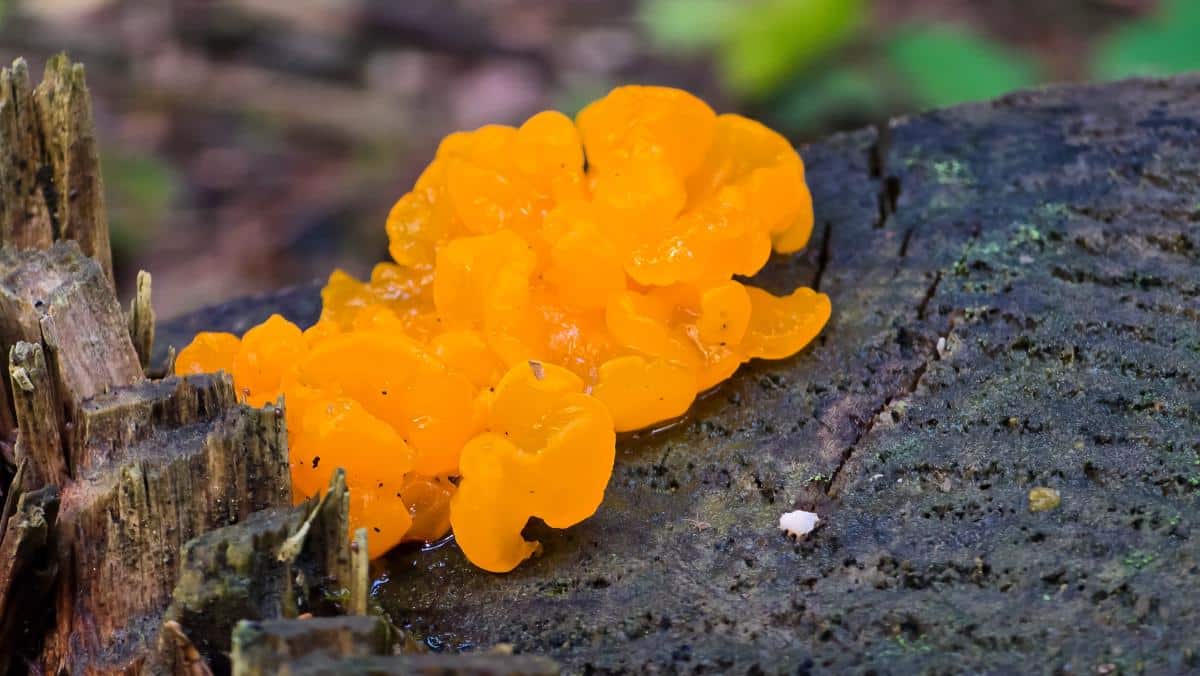
The fungus is saprotrophic and primarily grows on well-rotted conifer wood, including logs, stumps, fallen branches, brush, fence posts, and rails. It has been recorded on hemlock, pine, spruce, and fir. The fruit bodies like wood without bark, but they may also push through cracks in the remaining bark on a log.
While it prefers conifers, orange jelly spot has also been reported growing on hardwood. As the fungus consumes the wood, it causes brown rot or patches of brown pocket rot.
Orange jelly spot is widespread across North America and also grows in South America, Europe, Asia, Australia, South Africa, and several islands in the Indian Ocean.
Identification
Body
The young fruit body starts out as a small rounded cushion or teardrop. As it grows, the surface folds and as neighboring growths press together, they create an irregular mass that may resemble a brain, a cluster of petals, or a group of folded spoons. Some fruit bodies develop a short, stout stem and look like a fan, cup, spoon, or plate.
A cluster or orange jelly spot may reach about 2.5 inches across and 1 inch tall. The fresh fruit bodies are bright orange to yellowish orange, and they are smooth. They become slimy or sticky when wet.
When the fungus dries, it changes both the shape and color. The orange mass darkens to reddish orange or reddish brown, becomes more translucent, and contracts into a tough film against the wood. When it rains, they swell back into a gelatinous fruit body.
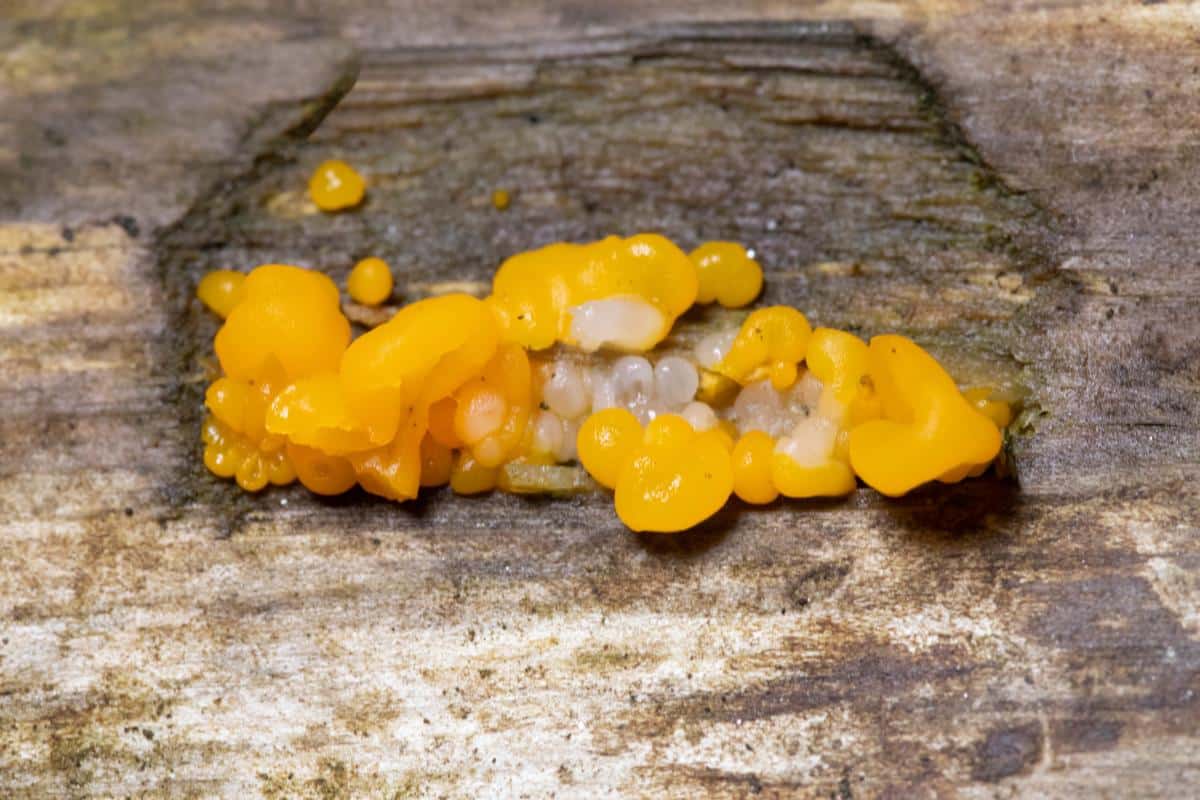
The fruit body narrows abruptly where it attaches to the wood. This attachment point is pale or whitish and may be surrounded by white fungal tissue. It can remain hidden in a crack or beneath the wood surface, so you may need to lift the entire cluster to see it.
Pores
Orange jelly spot has no gills or pores. Spores develop across the exposed surface of the folded fruit body.
Taste and Smell
Orange jelly spot has no distinctive smell or flavor.
Flesh Color and Staining
The flesh matches the outer surface in color and has a tough, gelatinous texture when fresh. It softens with age and may eventually begin to liquefy. It does not change color when it is cut or bruised.
Spore Print
The spore deposit ranges from pale yellow to deep orange.
Orange Jelly Spot Lookalikes
Several yellow and orange jelly fungi grow on dead wood and look similar. They also share common names, which can confuse identification attempts. The wood type, growth form, attachment point, and the presence of another fungus should be considered together. Color alone is not enough, particularly after a fruit body has aged or dried.
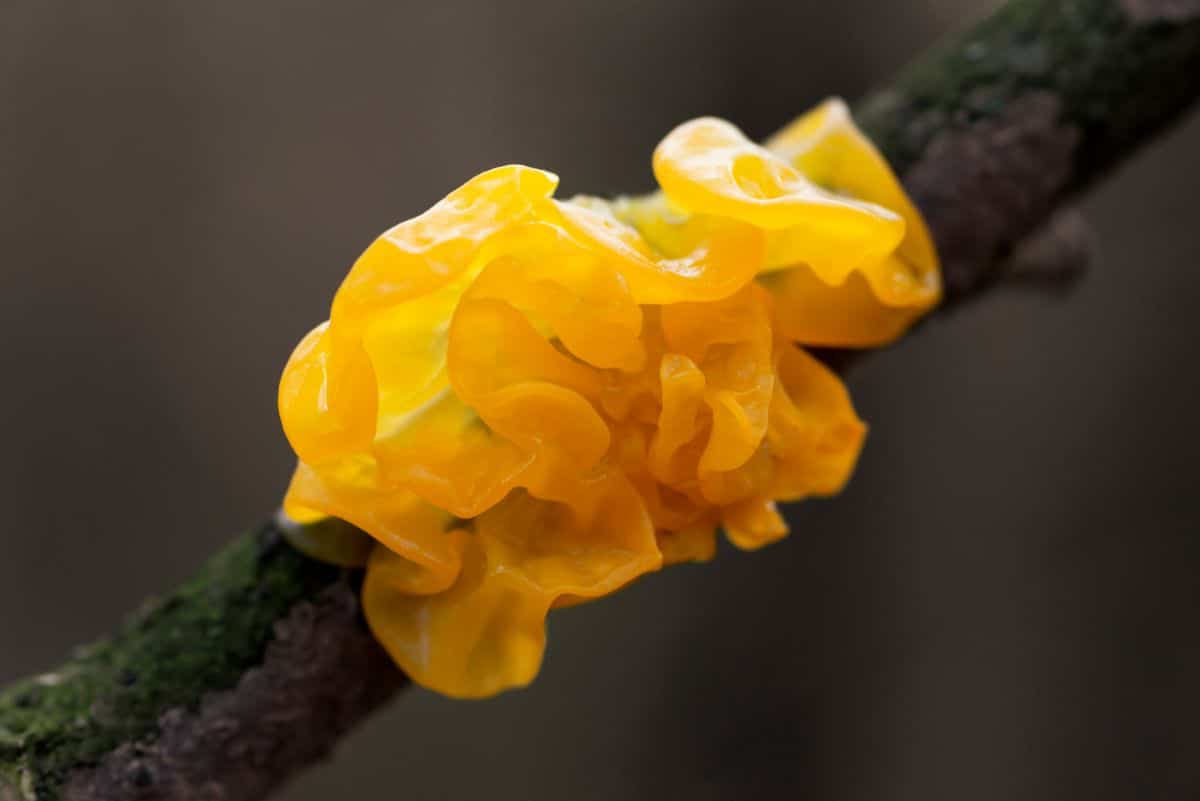
Witch’s Butter aka Yellow Brain (Tremella mesenterica)
Yellow brain, or witch’s butter, grows on hardwood rather than mainly on conifers. It parasitizes crust fungi in the genus Peniophora, which grow on dead attached or recently fallen hardwood branches, including oak. This means the crust fungi might be visible growing alongside the fungus, though it is often hard to see or find.
It has a yellow to orange fruit body that can reach about 3 inches across and 2 inches tall. The lobes are translucent, have smooth surfaces, and become hard when dry. Yellow brain doesn’t have the whitish rooting base that orange jelly spot has and has a whitish to pale yellow spore print.
Golden Ear aka Witch’s Butter (Naematelia aurantia)
Golden ear grows with hairy stereum, Stereum hirsutum, on dead broadleaf branches. The yellow jelly may surround and hide the thin, fuzzy brackets of its host, but if you look at the wood beneath and around the lobes, you may be able to see them.
Golden ear grows about 6 inches across, and it is much larger than orange jelly spot. Its lobes are thicker and more seaweed-like, and the surface is matte rather than greasy or shiny. When this fungus dries, it retains its shape instead of collapsing into a thin film.
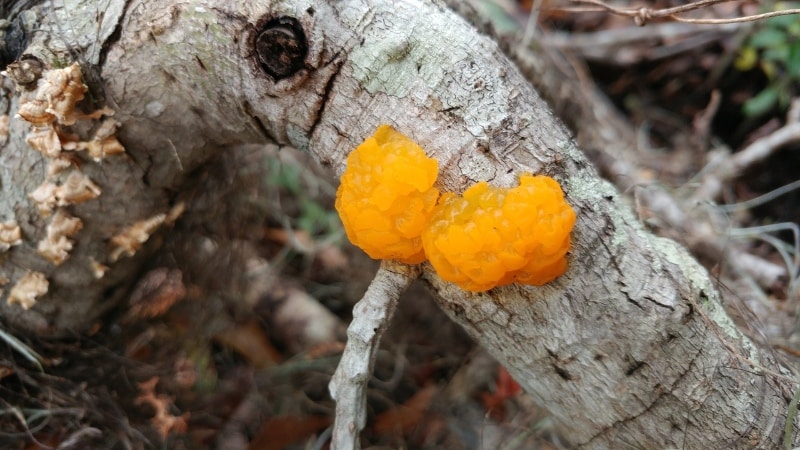
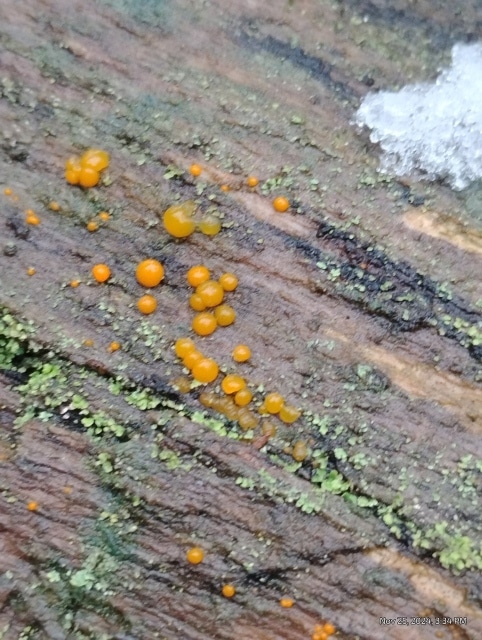
Common Jellyspot (Dacrymyces stillatus)
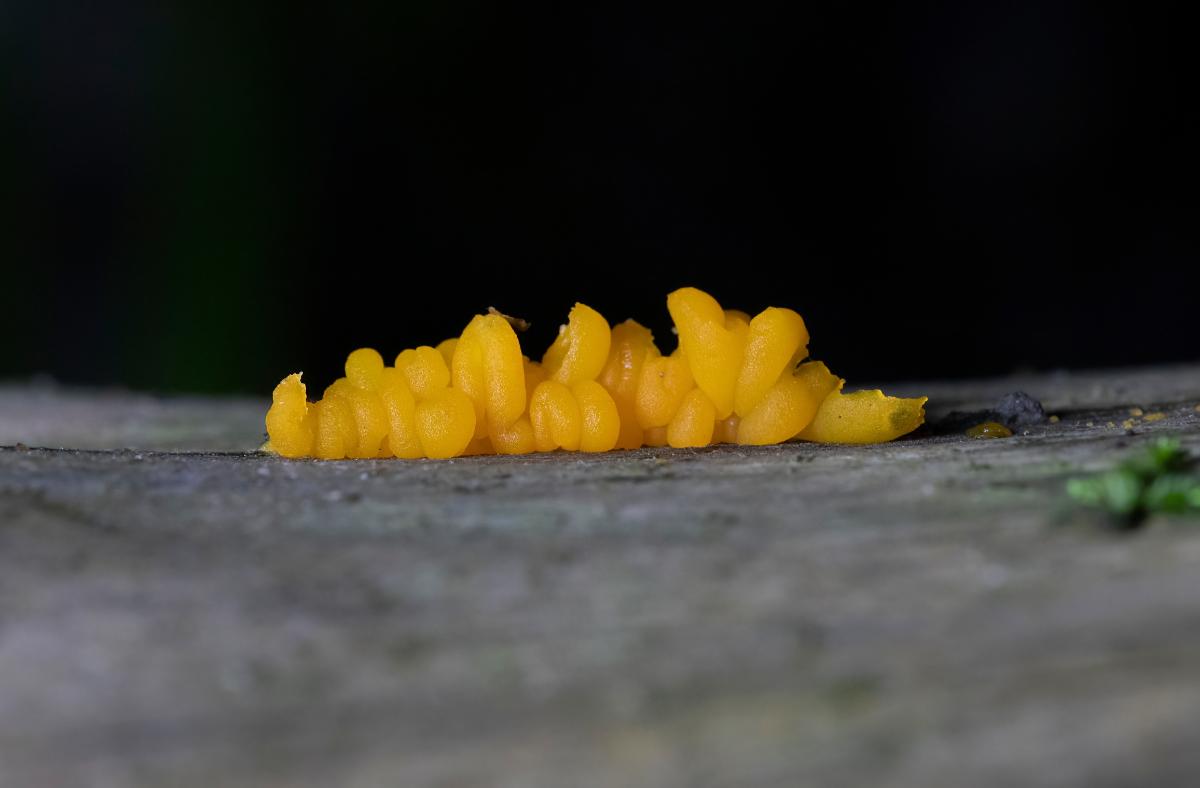
The common jellyspot is much smaller, measuring about 0.04 to 0.14 inches across, but the fruit bodies can merge together to create something bigger. It usually forms rounded or slightly flattened cushions rather than deeply folded, brainlike masses, but it may also look wrinkled like a brain.
The fresh growth is dull orange, and it may fade to gray-brown, olive brown, or pale brown with age. It grows in large groups on conifer wood. Its small size and simple cushion shape are the most visible differences from orange jelly spot.
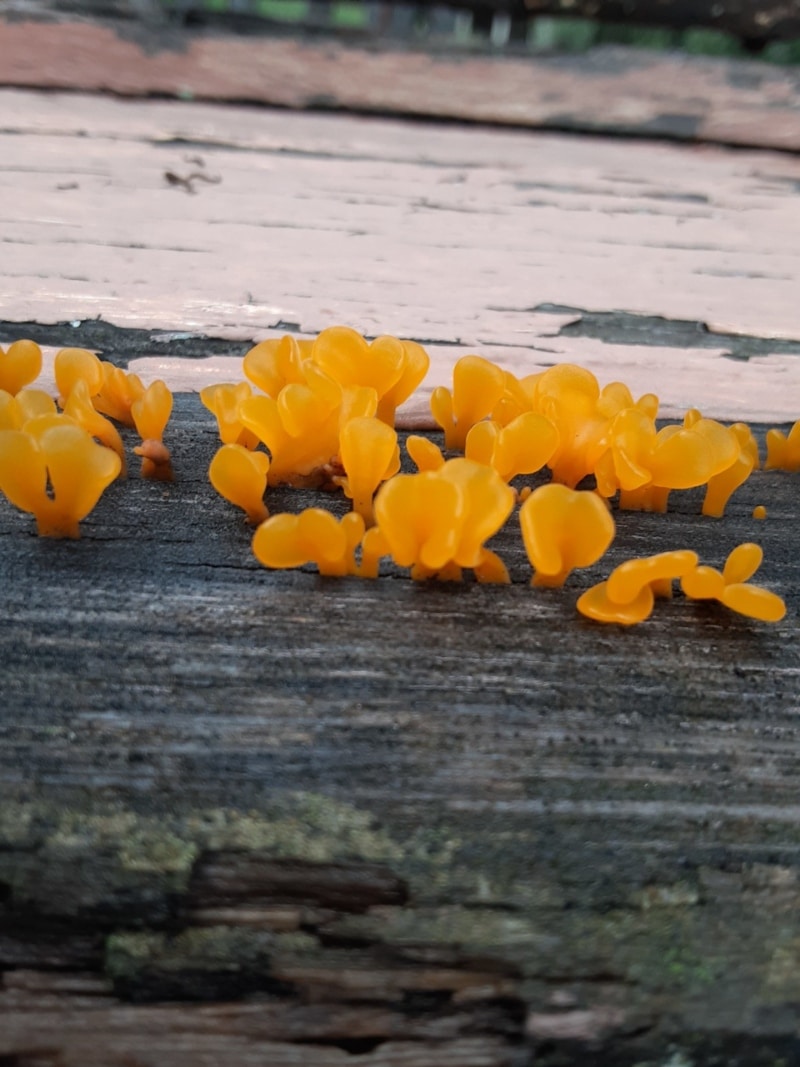
Dacrymyces spathularia
Dacrymyces spathularia has a distinct stem supporting a flattened, spoon-shaped or fan-shaped head. It grows about 0.25 to 1 inch tall and forms yellow to orange clusters on both conifer and broadleaf wood.
Young orange jelly spots may form similar spoon-shaped bodies, but they expand into larger and more irregular folded masses. Dacrymyces spathularia retains a clearer division between its stem and head.
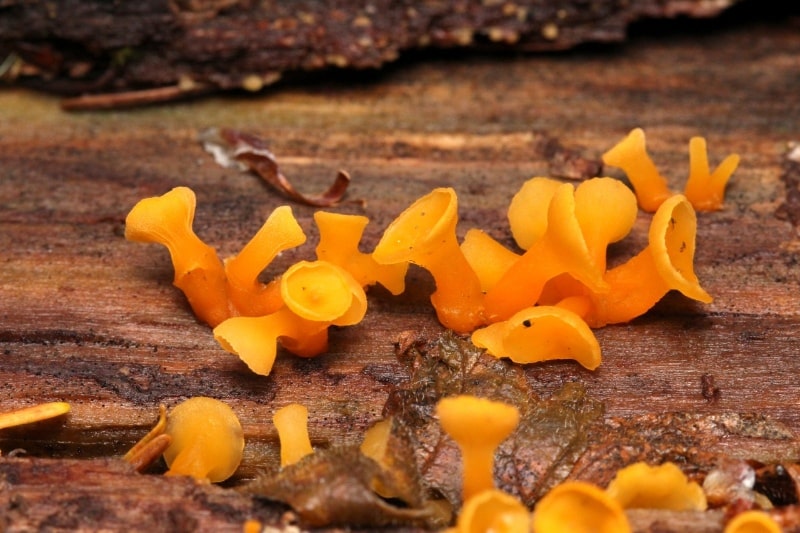
Other Small Yellow and Orange Jelly Fungi
Several jelly-like species that grow on hardwoods resemble young orange jelly spots, but they are much smaller. Femsjonia peziziformis has a shiny yellow upper surface and a finely fuzzy, whitish underside. Dacrymyces capitatus forms a yellow-to-orange cushion on a central, pale, fuzzy base. Guepiniopsis buccina resembles a tiny top or trumpet, with a defined stem that develops vertical grooves.
Dacrymyces chrysocomus is also smaller and yellower than orange jelly spot, with a cushion or cup-shaped body. Size, substrate, and the form of the attachment point will help separate these fungi.
Orange Jelly Spot Edibility and Toxicity
Orange jelly spot is edible, although it has almost no flavor. It is not considered a choice mushroom because of its gelatinous or rubbery texture. But this is also a reason some people harvest it. It is added to soups for that texture.
Common Questions About Orange Jelly Spot
Is orange jelly spot the same as yellow witch’s butter?
No. The name witch’s butter is shared by several fungi. Orange jelly spot is Dacrymyces chrysospermus, while yellow brain is Tremella mesenterica and golden ear is Naematelia aurantia.
Does orange jelly spot grow on hardwood?
It grows mainly on dead conifer wood. It has been recorded growing on hardwood, including an observation on alder, but these records are unusual.
Can dried orange jelly spot revive after rain?
Yes. A fruit body will contract into a reddish-brown membrane against the wood when it dries out. After absorbing rain, it can swell and regain its orange color and gelatinous texture.
Does orange jelly spot have medicinal uses?
There is no peer-reviewed research specific to this species. There are claims made about other witch’s butter species, but not this one.
Leave a Reply