
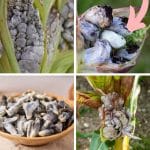
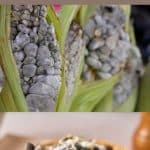
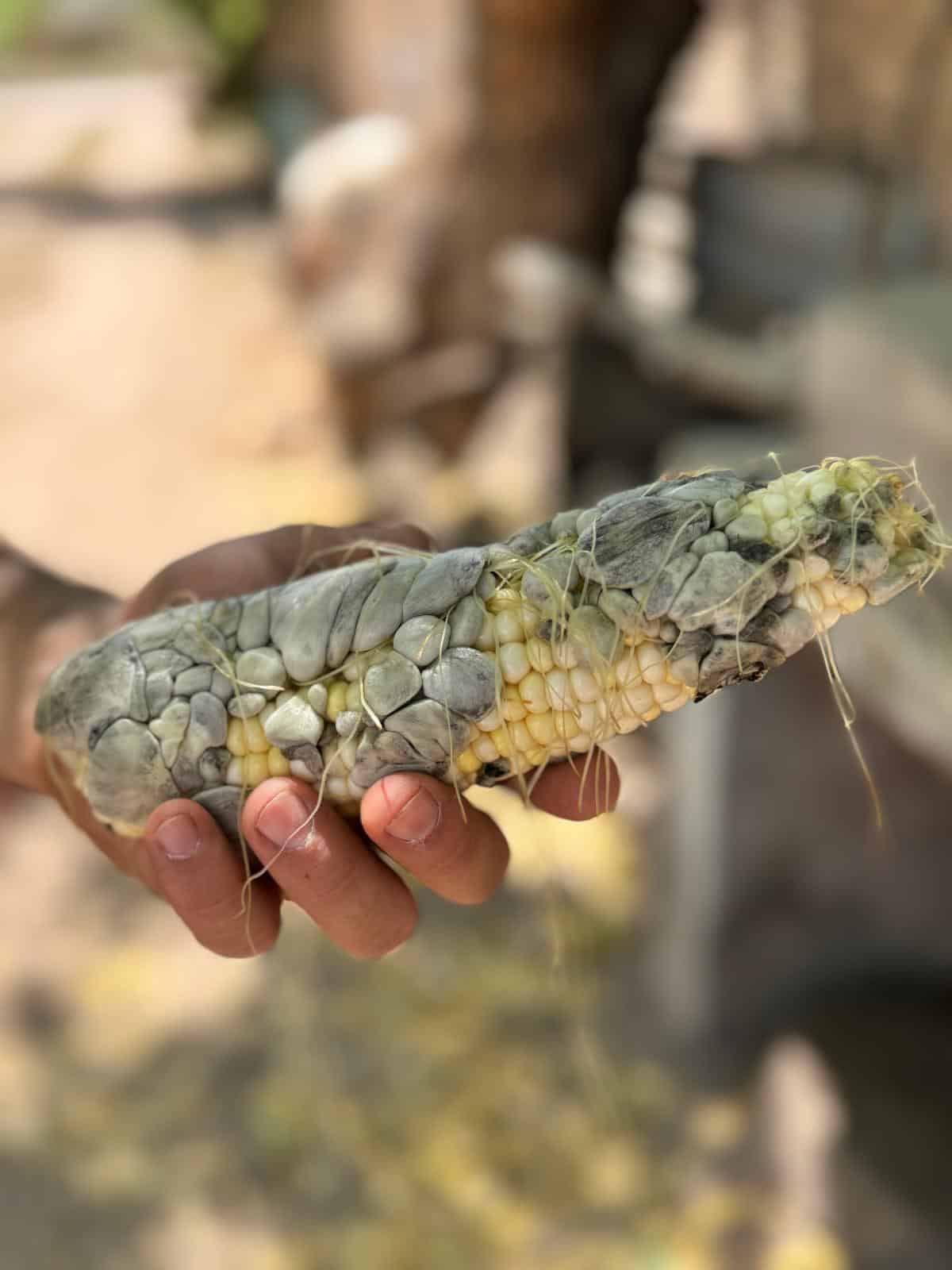
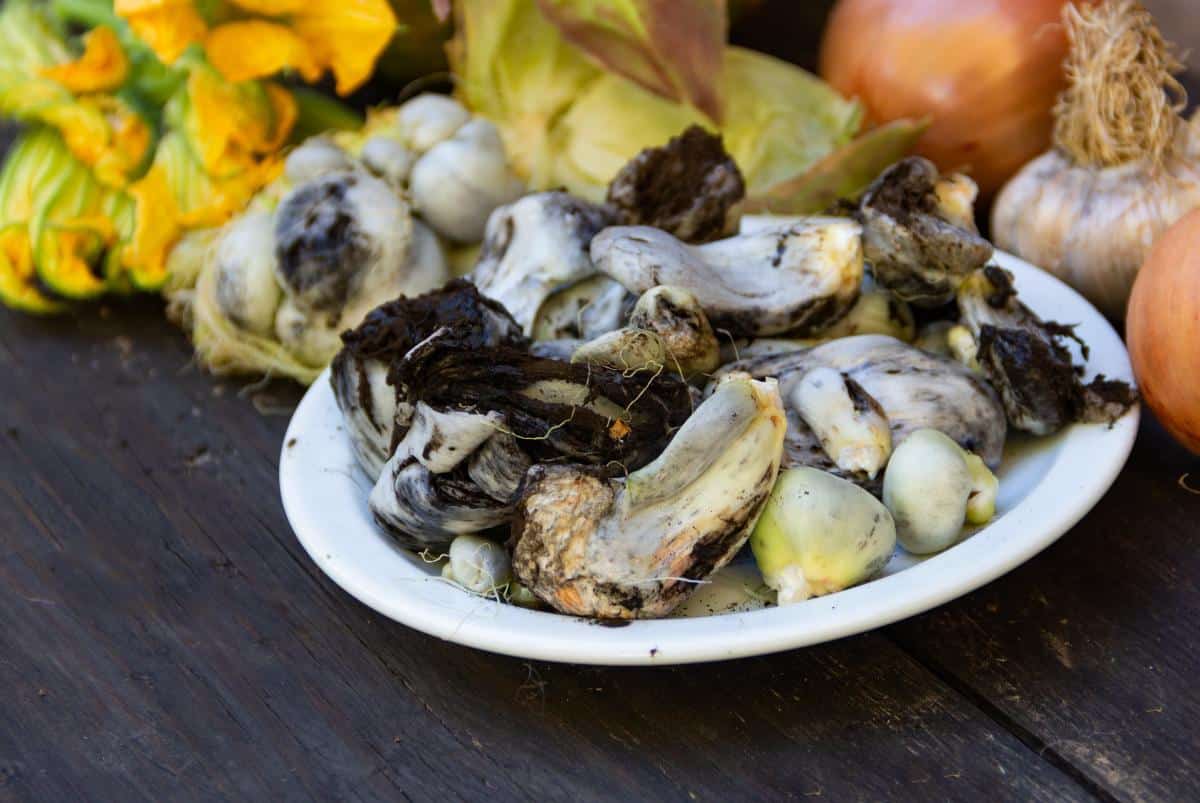
The young galls of the fungus Mycosarcoma maydis, known as huitlacoche (pronounced weet-la-COH-cheh), are a highly prized edible delicacy in parts of the world. Huitlacoche, also commonly known as corn smut, grows on fresh corn and looks bizarre and not particularly appetizing to many people. But in Mexico it is a bred on purpose and sold at a premium; it can be worth 20–50 times the maize it replaces. Outside Mexico, huitlacoche is a niche ingredient. The galls are the result of the fungus infecting the corn and producing swollen, pearly gray to bluish lumps.
These odd-looking fungi are used in quesadillas and soups, and they have been eaten in central Mexico since before the time of the Aztecs. The fungal disease is spread worldwide and is common in most places where corn is grown. Corn can also be intentionally infected with the fungal parasite to create these galls.
- Scientific Name: Mycosarcoma maydis (formerly Ustilago maydis)
- Common Names: Huitlacoche, cuitlacoche, corn smut, Mexican truffle, corn mold; chumo and pacho in Peru; hongo de maíz in parts of Mexico
- Habitat: Parasitic on corn
- Edibility: Edible and prized when young and moist
Jump to:
What Is Huitlacoche
The fungus Mycosarcoma maydis parasitizes corn and teosintes (wild grass species related to corn) and creates swollen whitish galls that turn into black, dusty spore masses like soot with age. The species was moved to the genus Mycosarcoma in 2016 but field guides, and even recent articles, still use the older name Ustilago maydis, so don’t be surprised to see both names in use.
Smuts are a large group of fungi, with thousands of species. As of 2008, 1640 smuts have been detailed, parasitizing around 4,100 plant species, but experts estimate there are likely more than 4000 smuts and many are still undescribed. Smuts favor grasses and sedges. Huitlacoche is one of only two smut fungi that are widely cultivated and eaten as common foods. The other is Chinese water bamboo (Ustilago esculenta).
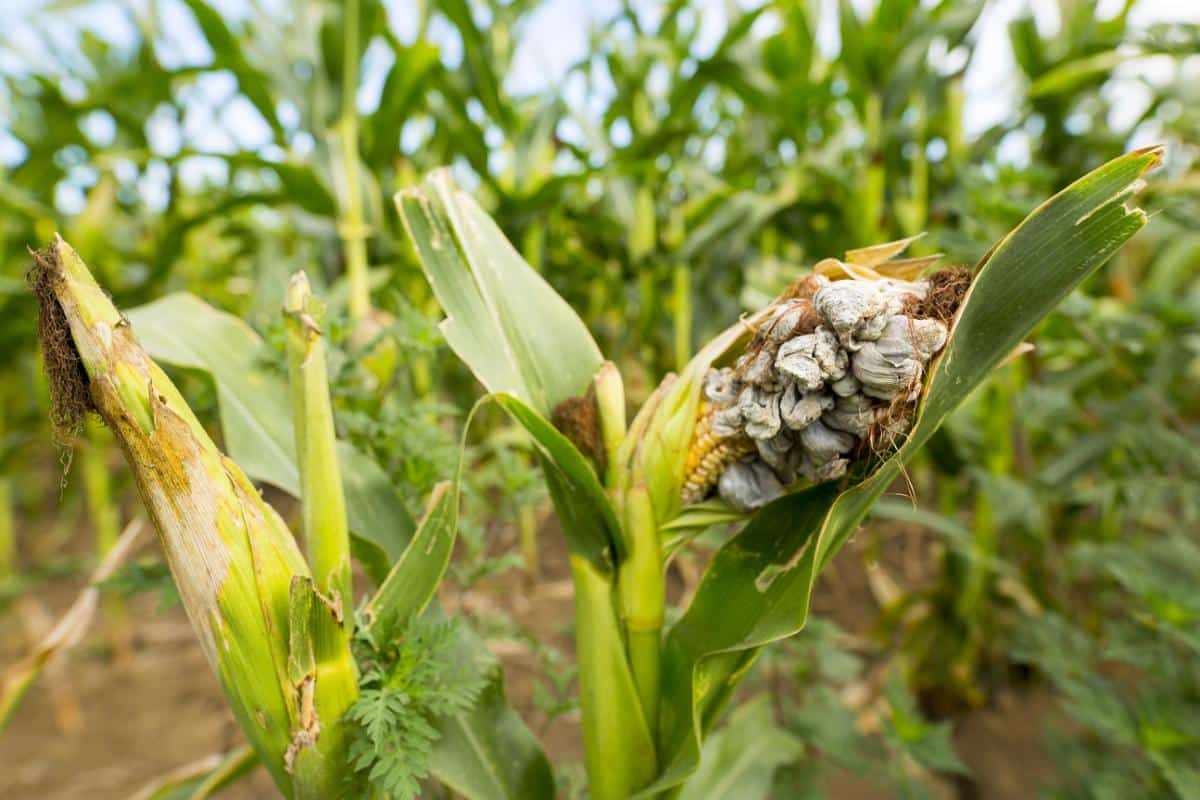
For a long time, people didn’t know exactly what corn smut was, and many believed it was caused by bad weather, insect bites, or sick plant sap. Scientists in the late 1700s first classified the fungus as a puffball species because of the dark, powdery spores inside at full maturity, but later moved it to smuts based on observations of how smuts operate. Most smuts are parasitic, so they assumed it was as well. It wasn’t until the 1870s and 1880s that German researcher Oscar Brefeld grew the fungus in a lab and mapped out its life cycle, demonstrating how airborne spores land on corn plants, infect their cells, and cause the plant to produce large, swollen smut galls.
In 2002, scientists studying how corn smut repairs its damaged DNA discovered a new way cells fix broken genes. This discovery helped researchers figure out how the human breast cancer gene, BRCA2, works because the fungus uses a simpler version of the same protein.
Corn smut is also valuable because it naturally makes several useful chemicals. The fungus produces malic acid, which gives sour candies and fruit drinks their tart flavor and acts as an exfoliating ingredient in skin serums. It also creates ustilagic acid, a natural antifungal used in eco-friendly soaps and farm sprays, and itaconic acid, which is used to make biodegradable plastics, paints, and latex. Scientists don’t collect corn smut from farm fields, though. They grow the fungus in controlled factory tanks.
The History of Huitlacoche
The eating of huitlacoche goes back to pre-Aztec times, but it wasn’t just popular in Mexico. The oldest physical proof of humans eating corn smut in North America comes from Turkey Pen Ruin in southeastern Utah. Archaeologists analyzing preserved Ancestral Puebloan coprolites (fossilized human waste) from around 100 to 200 AD found massive quantities of corn smut spores. This discovery proved that native peoples in ancient Utah were deliberately harvesting and eating smut galls nearly 2,000 years ago.
The name huitlacoche is Nahuatl, the language the Aztecs spoke, though modern speakers call the fungus cuitlacochin. The word’s original meaning is debated. One theory is that it means sleeping growth, because the fungus swells between the kernels and keeps them sleeping, while another suggests it means a simple corn outgrowth. A popular translation, raven’s excrement, is actually a mix-up with a different Nahuatl-derived word, the name of a bird called the thrasher. That bird’s name actually comes from cuīcatl, the Nahuatl word for song. The mix-up happened because, while the two names are not the same word, they are written identically.
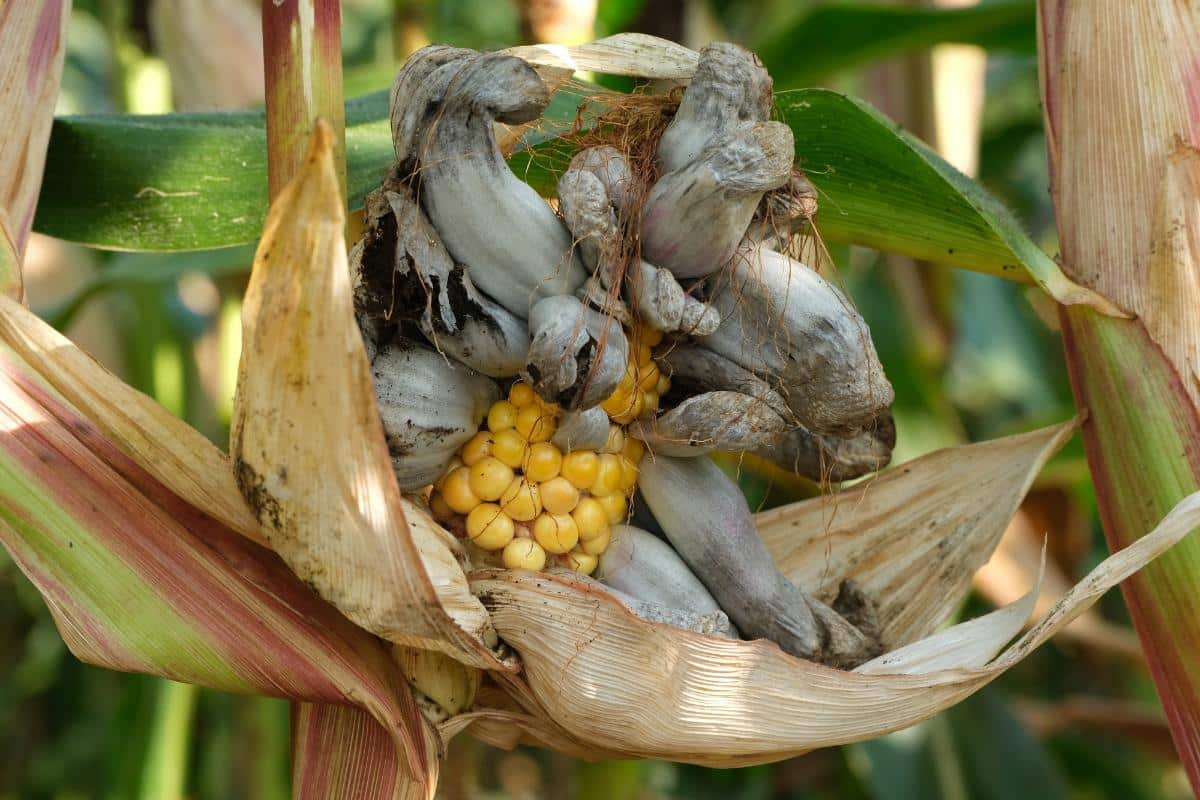
In Peru, the fungus is known as chumo or pacho, and in parts of Mexico as hongo de maíz, meaning maize fungus. It is also called corn mold, but that is inaccurate because that is the name for a different fungal parasite. Grain molds such as Fusarium and Aspergillus grow on the grain itself, while corn smut is a parasite that invades the living plant and causes swollen galls on the ears, leaves, stalks, and tassels.
The Native American Hidatsa people of North Dakota harvested the fungus from their own corn. A Hidatsa woman named Maxi’diwiac, known in English as Buffalo Bird Woman, described the practice in a 1917 account of her people’s agriculture. The Hidatsa called the fungus mapë’di and gathered the ear smut during the corn harvest, partly boiled it, and dried it on the cob. They then broke it off and stored it with dried green corn.
The corn smut was boiled together with that corn, and it was never eaten fresh from the garden or cooked on its own. They also didn’t eat the smut that grows on the stalk, with the reasoning that if it grows on the cob, it is a kind of corn, but if it grows on the stalk, it is not.
Corn smut and another fungus, ergot, were used in traditional medicine to control muscle contractions, particularly during pregnancy and childbirth. Ergot, a fungus that grows on rye, contains alkaloids that midwives in Europe used starting in the Middle Ages to speed up a slow labor, stop heavy bleeding after delivery, or terminate unwanted pregnancies. But ergot can have very severe side effects if too much is used.
Corn smut produces a similar but milder chemical called ustilagine. Knowledge of its properties was widespread across Indigenous cultures throughout the American Southwest and Mesoamerica, including the Zuni, Hopi, Navajo, and Nahua-speaking groups, who used it to induce labor, manage menstrual regulation, and bring on abortions.
During the 1800s, American doctors learned about these remedies from Indigenous healers and began making corn smut extracts. They preferred them over ergot because their milder strength made dangerous side effects less likely. It was listed in the official United States Pharmacopeia (USP) in 1882 as a uterine stimulant.
In America, the fungus was (and still is considered by many) to be a big problem because it destroys corn crops. The Department of Agriculture spent years and lots of money trying to wipe corn smut out of American fields. When a different smut, Karnal bunt of wheat, was found in a few Texas and New Mexico counties in the late 1990’s and early 2000s, 35 countries put specific restrictions on American wheat, and losses were estimated at more than $27 million dollars.
In 1989, the James Beard Foundation hosted a huitlacoche dinner prepared by Josefina Howard, chef at the Rosa Mexicano restaurant, and the event tried to popularize the food by renaming it the Mexican truffle. By the mid-1990s, demand from high-end restaurants had grown enough that the USDA allowed farms in Pennsylvania and Florida to infect their corn with huitlacoche on purpose.
The results were mixed. A 2012 review described growing acceptance among the North American public, while more recent reports show the fungus has struggled to enter American and European diets despite promotion. However, some American farmers are trying to grow heavily smutted corn because the fungus is worth more than the corn it destroys.
Huitlacoche Identification Guide
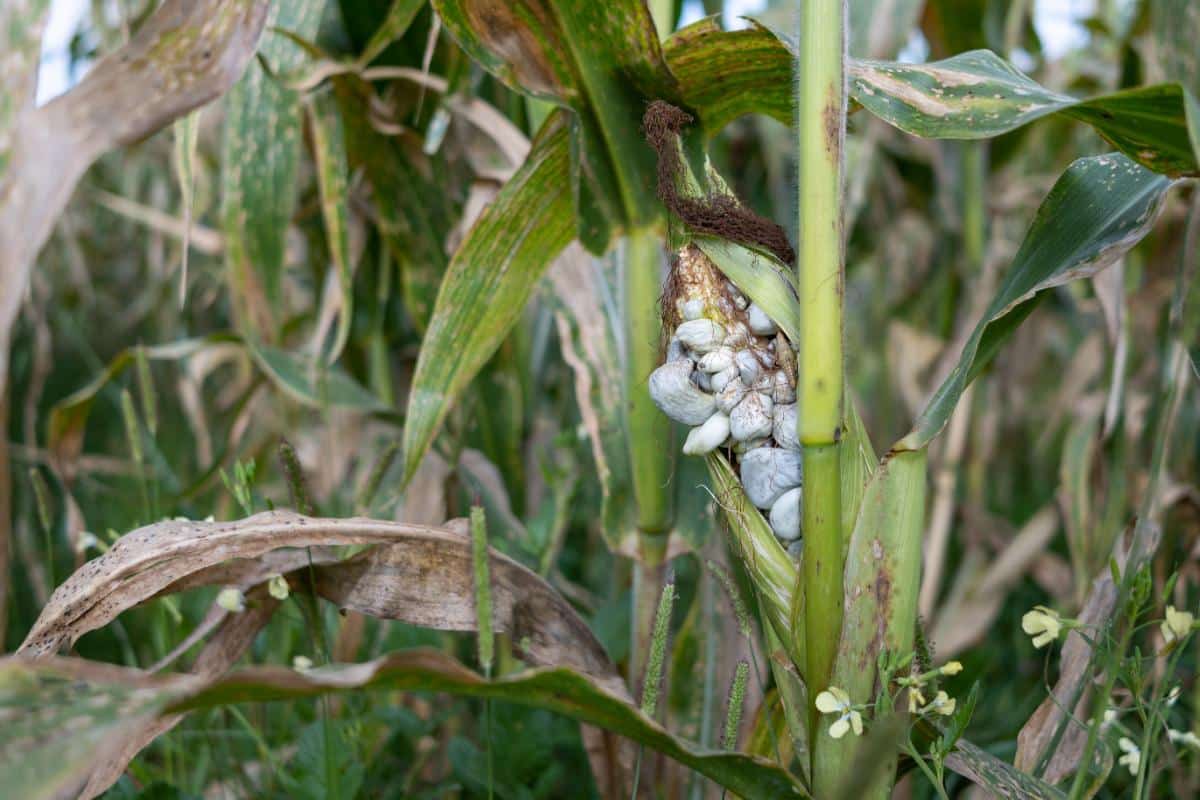
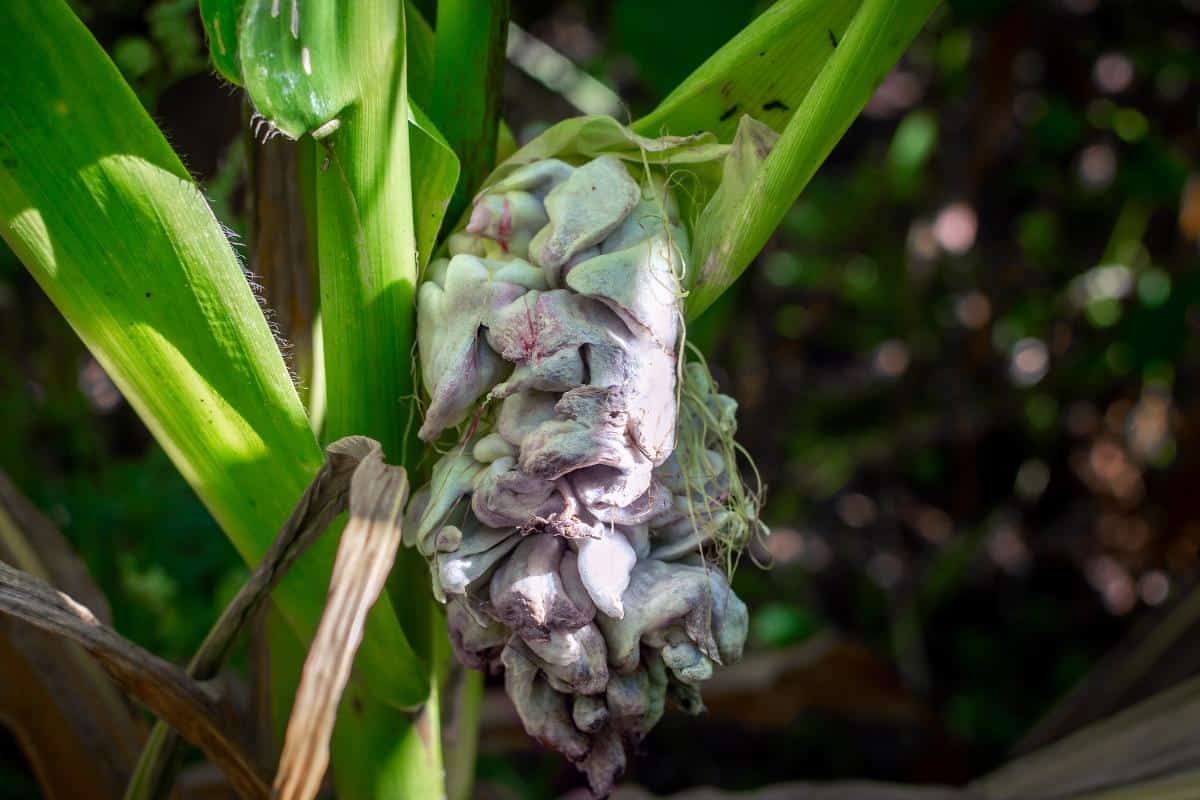
Corn smut doesn’t have a cap, gills, or stem. It is a gall, and when the gall is moist and pearly, it’s good to eat, but if it’s dry and powdery, it is all spores and past the point of edibility.
Season
Galls can appear at any point in the growing season, on any above-ground part of the plant. It prefers young, actively growing tissue and can be found on corn ears, leaves, stalks, and tassels. It will take advantage of any wounds in the corn stalk from hail, wind, or tools. The spores are spread by high winds and heavy rain.
The fungus is persistent once it arrives. It overwinters in crop debris and soil and can stay viable for several years. There is no fungicide that can control it, because it infects individual kernels rather than the whole cob. Farmers manage it instead with resistant hybrids, crop rotation, debris cleanup, and by being careful not to injure the plants.
Habitat
This smut grows wherever corn grows. The disease is distributed worldwide and is common in most places where corn is cultivated. Its host is corn and teosinte, a wild Mesoamerican grass from which corn was domesticated.
The Galls
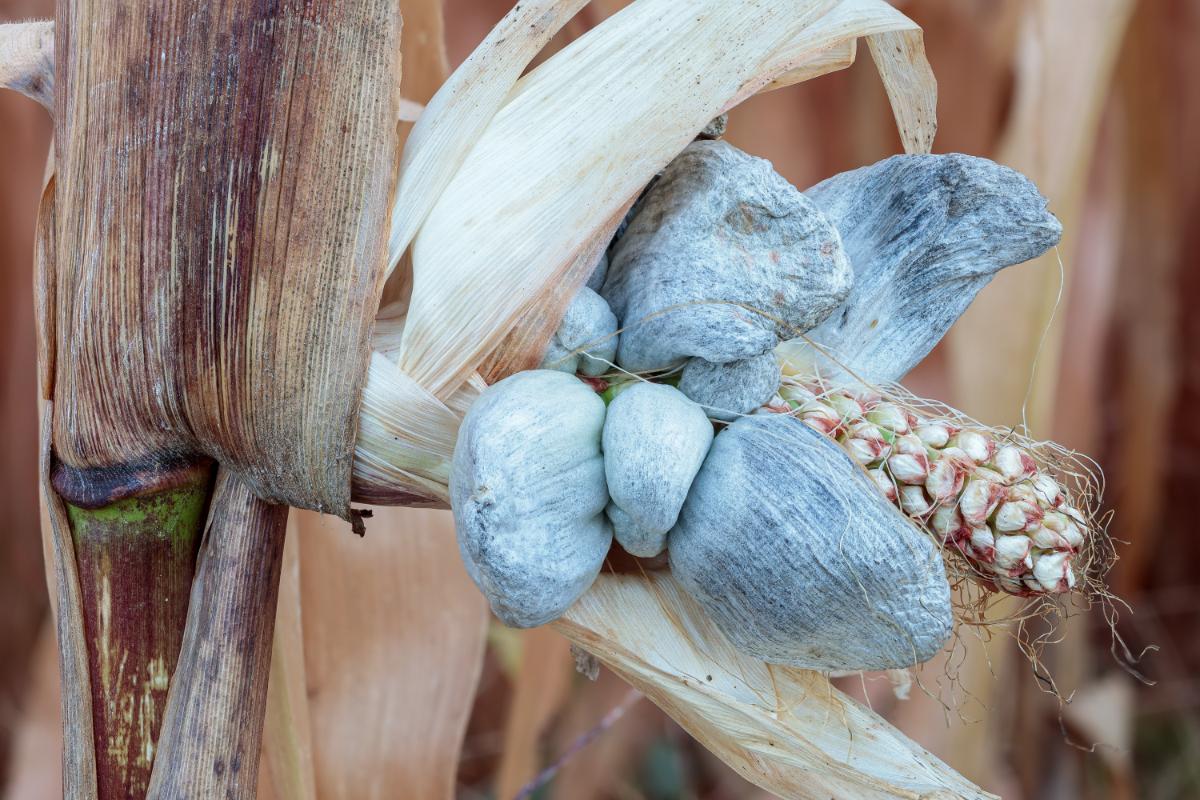
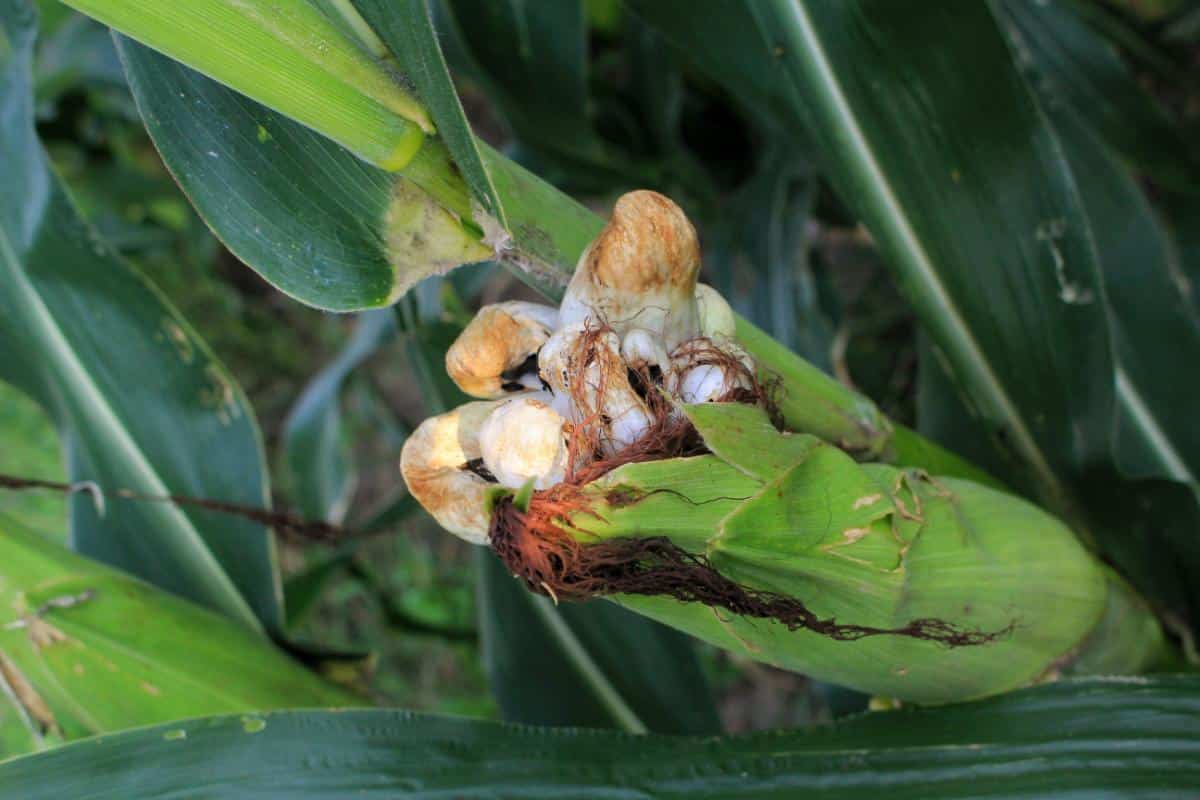
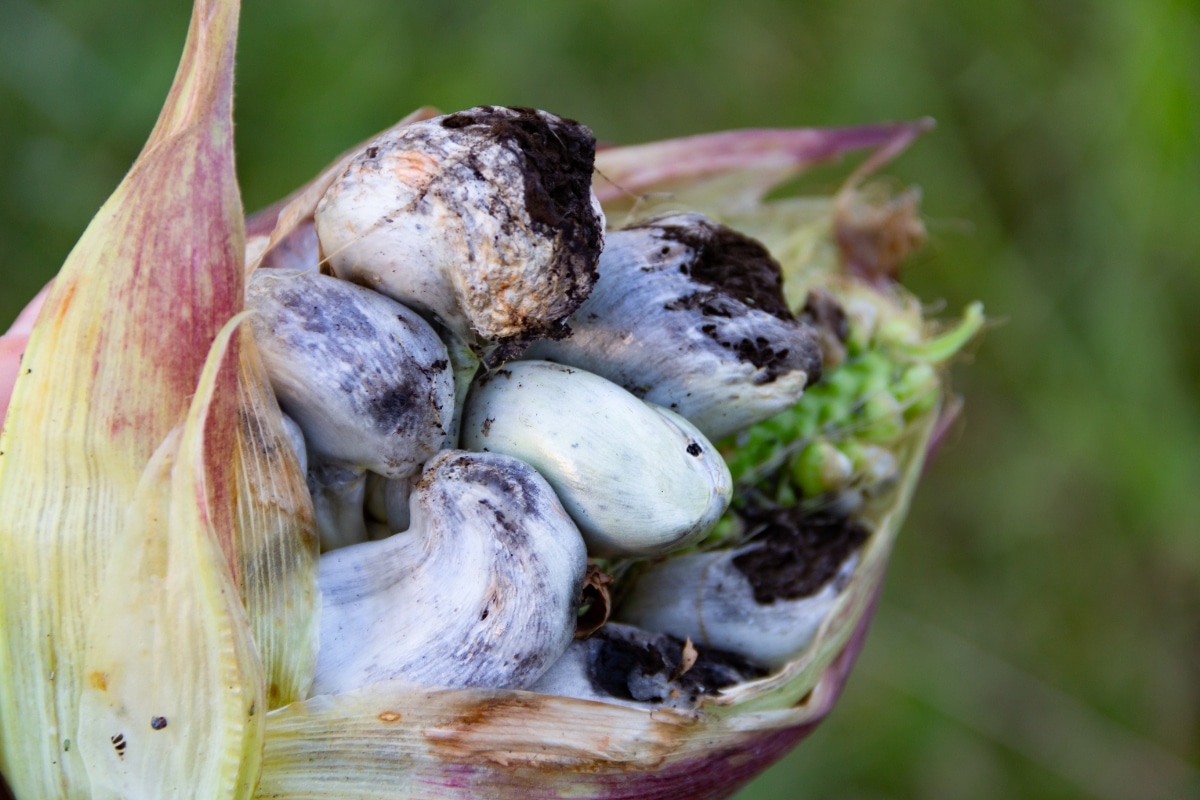
A gall starts as a swelling on the corn covered with white to silvery tissue. It is pearly gray, bluish-gray, or silver-gray, and rounded or egg-shaped, and it pushes the kernel rows apart. A single gall can grow 4-12 inches across. The gall is made up of the corn plant’s cells, which the fungus forces to divide and swell.
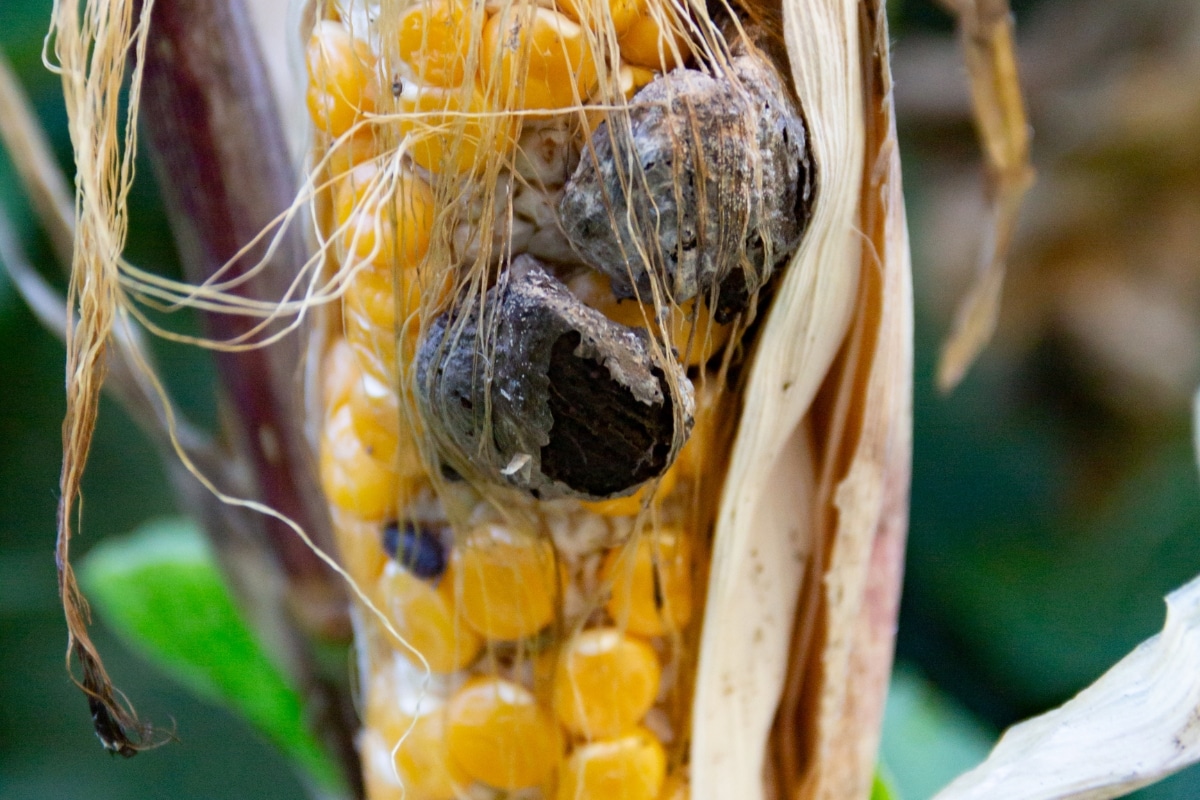
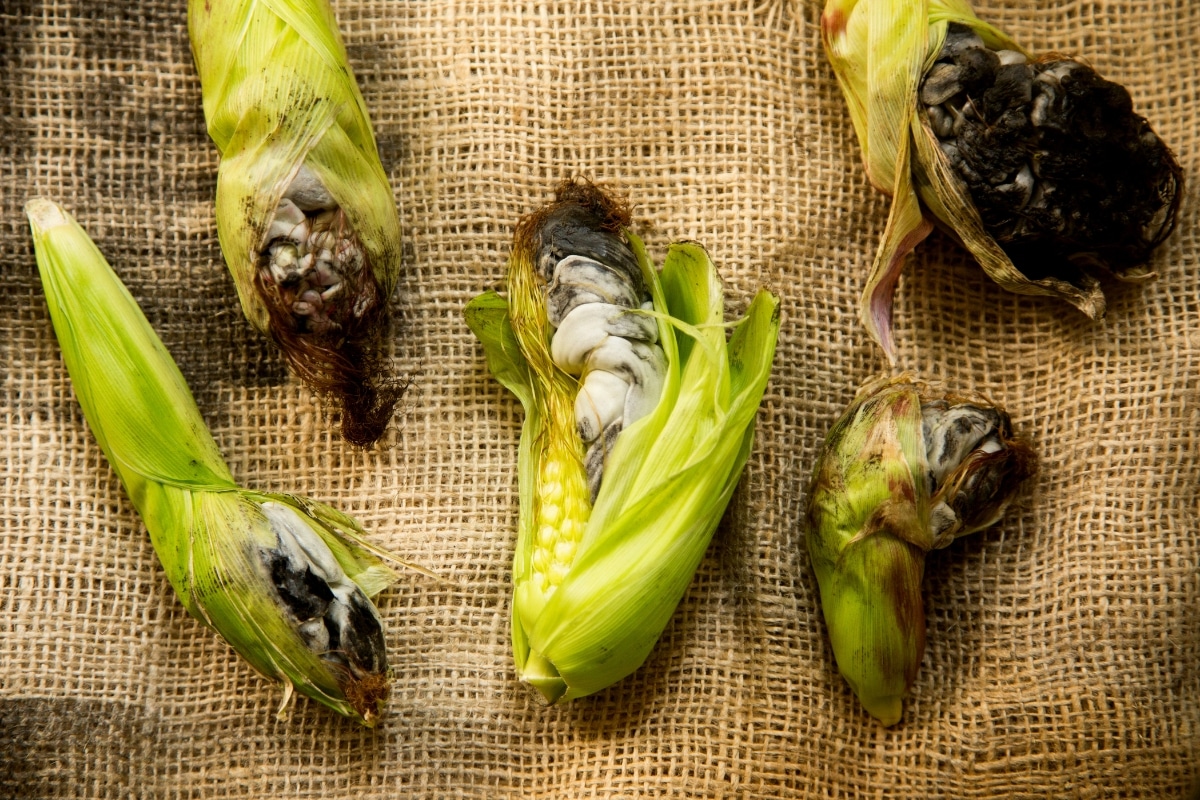
When galls grow on the leaves, they stay small. As a gall matures, the silvery skin breaks, exposing the black interior, and when the whole mass dries, it is almost nothing but spores. The dark spores give the cob a burned, scorched look, and at that stage it isn’t edible.
Taste and Smell
The fresh galls taste more like a mushroom than like corn. The flavor is sweet, savory, woody, and earthy, and researchers have traced the taste to compounds including sotolon and vanillin, along with the sugar glucose. Its smell is mild, sweet, clean, and earthy. Many say it smells fresh like rain and fresh husked corn.
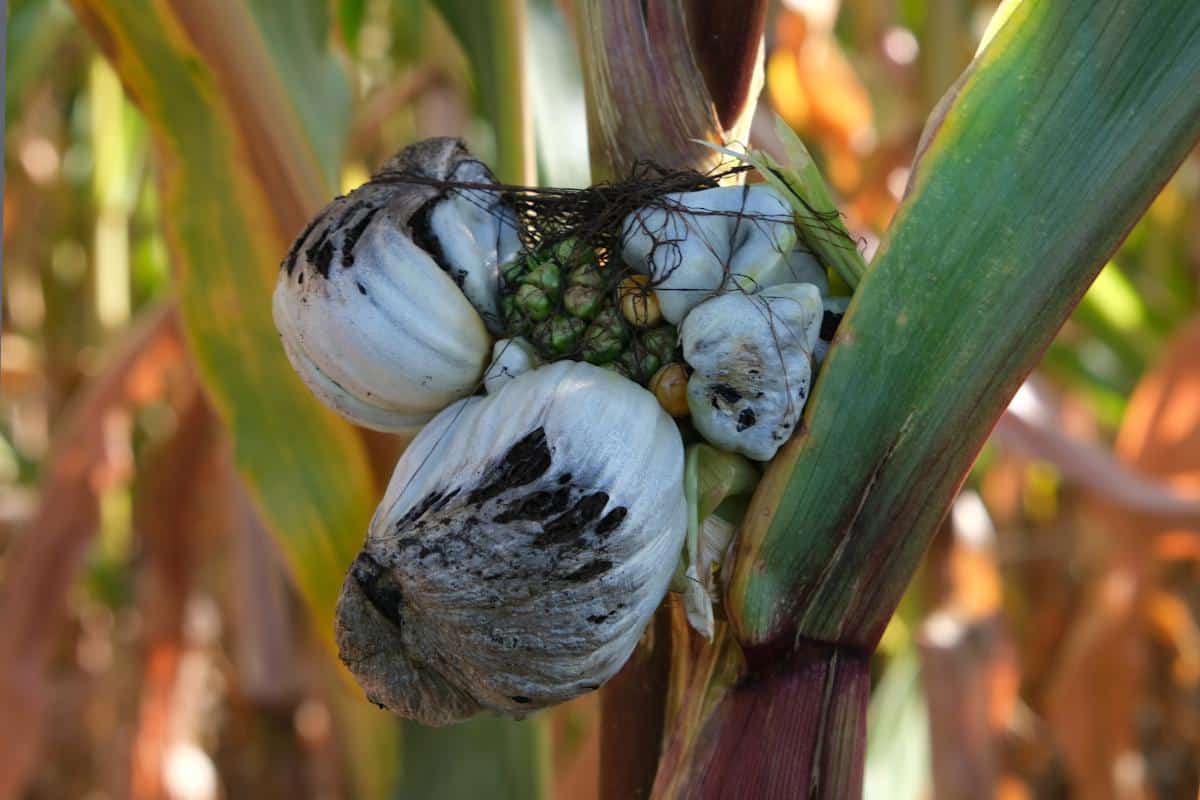
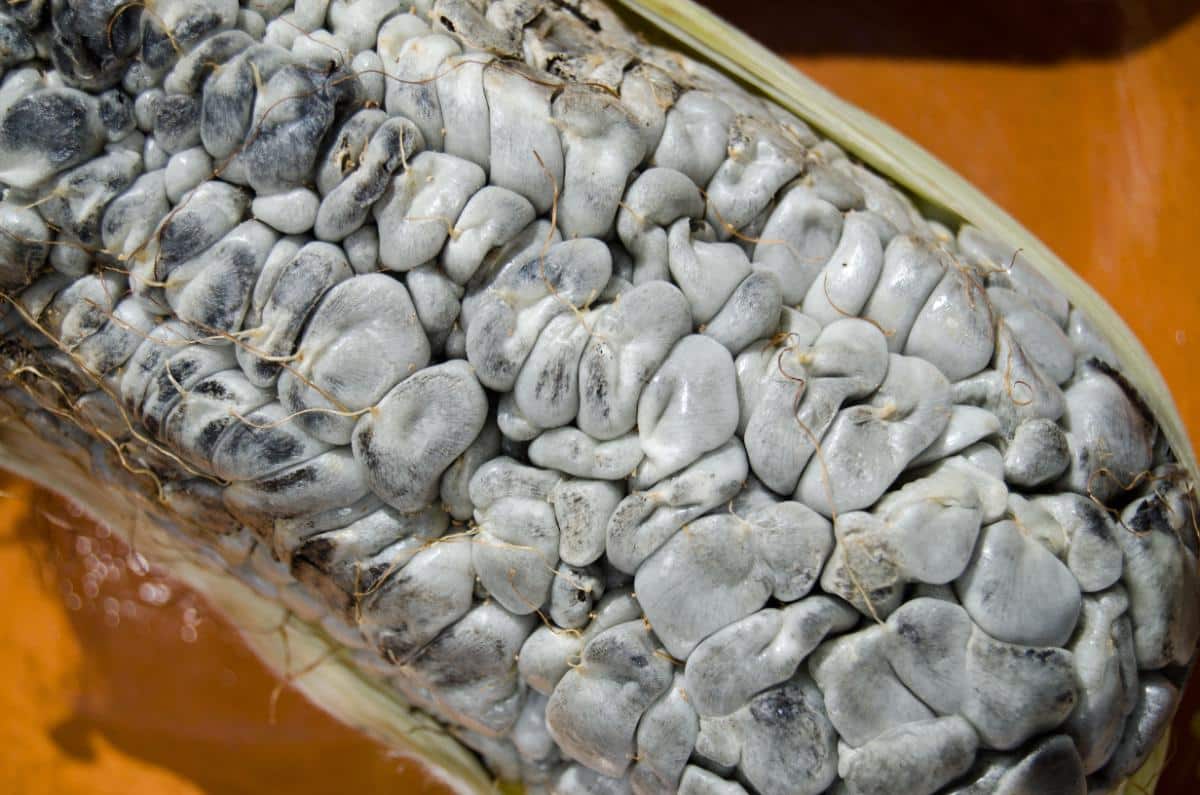
The galls of huitlacoche are distinctive, and the biggest risk is harvesting the fungus at the wrong stage, not misidentifying it.
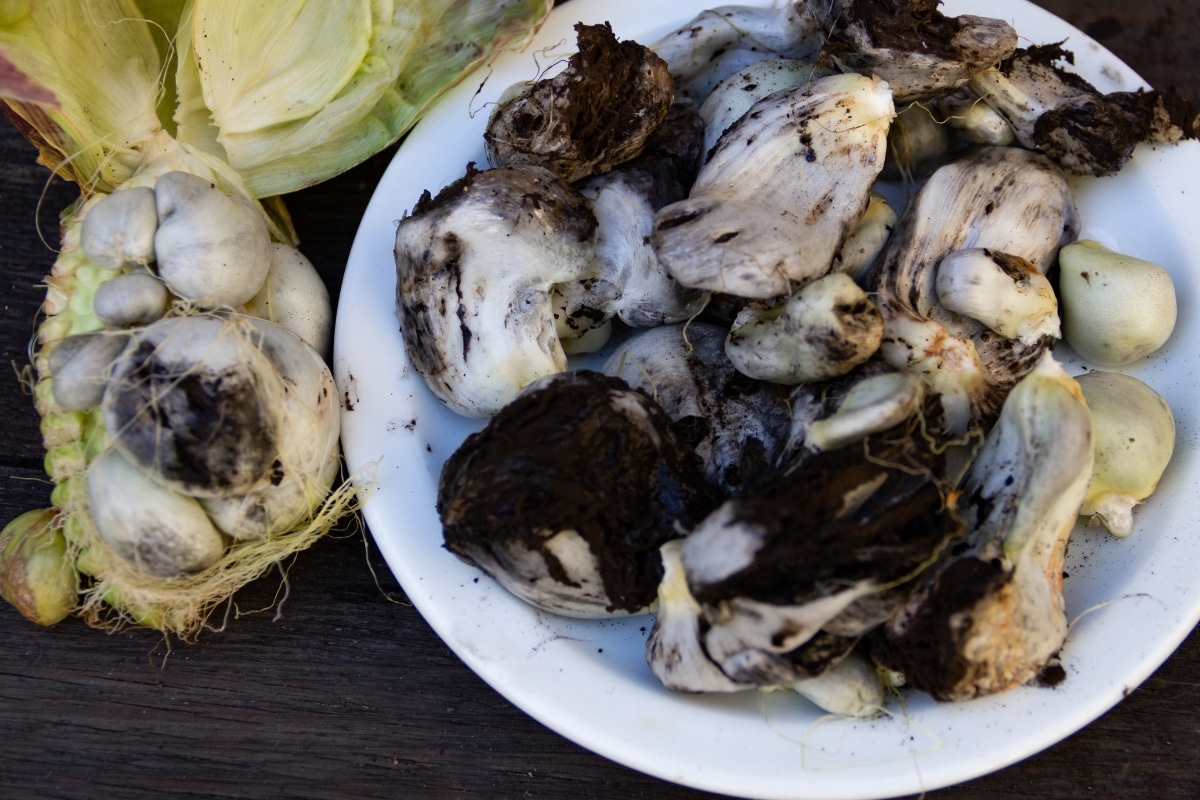
A gall good for eating is moist and pearly gray, with the silvery skin intact and the black flesh still soft beneath it. An old gall will have the black interior widely exposed, and the gleaming, pearly surface gone. Or, it might be dried and powdery.
Huitlacoche Lookalike Species
Head Smut (Sporisorium reilianum)
Head smut, formerly called Sphacelotheca reiliana, does not grow galls across the plant the way common smut does. Instead, it takes over the whole ear or tassel and is a dry, powdery blackish-brown spore mass covered by a whitish membrane. When an ear is infected, it looks very small and teardrop-shaped, as though it has no cob inside at all. This is because the cob has been replaced by the smut. It is never plump or pearly, like huitlacoche.
Head smut occurs in most places that grow corn, including many regions of North America, Australia, Asia, and southern Europe, with reports from Africa and China as well. It has two forms: one that attacks sorghum and one that attacks maize. It is not edible.
Maize Ergot (Claviceps gigantea)
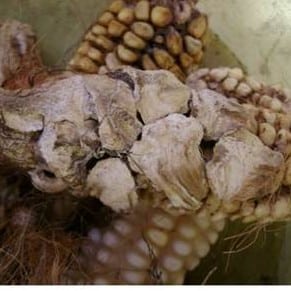
Maize ergot has been found only at high altitudes in Mexico. When maize ergot is young, it is off-white to cream or light grayish-tan and soft. As it ages, it turns gray-brown to dark brown on the outside and has a pale white/cream interior when broken open. The outside is tough and corky, and the inside is solid and white. It is dense and firm, like the inside of a nut or seed, not plump and soft like huitlacoche.
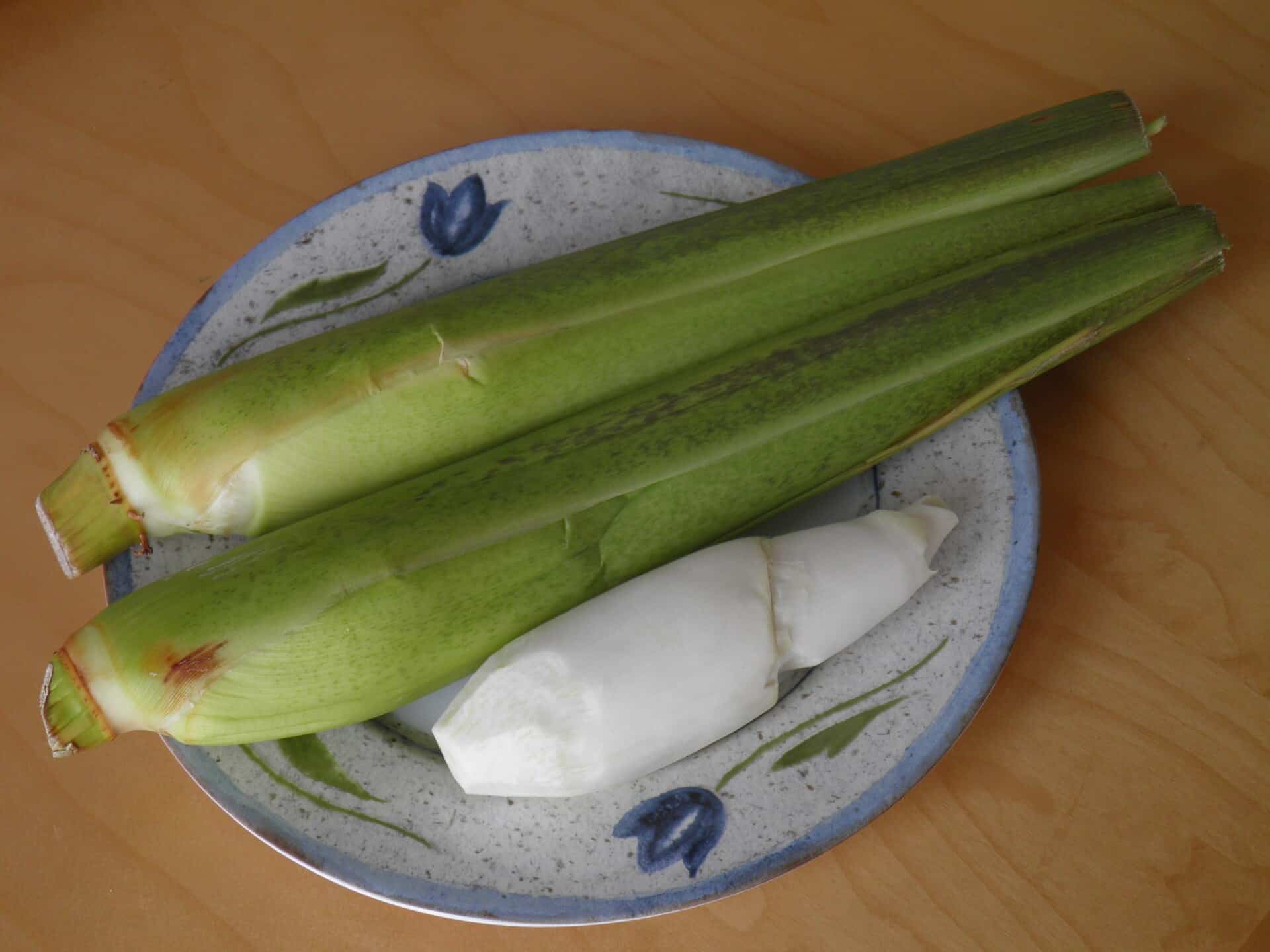
Chinese water bamboo (Ustilago esculenta)
This smut infects Manchurian wild rice (Zizania latifolia), a grass grown in paddies across Asia. It causes the plant’s stems to swell into juicy galls 1.2 to 1.6 inches wide and up to about 10 inches long. The fungus destroys the plant’s flowers, so the crop never sets seed, and farmers grow it from spreading underground stems.
In China, these galls have been purposely grown and eaten as a vegetable for at least 1000 years. They are also known as jiaobai in Chinese and makomotake in Japanese.
In the US, this fungus is treated as a threat to North American wild rice and is regulated. A small infested plot found near Modesto, California, in 1991 was destroyed.
Huitlacoche Edibility and Toxicity
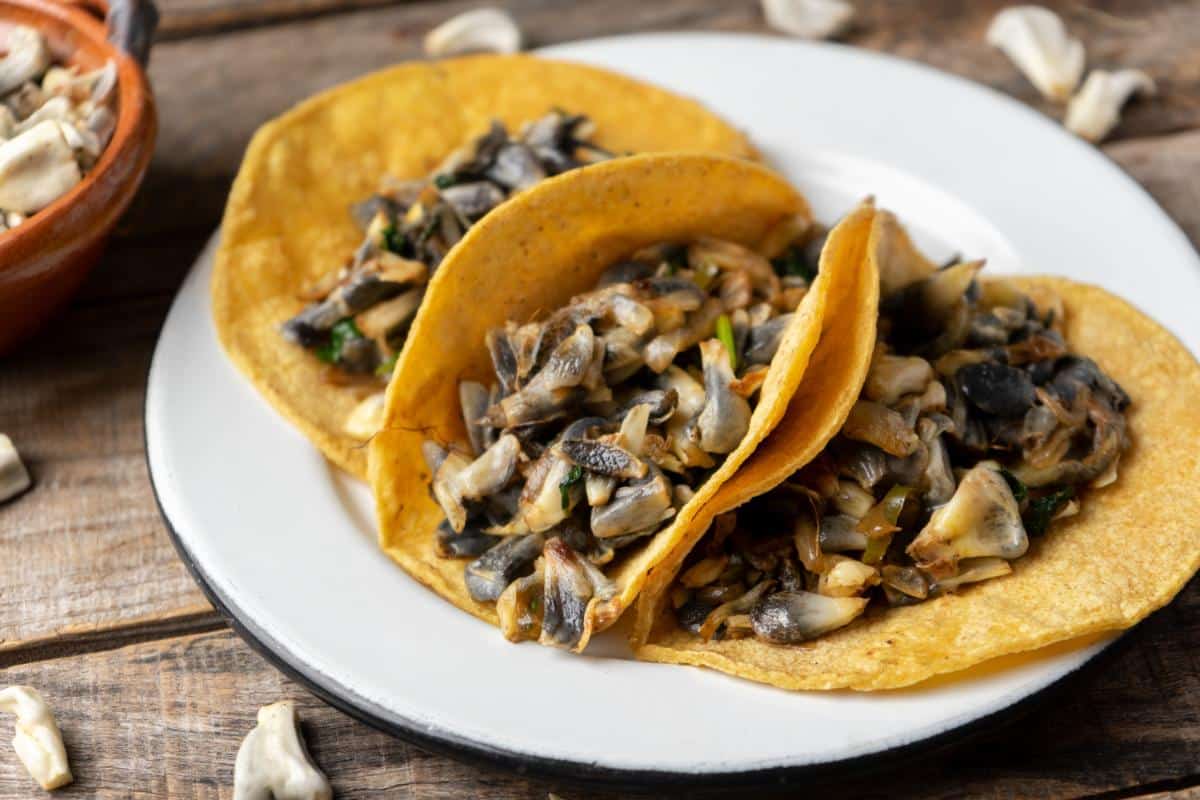
In Mexico, huitlacoche galls are considered a delicacy and are frequently added to quesadillas, soups, and other tortilla dishes. Fresh galls are bluish in color and turn a rich black when cooked. Chefs often simmer them slowly until they darken into a thick, black, oily sauce. This slow-cooking process also helps break down the natural corn starches. Huitlacoche is used in succotash dishes made with chorizo, peppers, and shrimp (where its rich flavor helps tone down the heat) and Riviera Maya omelets, where its earthy taste transforms into something similar to wild truffles.
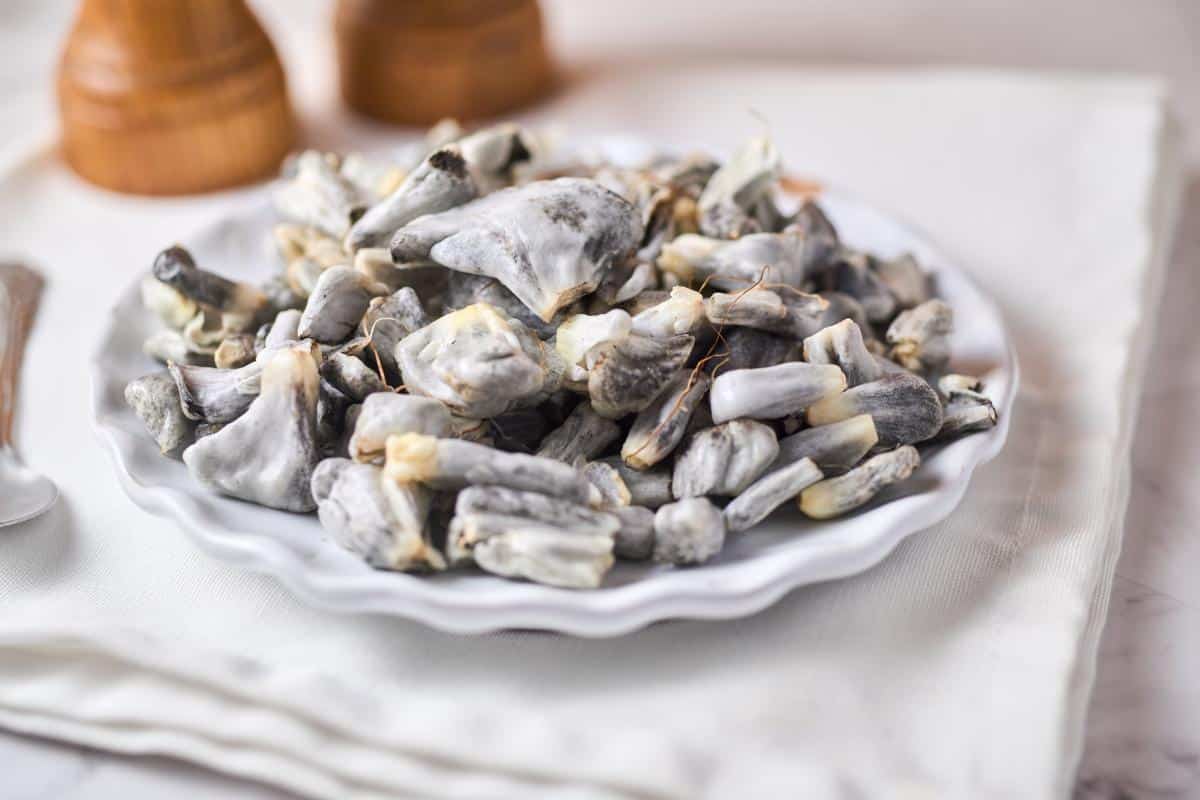
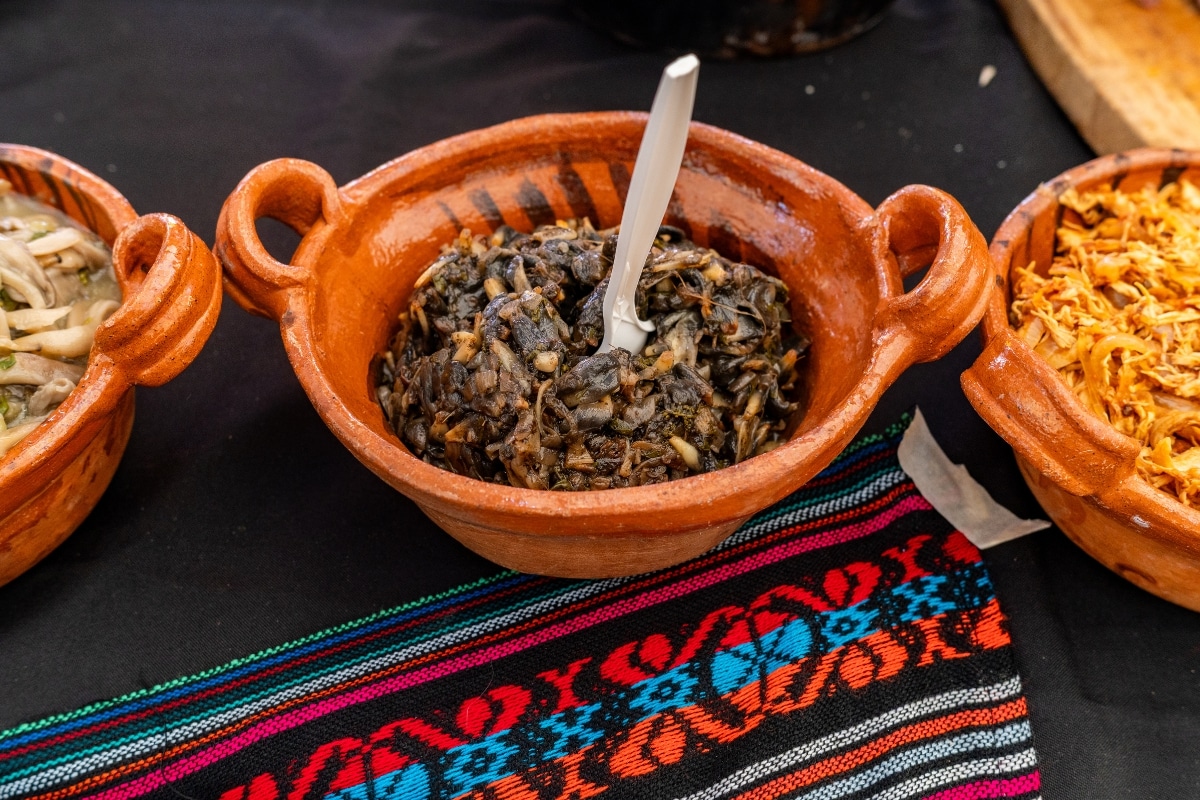
One home recipe starts with a simple white sauce. Because huitlacoche cooks quickly, it is added last. Then, it is blended with chicken broth and stirred into the white sauce. The final dish has a mild gray color and a delicious, rich taste. For a little extra flavor, green chilies or a dash of hot sauce can be added.
Finding fresh huatachle can be difficult, depending on where you live. In Mexico, people mostly eat the galls fresh and buy them at restaurants, from street vendors, or at farmers’ markets. Corn farmers in the countryside spread the spores intentionally to produce more. Fresh huitlacoche is almost never sold outside Mexico, but the canned version can be found in Mexican grocery markets in the United States.
Only young, moist galls should be used. Old, decayed galls may cause uterine contractions in pregnant women, and huitlacoche should be avoided as a precaution.
Huitlacoche Sources:
- Huitla (fresh)
- Walmart (canned, may not be available in all regions)
- Amazon (canned)
- Foraged.com, various venders (fresh and frozen)
Medicinal Uses of Huitlacoche
The galls are highly nutritious and have lysine, an essential amino acid the body cannot make. It is abundant in corn smut, while corn itself contains very little. The galls also have beta-glucans, along with carbohydrates, fats, vitamins, minerals, and considerable levels of the essential fatty acid linoleate.
This fungus has been engineered as a drug delivery mechanism. By genetically modifying the fungus, researchers got it to produce a harmless part of the cholera toxin inside its galls. When mice ate these modified galls, their bodies built up an immune response that protected them against cholera. This research explored using huitlacoche as a cheap, edible vaccine (known as molecular pharming), but testing is still in the early stages with laboratory animals. Wild corn smut does not have these properties; this was specifically the genetically modified fungus.
Common Questions About Huitlacoche
Is huitlacoche safe to eat?
The fresh, immature galls are safe to eat. The old, dry, powdery galls are not edible, and pregnant women should avoid huitlacoche altogether, since decayed galls have been linked to uterine contractions.
What does huitlacoche taste like?
The flavor is mushroom-like, sweet, savory, woody, and earthy. Even the canned version is delicious, with an inky, mushroomy taste that is hard to describe.
Where can huitlacoche be found for sale?
In Mexico, it is mostly sold fresh at restaurants, by street vendors, and at farmers’ markets. Outside Mexico, fresh galls are seldom available, but canned huitlacoche can be found in Mexican grocery stores.
Can huitlacoche be eaten raw?
No, this fungus should always be cooked.
Is huitlacoche the same thing as moldy corn?
No. Corn smut forms swollen galls on the living plant, while the surface molds that grow on stored grain (such as Fusarium and Aspergillus) are different organisms altogether.
- References:
MykoWeb — “Can You Say Huitlacoche?” / Huitlacoche Soup (Michael Wood; reprinted from Mycena News, March 1992; recipe by Ellen and Tom Duffy) — https://www.mykoweb.com/EdibleMushrooms/recipes/mn_mar92.html - MykoWeb — “Psst…Let’s talk smut today” (Else C. Vellinga; Mycena News, November 2004) — https://www.mykoweb.com/articles/LetsTalkSmut.html
- University of Minnesota Extension — “Common smut on corn” (Dean Malvick, reviewed 2018) — https://extension.umn.edu/corn-pest-management/common-smut-corn
- Juárez-Montiel M, Ruiloba de León S, Chávez-Camarillo G, Hernández-Rodríguez C, Villa-Tanaca L. “Huitlacoche (corn smut), caused by the phytopathogenic fungus Ustilago maydis, as a functional food.” Rev Iberoam Micol. 2011;28(2):69–73. PMID 21352944 — https://pubmed.ncbi.nlm.nih.gov/21352944/
- Valdez-Morales M, Carlos LC, Valverde ME, Ramírez-Chávez E, Paredes-López O. “Phenolic Compounds, Antioxidant Activity and Lipid Profile of Huitlacoche Mushroom (Ustilago maydis) Produced in Several Maize Genotypes at Different Stages of Development.” Plant Foods Hum Nutr. 2016;71(4):436–443. PMID 27605221 — https://pubmed.ncbi.nlm.nih.gov/27605221/
- Juárez-Montiel M, et al. “The Corn Smut (‘Huitlacoche’) as a New Platform for Oral Vaccines.” PLoS One. 2015;10(7):e0133535. PMID 26207365 — https://pubmed.ncbi.nlm.nih.gov/26207365/
- Chavan S, Smith SM. “A rapid and efficient method for assessing pathogenicity of Ustilago maydis on maize and teosinte lines.” J Vis Exp. 2014;(83):e50712. PMID 24430201 — https://pubmed.ncbi.nlm.nih.gov/24430201/
- Bhatta U, Smith SM. “Phenotypic Analysis of Maize and Maize-Teosinte Near-Isogenic Lines for Resistance to Corn Smut (Ustilago maydis).” Plant Dis. 2026;110(6):2180–2192. PMID 41117632 — https://pubmed.ncbi.nlm.nih.gov/41117632/
- Wilson GL, Waheenee. Agriculture of the Hidatsa Indians: An Indian Interpretation (1917), “Mapë´di (Corn Smut)” section. Project Gutenberg #60313 — https://www.gutenberg.org/ebooks/60313
- Eater — “What Is Huitlacoche — And Why Aren’t U.S. Diners Eating More of It?” (Sylvio Martins, Oct 1, 2021) — https://www.eater.com/22688579/what-is-huitlacoche-corn-usa-mexican-food-bias
- Modern Farmer — “Huitlacoche, a Mexican Fungus, is Popping Up On Restaurant Menus Across the US” (June 2023) — https://modernfarmer.com/2023/06/huitlacoche/
- Fine Dining Lovers — “What huitlacoche is and how to eat it” (updated Mar 31, 2023) — https://www.finedininglovers.com/explore/articles/what-huitlacoche-and-how-eat-it

Leave a Reply