

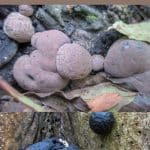
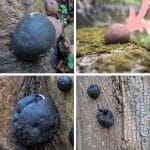
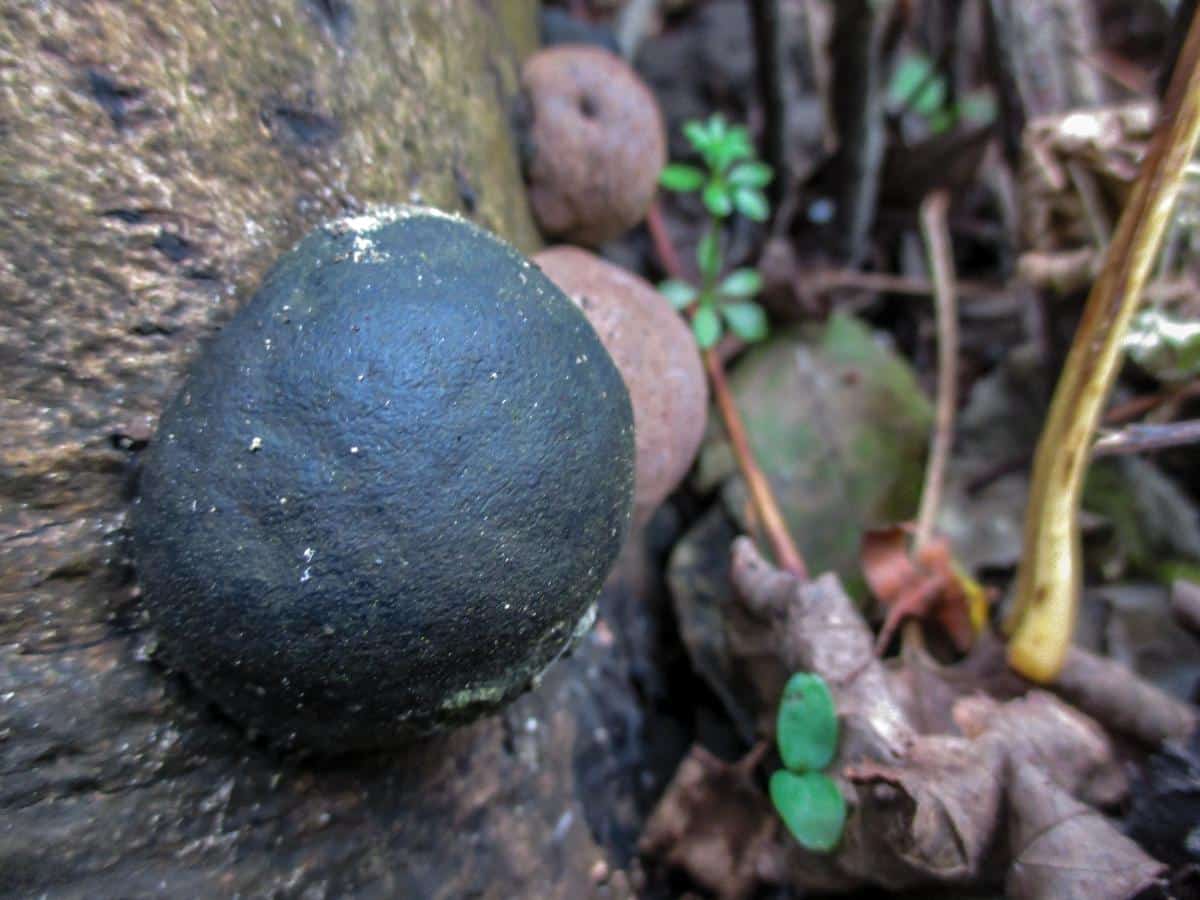
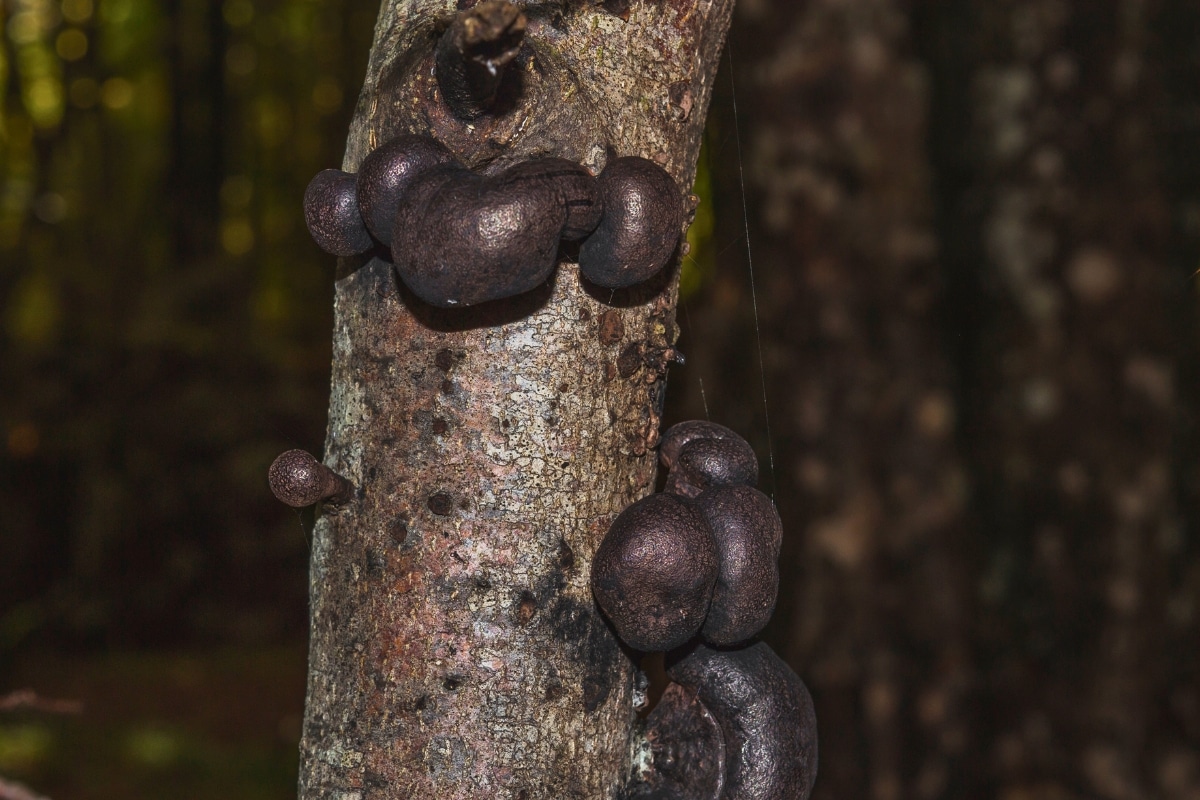
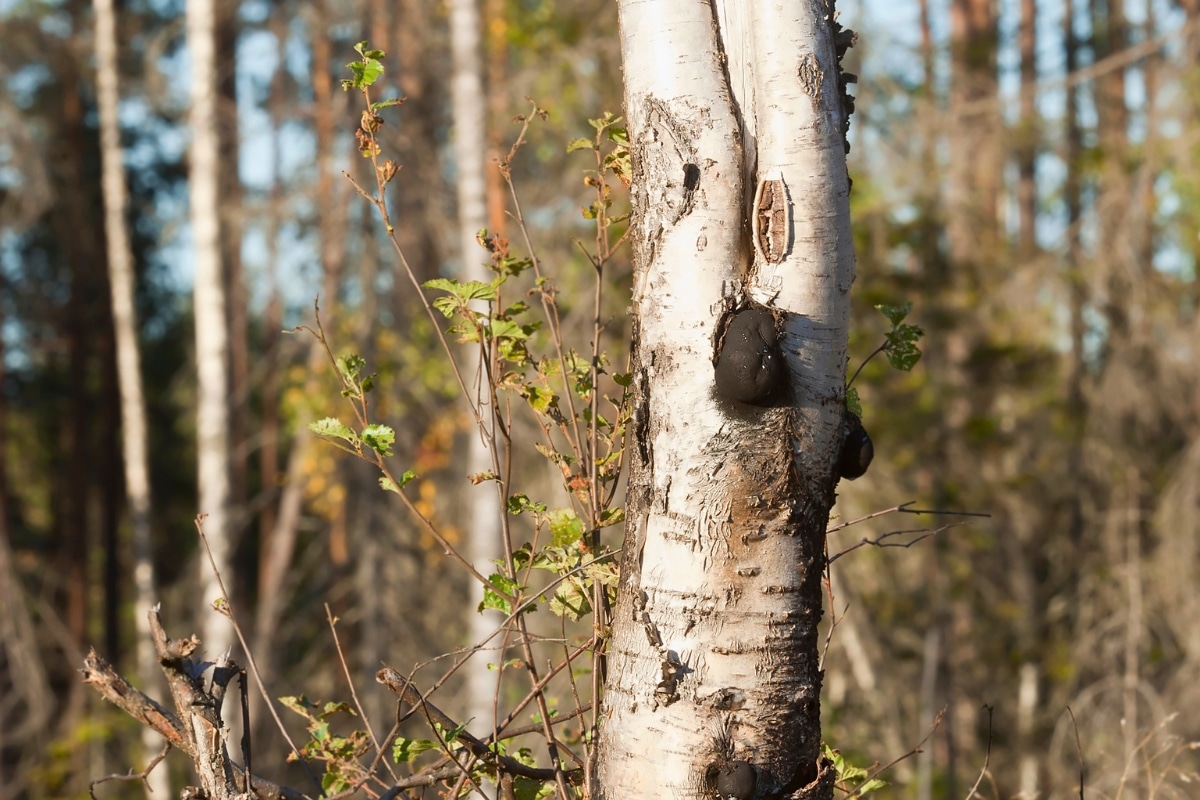
Carbon ball fungi (Daldinia childiae) look like a lump of charcoal or little black purses attached to a log. Carbon balls look nothing like a traditional mushroom and is easy to miss because it is so small and dark. The round, dark fungal balls grow on decaying hardwood, and their tough fruiting bodies can last through winters.
In North America, many field guides call this fungus Daldinia concentrica, commonly known as King Alfred’s cakes or cramp balls. However, recent DNA analysis shows this species is primarily European, and the North American fungus is not genetically the same. The two species look basically identical but react differently in a potassium hydroxide test.
- Scientific Name: Daldinia childiae
- Common Names: Carbon balls
- Habitat: Decaying hardwood logs, sometimes conifer logs
- Edibility: Inedible because it is too tough
Jump to:
All About Carbon Balls
In the 2000s, DNA research found that Daldinia childiae is a distinct species, separate from the European one. The scientific name honors Marion Child, a mycologist who wrote a major study of the genus in 1932. The common name carbon balls perfectly describes the hard, dark surface and charcoal-like interior.
The genus Daldinia was described in 1863, and it honors Agostino Daldini, a Swiss clergyman and botanist. As of October 2024, there were 56 described Daldinia species.
The common names “King Alfred’s cakes” and “cramp balls” are also used for this species, but that name originates in Britain and applies to D. concentrica. The story is that King Alfred fell asleep while there were cakes in the oven and let them burn. There is also an old British folk belief that carrying the fungus in your pocket can prevent or relieve leg cramps, but the origin or reason for this is unknown. In California, there is another fungus with the common name “cramp balls”; that lookalike species is Annulohypoxylon thouarsianum.
Carbon balls cause soft rot in the trees and logs they grow on. They slowly break down the wood from the inside out and turn it into a dry, crumbly mess.
Carbon Balls Fungus Identification
Season
The fruitbodies fruit from spring through fall and may persist through winter. They are tough and may remain on the tree long after they’ve released their spores.
Habitat
Carbon balls grow attached directly to decaying wood, and they may grow alone or in groups. They fruit mainly on hardwood logs but are occasionally found on conifer logs. The species is widespread in North America, but more common east of the Rocky Mountains. The fungus also grows in Europe, Asia, and South America. In 2022, it was recorded for the first time in Poland.
Identification
Fruitbody
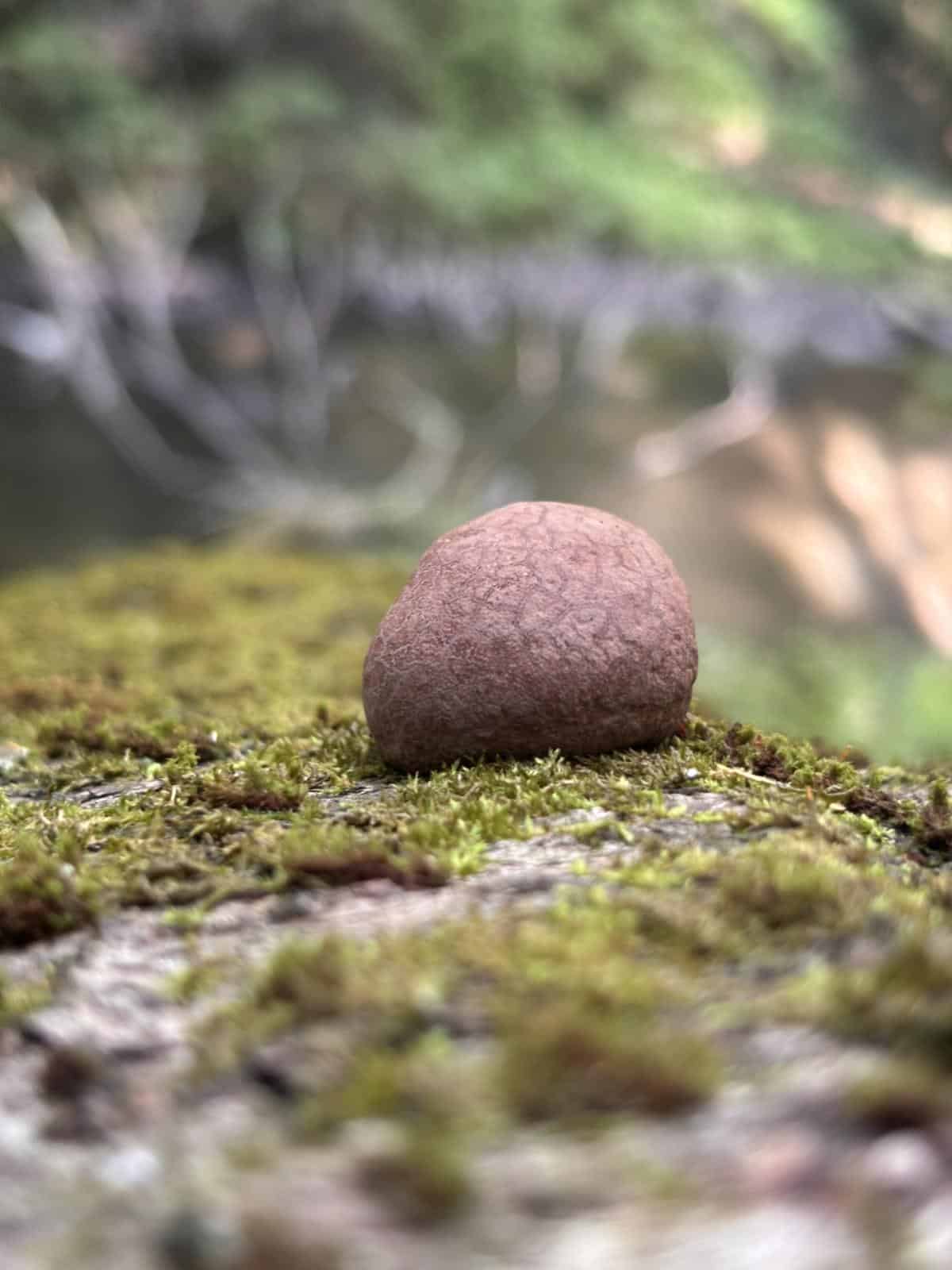
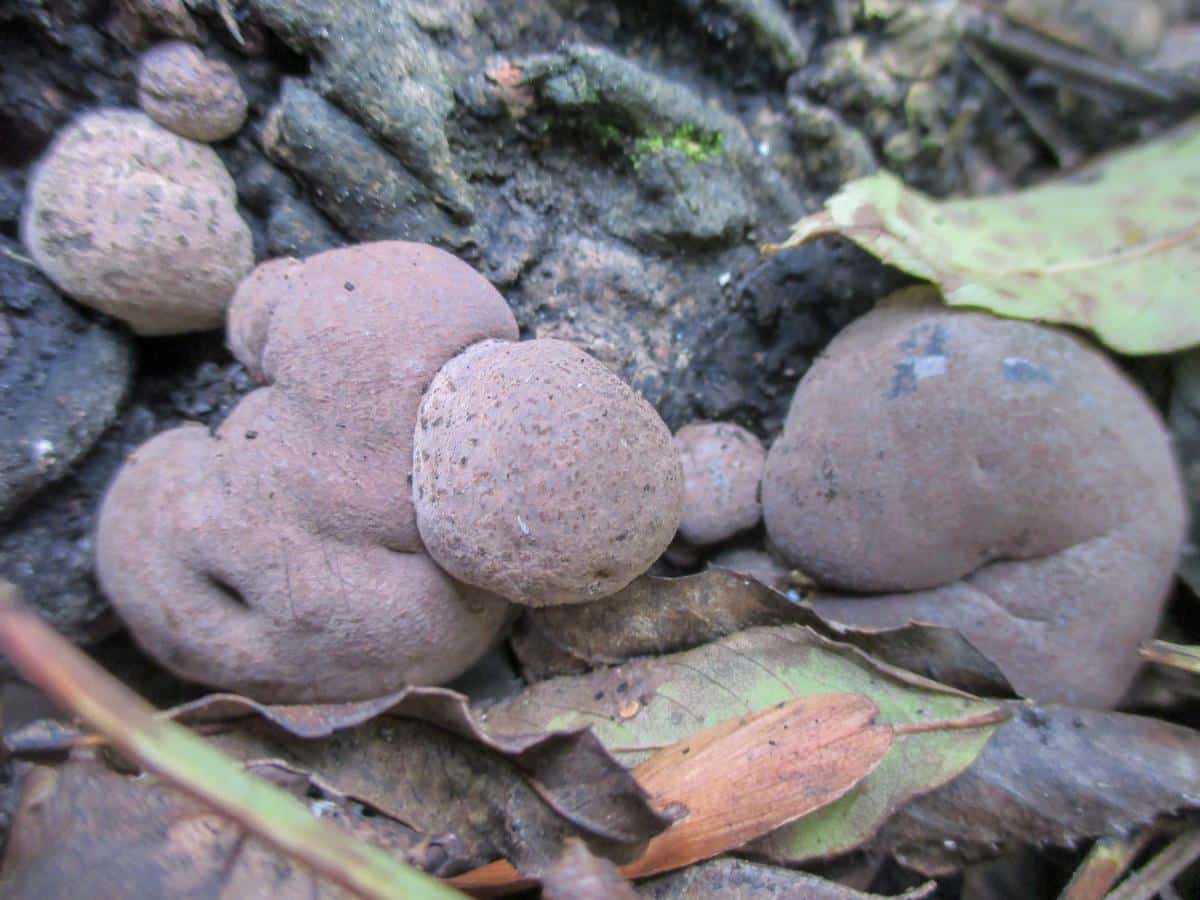
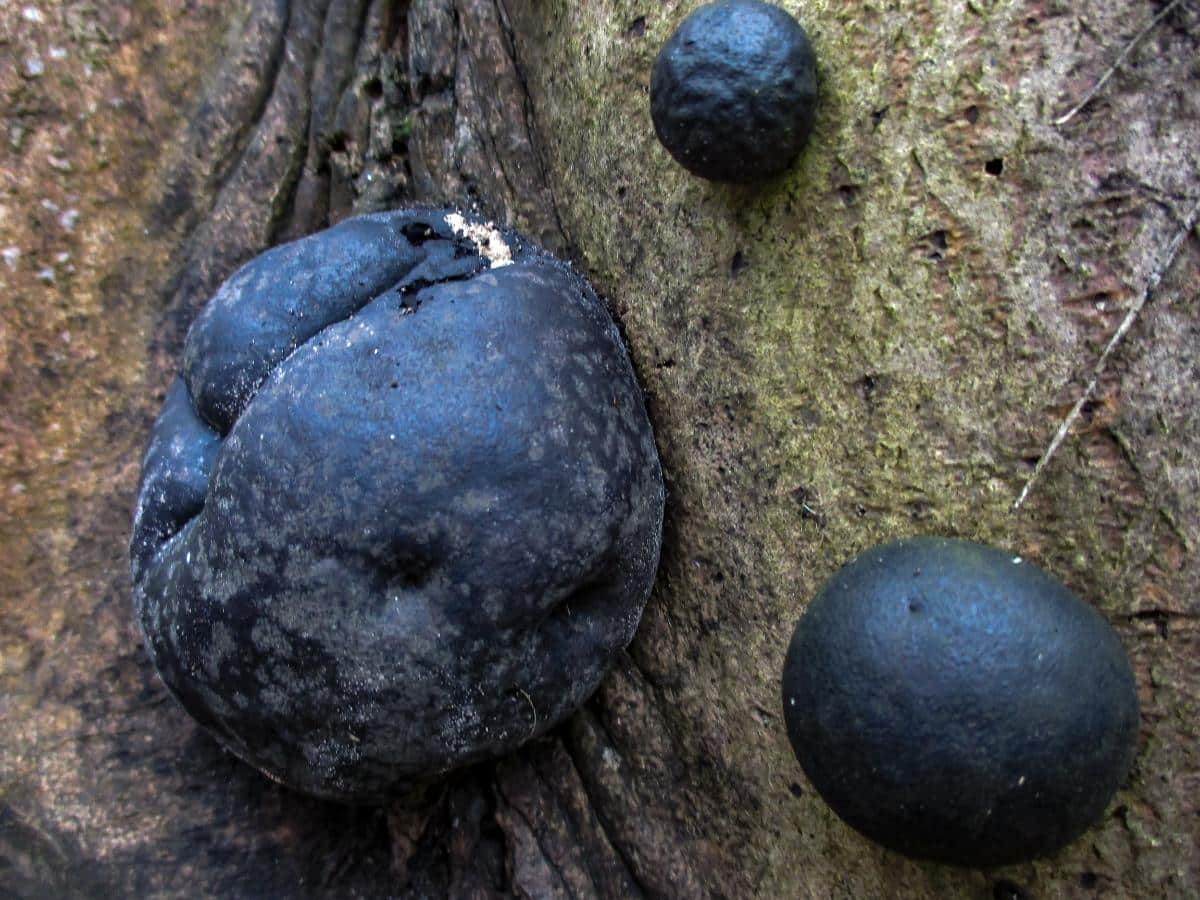
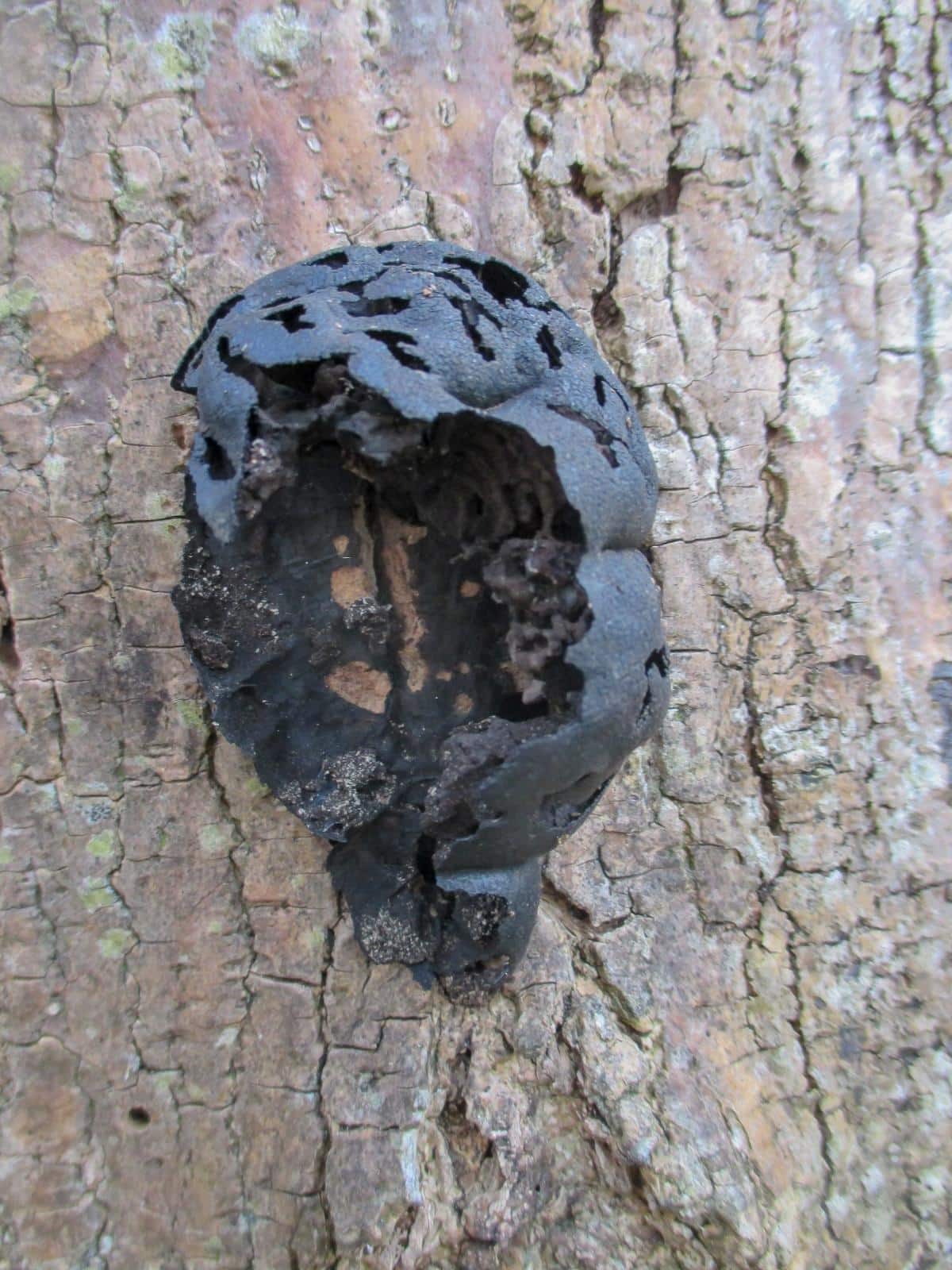
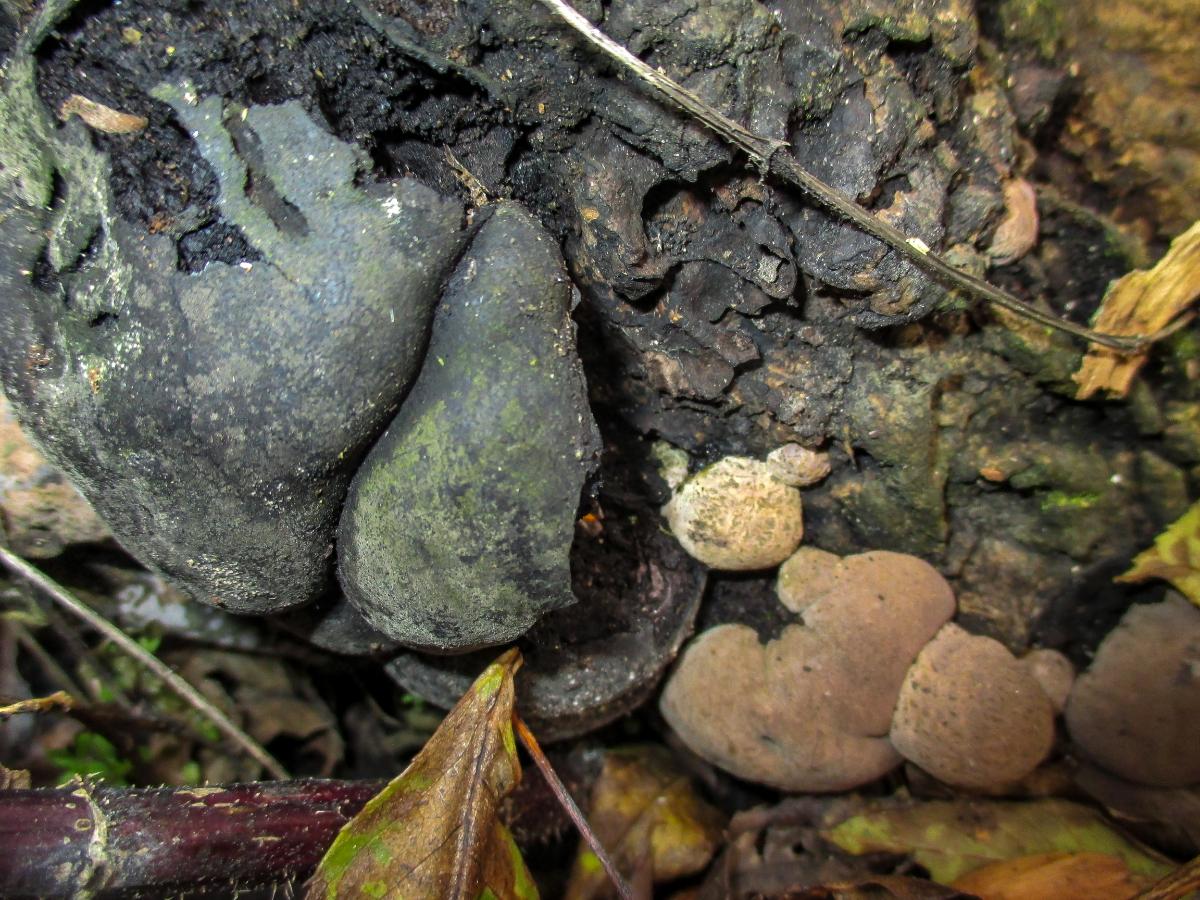
The fruitbody is a hard ball and may be cushion-shaped or pear-shaped. It is 1/4-1 1/4 inches wide and up to 3/4 inch tall and sometimes has a short, poorly defined base or “stem.” Its surface starts out smooth and pinkish brown, and then darkens and becomes pimply. The mature fruiting bodies are reddish brown to dark brown to nearly black.
The inside of the ball has alternating blackish and pale gray or whitish bands. These layers build up throughout the year and look like the bands of a tree, but they are not related to their age. The inside looks a lot like charcoal.
Odor and Chemical Test
Carbon balls do not have a distinctive odor. However, in a laboratory study, when it was made into a fermented broth, it produced a pleasant, woody, perfume-like aroma. Researchers have identified 30 odor compounds, and the strongest one is also in patchouli.
To reliably separate D. childiae from D. concentrica, you need to do a potassium hydroxide test. The crushed crust of D. childiae releases brown to reddish-brown pigments, while D. concentrica releases purple pigments.
Spores
The spores are dark brown.
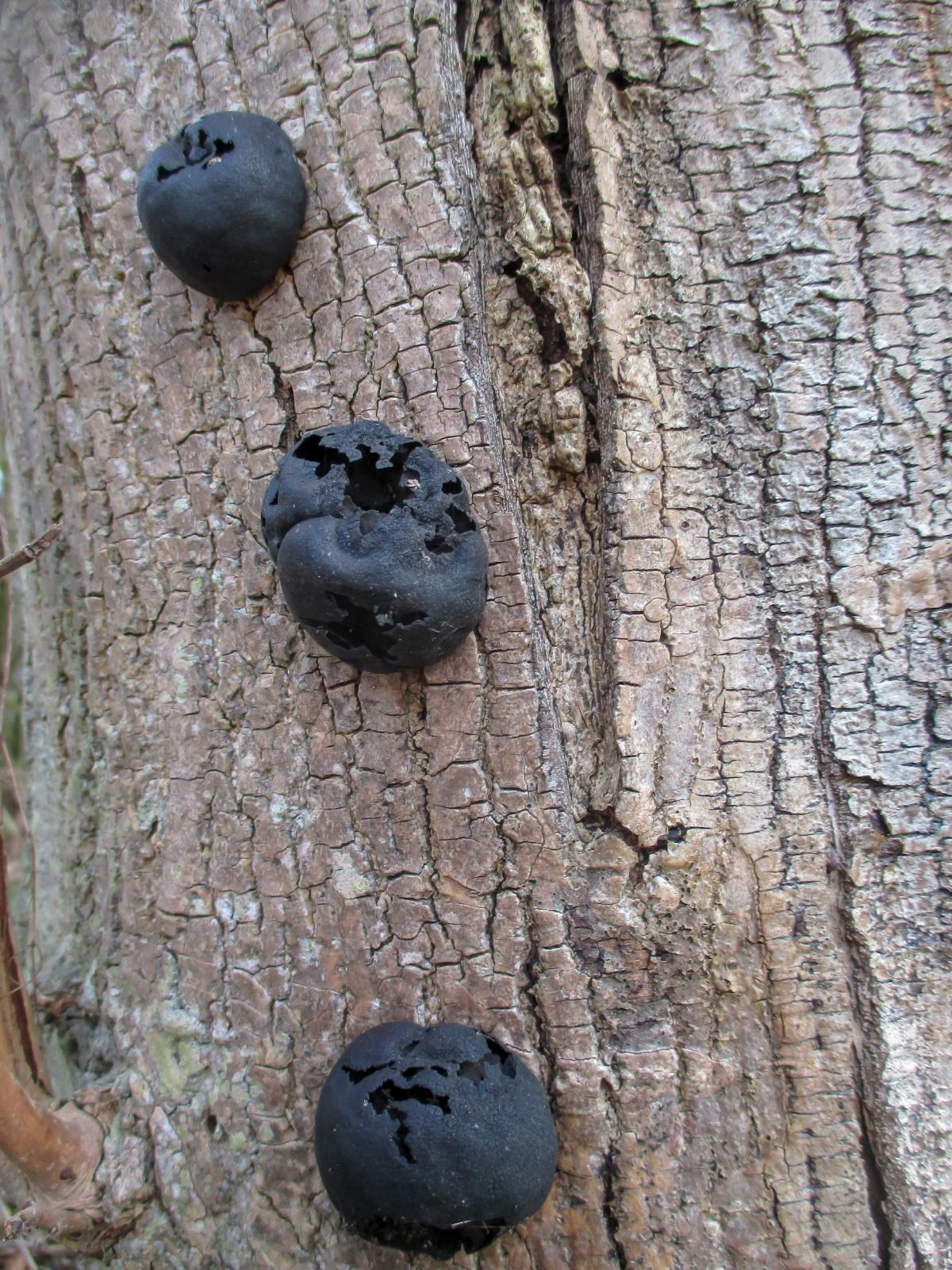
How Daldinia childiae Differs from Daldinia concentrica
Daldinia childiae is the common North American species and is particularly common east of the Rocky Mountains. D. concentrica is considered a European species that grows mainly on dead or dying ash. Some older sources list D. concentrica in North America, but these are actually D. childiae or other related species.
The fruitbodies are both dark, rounded, hard, and banded inside. D. childiae ranges from 0.28 to 1.26 inches across and 0.39 to 0.79 inches tall, while D. concentrica can be much larger, with a width of 0.79 to 3.15 inches. Its fruitbody attaches to the tree with a broad, flat base and may merge with nearby fruitbodies.
The potassium hydroxide color test (KOH) is the best way to tell these apart. When potassium hydroxide is applied to D. childiae, it turns brown to reddish-brown. D. concentrica turns purple.
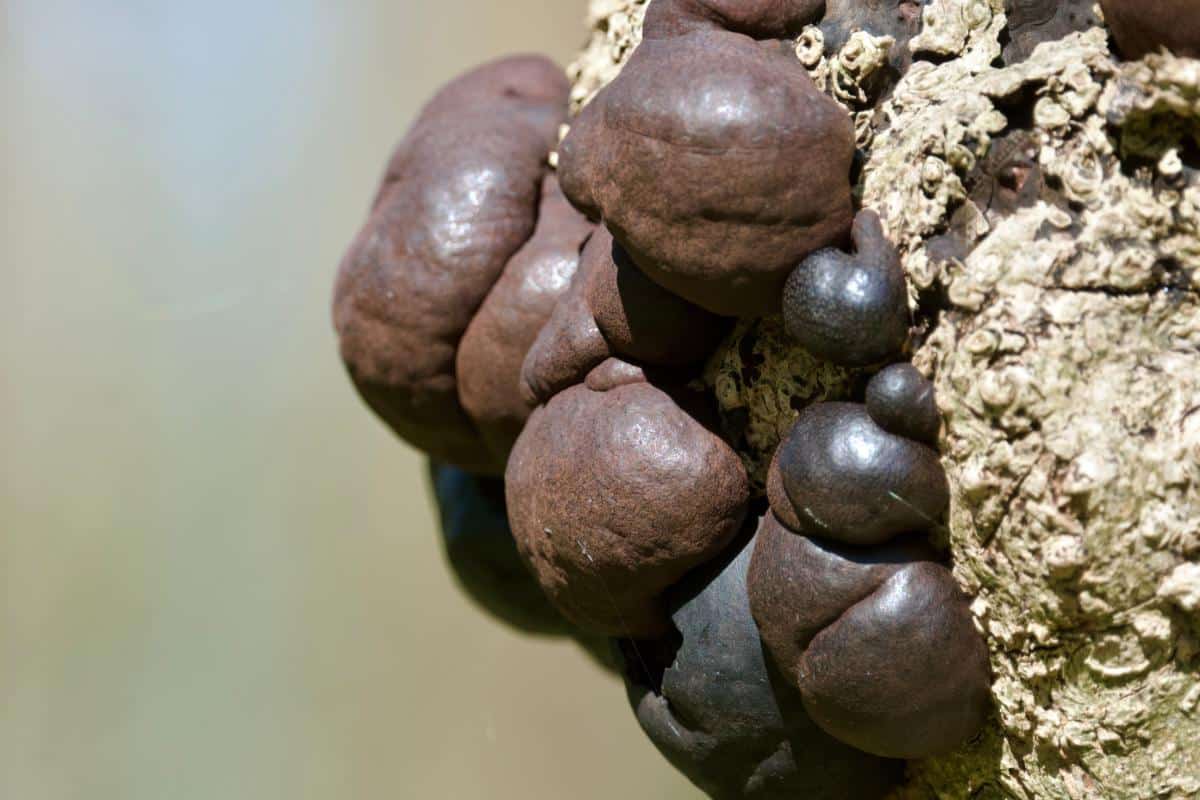
Curious about wild mushrooms? Here’s a good place to start with the Top 25 Edible Mushroom Species in North America
Carbon Ball Lookalikes
Cramp Balls/Carbon Balls (Annulohypoxylon thouarsianum)
This California species is also commonly called cramp or carbon balls. It grows on hardwood bark, especially coast live oak and tanbark oak, and forms dark, rounded fruitbodies.
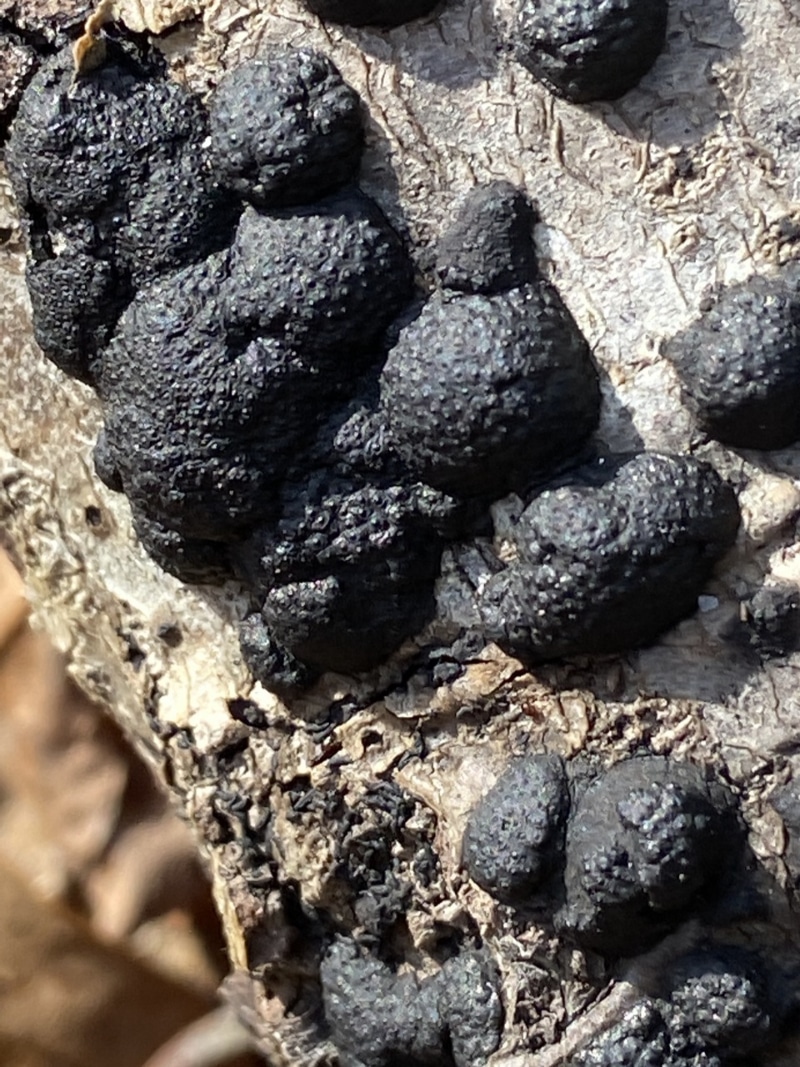
It helps to have a hand lens to look closely at the surface detail. Each bump on the surface of this carbon ball is surrounded by a small flat or sunken disc. The interior is fibrous, and it has faint gray and brown zones. While Daldinia also has concentric bands inside, they are more defined. It also doesn’t have the surface bumps with discs around them.
California’s charcoal-like fungi were once all grouped with Daldinia, and related names were used for them. The common name now applies to both species in some California field guides.
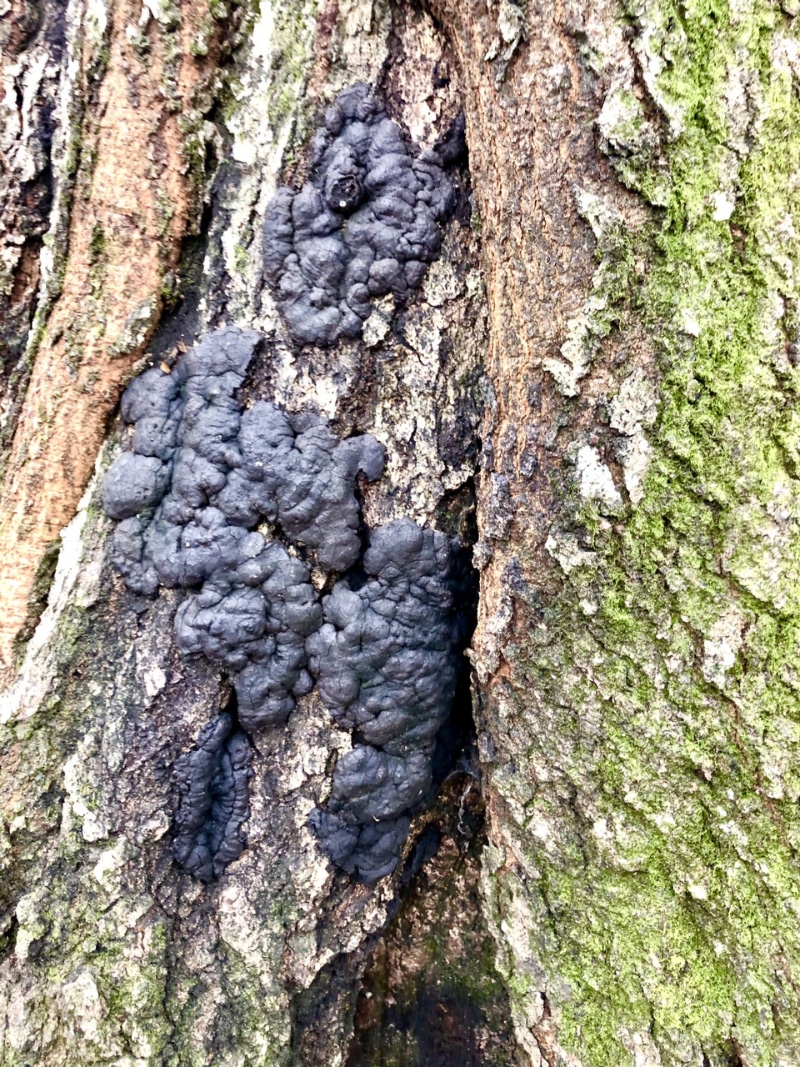
Brittle Cinder (Kretzschmaria deusta)
Brittle cinder grows as a crust or cushion rather than a rounded, black ball with a banded interior. Its young fruitbody is gray with a white edge, but as it ages, it turns black, hard, and brittle, like charred wood. It grows on hardwoods and can infect living trees. Infected trees are prone to sudden collapse.
Daldinia grandis and Daldinia loculata
Daldinia grandis grows in tropical and temperate parts of the Americas, including California (though that is questionable), on many kinds of broadleaf trees. Its fruitbodies are large, rounded cushions, usually 1-3 inches across, and the interior has alternating dark brown and lighter brown bands. It gets larger than D. childiae and is less widespread in N. America.
Daldinia loculata has a broader range and grows in northern North America. It prefers cooler, boreal regions and most often grows on birch, though it also occurs on poplar, other hardwoods, and members of the rose family. It also grows on fire-damaged trees, and it can be one of the first fungi to colonize the wood. Its fruitbodies are about the same size as those of D. grandis, and it also has dark and lighter bands inside.
Both species are usually larger than Daldinia childiae, which is mostly less than 2.5 inches across. The mature fruitbodies of D. grandis and D. loculata may also become black and shiny, while D. childiae usually remains dull.
Carbon Balls Edibility
Carbon balls are inedible because they are too hard and tough. They are not known to be toxic, and no poisoning cases are reported.
Research On Carbon Ball Fungi
Scientists have found 280 chemical compounds inside Daldinia fungi over nearly 30 years of research. In lab tests, over 100 of these compounds could fight off bacteria, viruses, fungi, inflammation, or harmful cells. However, there have not been any human trials to prove their efficacy.
In one experiment, scientists tested airborne chemicals produced by a Daldinia found on olive trees. These natural gases were tested in a lab, and they stopped several plant diseases from spreading and kept mold from growing on stored peanuts, wheat, and dried fruit. This is still just early lab research, though.
Common Questions About Carbon Ball Fungi
Where do carbon balls grow?
The species Daldinia childiae is widespread in North America, especially east of the Rocky Mountains. It grows mainly on decaying hardwood logs.
Are carbon balls edible or poisonous?
Carbon balls are not poisonous but they aren’t edible either. Their flesh is too hard and tough to eat.
Leave a Reply